Home / Industry Insights
FOB vs CIF for Used Excavators: How to Compare a China Export Quote
Compare FOB and CIF used excavator quotes by checking the named port, machine identity, included costs, insurance scope and destination charges before you commit.
October 27, 2026 · Import & Shipping Guide
When comparing a used excavator export quote from China, the first question is not simply “Which number is lower?” It is “What does each number include, where does the seller’s responsibility end, and which costs still sit with me?” A low FOB figure and a higher CIF figure may cover different transport stages. Without a shared scope, the comparison can be misleading.
This guide explains how buyers can read an FOB vs CIF quote for a used excavator, build a simple cost worksheet and request the evidence needed to connect a quote to one real machine. The same method applies when sourcing a used CAT 320 excavator or another crawler model. It does not provide a universal freight rate: vessel schedules, cargo dimensions, port charges, insurance terms and destination-country requirements vary, so ask the relevant providers for current, written figures.
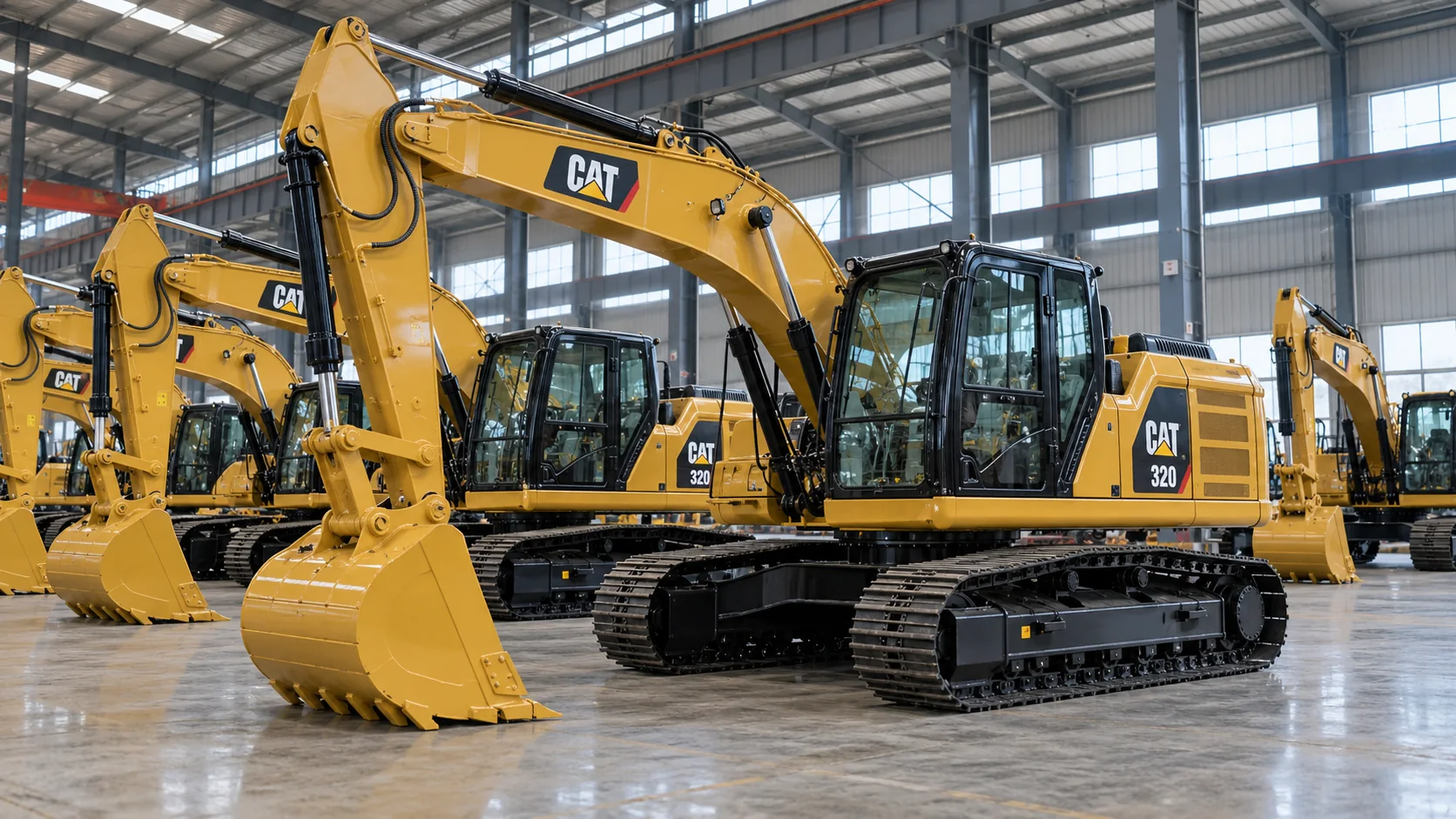
AI-generated illustration of near-new-looking CAT 320 machines. It is not a photograph of a verified unit and does not confirm current stock or condition.
What FOB and CIF mean in a used excavator offer
Incoterms® rules allocate specific delivery obligations, costs and risk-transfer points between seller and buyer. The exact term should be written with the named place or port and the version used, such as “CIF [named destination port], Incoterms® 2020.” A short label without the named place and agreed scope leaves room for different interpretations. The International Chamber of Commerce explains that these rules support the sale contract; they do not replace it.
For sea and inland-waterway transport, FOB (Free On Board) generally means the seller delivers the goods on board the buyer-nominated vessel at the named port of shipment. The buyer arranges and pays for the main carriage and onward costs after that delivery point. CIF (Cost, Insurance and Freight) means the seller arranges and pays carriage and insurance to the named destination port, while risk transfers at the shipment point defined by the rule. CIF insurance is limited to the required minimum cover unless the parties agree to more.
These are not just freight-payment labels: the agreed rule affects responsibilities and risk. For containerized equipment handed to a carrier at a terminal before it is loaded on board, ask a freight professional whether FCA is more suitable than FOB for the actual shipment. Confirm the correct rule and delivery point with your forwarder and contract adviser. See the ICC Incoterms® 2020 overview for the official framework.
FOB versus CIF: a practical buyer comparison
| Question | FOB offer | CIF offer |
|---|---|---|
| What must be named? | Port of shipment and the agreed Incoterms® version | Destination port and the agreed Incoterms® version |
| Who books the main sea carriage? | Usually the buyer, under the agreed rule | Seller arranges and pays carriage to the named destination port |
| What about insurance? | Buyer should confirm and arrange cover if needed | Seller arranges the minimum cover required by CIF; check whether broader cover is needed |
| Are destination terminal, duty and taxes included? | Not by default | Not by default; confirm destination costs and import obligations separately |
| Does it include delivery to the jobsite? | No, unless separately stated | No, unless separately stated and supported by a suitable delivery term |
This is a planning comparison, not a substitute for the agreed contract or the official rule text. Ask the seller to list each included service and exclusion instead of relying on assumptions based on a three-letter term.
Build a landed-cost worksheet before choosing a quote
Use one row for each cost, one currency and one destination plan. A practical estimate can be expressed as:
Estimated cost to site = machine and attachments + agreed inspection or preparation + China inland transport and export handling + sea freight + insurance + destination terminal and documentation + customs clearance, duties and taxes + port-to-site delivery + planned repairs or commissioning.
Not every charge applies to every shipment, and some may be bundled. The purpose of the worksheet is to expose missing lines, not to invent a precise final amount before the route and machine are known.
1. Start with the exact machine and its condition
Ask the seller to identify the offered unit by model, serial or product-identification number, configuration, attachments, current location and quote validity. Match those details to fresh photos, a walkaround video and any inspection report. For an excavator, the attachment package, undercarriage condition, repairs and preparation work can change both the machine value and the cargo plan. A price for a model family is not an offer for a specific machine.
2. Separate China-side preparation from transport
Request separate entries for inspection, cleaning, repair, disassembly, inland haulage to the port, export handling, loading, lashing and documentation. The list will differ depending on where the machine is stored, whether it can travel under its own power, and whether the carrier requires dismantling. Ask who performs each task, what evidence is supplied and whether the amount is fixed or estimated.
3. Specify the cargo envelope, not just the brochure size
Before requesting a used excavator shipping-cost estimate from China, confirm the actual dimensions and weight for the shipment after any agreed disassembly. Include the boom, arm, bucket, counterweight and other packages if they ship separately. Ask the forwarder to confirm the proposed method—container, flat rack, RoRo or another option—based on measured cargo details and carrier acceptance. Do not choose a method from operating weight alone.
4. Identify destination charges and import checks
Ask the destination forwarder or terminal for likely local charge categories, such as discharge, terminal handling, documentation, storage or inspection where applicable. A licensed customs broker in the receiving country should confirm classification, customs value, duties, taxes, used-equipment restrictions and required documents for the exact transaction. These requirements differ by country and can change; do not treat a supplier’s general estimate as an official customs ruling.
5. Check what the insurance actually covers
For a CIF offer, request the insurance certificate or policy details, insured amount, covered risks, deductible, claim process and exclusions. Ask whether the cover applies to the full machine, attachments and any separate packages. If the cover is not sufficient for your risk tolerance, ask about additional insurance. For FOB, ask your own forwarder or insurer what cover is available from the agreed delivery point.
Quote checklist: questions to send both suppliers
- Does the quotation identify the same serial-numbered machine, configuration and attachments?
- Which Incoterms® rule, version and named place or port apply?
- What inspection, repair, preparation, haulage, loading and export-handling work is included?
- Who books the vessel, and what freight validity, schedule and cargo assumptions apply?
- For CIF, what insurance cover, insured value, deductible and exclusions are provided?
- Which destination charges, customs services, duties, taxes and inland delivery are excluded?
- What is the quotation currency, validity period, payment schedule and refund or cancellation condition?
- Which documents and loading evidence will be supplied before balance payment and after shipment?
Compare both offers in a table with columns for “included,” “excluded,” “amount,” “provider,” “valid through” and “evidence required.” If a line is unknown, mark it as pending rather than entering zero. That one habit prevents an incomplete estimate from looking like a complete quote.
Common quote-comparison mistakes
- Comparing FOB with CIF as if they were the same scope. Add the missing main-carriage and insurance lines to make the basis comparable.
- Assuming CIF is a door-to-door price. Confirm destination terminal costs, import clearance, taxes and final delivery separately.
- Using a generic freight estimate. Rates depend on route, date, dimensions, handling and carrier availability; request a current quote tied to the actual cargo.
- Ignoring the machine identity. A shipping quote is not proof that the seller controls the photographed unit. Tie the commercial offer to serial evidence and a dated inspection record.
- Leaving important promises verbal. Put condition, scope, delivery point, costs, documents and remedies into the signed purchase contract.
Before making a decision, review the used excavator price comparison guide and the inspection checklist. To compare specific equipment, browse the current excavator catalog and request a written offer for the exact unit, destination port and shipping basis.
FOB and CIF Used Excavator Quote FAQ
Is a CIF quote the total cost to import a used excavator?
No. CIF generally includes seller-arranged carriage and minimum insurance to the named destination port under the agreed rule. Destination terminal charges, customs clearance, duties, taxes, local delivery and commissioning are not automatically included. Ask for each item in writing.
Which is cheaper for a used excavator, FOB or CIF?
Neither is always cheaper. Compare the same machine and route, then add the buyer-paid freight, insurance and destination costs to the FOB quote. Check the CIF freight scope, insurance level and exclusions before comparing totals.
What does a used excavator FOB price from China include?
The included scope depends on the exact contract. The quotation should name the shipment port and rule version, identify the machine and state whether preparation, inland transport, export handling and loading are included. Confirm the named delivery point with a freight professional.
Does CIF insurance cover the full value of my machine?
Not necessarily. CIF requires minimum insurance under the rule, but coverage terms, insured value, deductible and exclusions matter. Request the policy details and arrange additional cover if the provided protection does not meet your needs.
Can I use FOB for a containerized excavator?
Ask your forwarder to confirm the appropriate rule for the actual handover. When goods are handed to a carrier at a terminal before loading on board, FCA may fit the delivery point better. Record the chosen rule, named place and version in the contract.
What information is needed for a current shipping quote?
Provide the exact machine and attachments, measured shipping dimensions and weight, loading or dismantling plan, origin location, destination port, preferred timing and required insurance. Ask the carrier or forwarder to state the quote validity and exclusions.