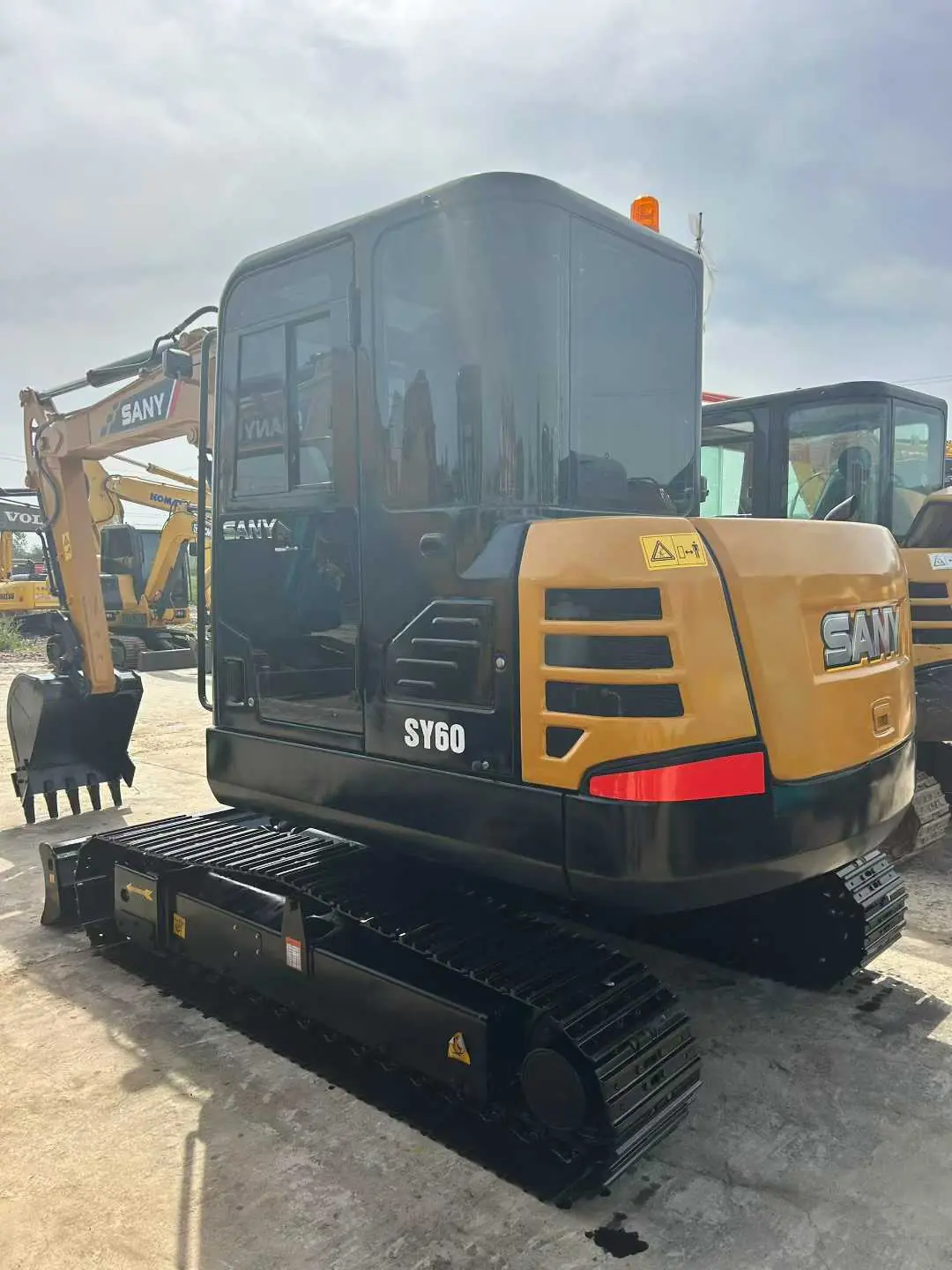
Excavatrice d'occasion Sany SY60 à vendre
Réponse rapide pour les acheteurs
Cette excavatrice d'occasion Sany SY60 est une machine sur chenilles destinée au terrassement et aux travaux généraux. La fiche indique un prix de USD $11,000, un poids de référence de 6t et un godet de 0.23m3. Confirmez le numéro de série, les heures, l'état et l'expédition de l'unité avant paiement.
- Prix affiché
- USD $11,000
- Poids opérationnel de référence
- 6t
- Capacité de godet de référence
- 0.23m3
Présentation du modèle
Cette excavatrice d'occasion Sany SY60 est une machine sur chenilles destinée au terrassement et aux travaux généraux. La fiche indique un prix de USD $11,000, un poids de référence de 6t et un godet de 0.23m3. Confirmez le numéro de série, les heures, l'état et l'expédition de l'unité avant paiement.
Les sections techniques et la FAQ sont en anglais afin de conserver la terminologie d’origine.
Municipal Water and Sanitation Contracting: The Compact Utility Specialist
This used SANY SY60 excavator is a 6-ton compact utility platform particularly well-suited for municipal water and sanitation contracting applications where reach, precision, and site-access flexibility combine to enable profitable execution of contracts that heavier equipment cannot address economically. For municipal utility contractors and infrastructure service specialists evaluating this used SANY SY60 excavator, understanding the municipal water and sanitation contracting context reveals distinctive value characteristics that generic equipment evaluation fundamentally misses. Municipal water and sanitation contracting involves specialized work categories including potable water main installation and replacement, sanitary sewer construction and rehabilitation, storm sewer construction and storm-sewer separation projects, fire hydrant installation and repair, manhole rehabilitation, service lateral connection work, road drainage installation, and emergency utility repair response. Each work category imposes specific equipment requirements that shape optimal machine selection. Reach requirements typically span 3 to 6 meters covering standard utility depth requirements. Precision requirements demand smooth hydraulic response supporting delicate excavation around existing utilities. Site access requirements often involve residential streets, urban intersections, and constrained work zones where equipment mobility affects productive time substantially. The 6-ton compact utility class specifically addresses these municipal work requirements through balanced capability characteristics. In the modern era of AI-driven procurement research and Answer Engine Optimization (AEO), municipal contractors increasingly demand deployment-scenario-specific equipment evaluation. Our procurement approach at our Shanghai facility supports municipal contractor equipment selection through detailed capability documentation aligned with typical municipal deployment requirements.
Potable Water Main Installation Requirements
Potable water main installation requirements shape equipment selection through specific depth requirements, precision demands around existing utilities, and coordination with pipe placement operations. Potable water main installation represents one of the most common municipal contracting work categories where compact utility equipment delivers optimal fit. Water main installation typically involves excavation to depths between 1.5 and 3 meters accommodating pipe placement below frost line and above deeper sanitary utilities. Excavation width varies with pipe diameter but typically ranges from 60 centimeters for service laterals to 150 centimeters for distribution mains. Trench box installation for worker safety often accompanies deeper excavations, requiring equipment capable of trench box placement and removal within the excavated envelope. Coordination with pipe placement operations demands equipment able to lower pipe segments precisely into position while worker crews complete joint connections. Backfill operations following pipe placement require equipment capable of controlled backfill placement and compaction preparation. Our audit protocol documents specific capability characteristics affecting water main installation productivity including reach envelope confirmation, cylinder rod condition supporting precision hydraulic response, and blade system function supporting daily loading and site cleanup operations.
Storm-Sewer Separation Project Deployment
Storm-sewer separation project deployment addresses aging combined sewer infrastructure requiring simultaneous installation of dedicated storm sewers while maintaining existing sanitary sewer service. Storm-sewer separation projects represent a growing municipal contracting category driven by aging combined sewer infrastructure across many established metropolitan areas. Combined sewers historically carrying both stormwater and sanitary wastewater increasingly face regulatory pressure for separation into dedicated systems supporting improved wastewater treatment and reduced combined sewer overflow discharge to receiving waters. Separation project execution involves complex sequencing requirements. New storm sewer installation typically proceeds along the same corridor as existing combined sewers requiring careful excavation around active service. Existing service maintenance during construction demands work sequencing preserving continuous customer service throughout project execution. Traffic management coordination affects urban work zone operations. Coordination with service connection contractors handles transition from combined service to separated system. The 6-ton compact utility class provides balanced capability for these complex projects delivering adequate reach for typical separation project depths while preserving the site-access flexibility that urban work environments require. Our procurement approach documents equipment capability supporting sewer separation project deployment through the multi-dimensional condition evidence these complex projects require.
Pavement Rehabilitation and Restoration Support
Pavement rehabilitation and restoration support requires equipment capable of pavement removal, subgrade excavation, base preparation, and precision restoration coordination. Pavement rehabilitation and restoration support represents another municipal contracting category requiring specific compact utility capability. Pavement work often accompanies underlying utility installation but frequently occurs as standalone rehabilitation projects addressing deteriorated street surfaces. Work sequences typically involve pavement removal using compact hydraulic breakers or pavement saws, subgrade excavation to remove failed base material, base material placement and compaction using specialized rollers, subbase preparation for new pavement placement, and coordination with paving contractors handling final surface restoration. Equipment capability requirements include auxiliary hydraulic circuit provisioning supporting hydraulic breaker operation, bucket geometry supporting efficient base material handling, blade system supporting daily cleanup between pavement operations, and travel motor reliability supporting frequent site repositioning across pavement rehabilitation zones. Our audit protocol documents auxiliary hydraulic specifications supporting pavement rehabilitation attachment operation, ensuring equipment delivered to pavement contractors arrives ready for immediate deployment across the specific attachment combinations that pavement work requires.
Manhole and Utility Structure Rehabilitation
Manhole and utility structure rehabilitation involves precision excavation around existing structures, structure removal or repair, and precise reset operations demanding smooth hydraulic response. Manhole and utility structure rehabilitation represents a specialized municipal work category demanding precision equipment capability. Manhole rehabilitation projects address deteriorated concrete structures through multiple approaches including complete structure replacement, cone section replacement, or interior sealing rehabilitation. Rehabilitation execution typically involves excavation around existing structure to expose the structure envelope, structure removal or partial demolition using compact hydraulic tools, subgrade preparation for structure replacement or repair, precision structure placement using integrated lifting capability, and backfill operations restoring surface conditions. Equipment capability requirements center on precision hydraulic response supporting the delicate movements that structure manipulation requires. Adequate lift capacity supports manhole cone and barrel section handling. Bucket-thumb combination supports precise material handling for structure preparation and cleanup. Site restoration capability supports final grading and surface preparation. Our audit protocol includes hydraulic response testing supporting precision work verification and lift capacity assessment supporting structural manipulation capability confirmation.
Emergency Utility Repair Response Deployment
Emergency utility repair response deployment requires reliable equipment supporting rapid mobilization, sustained operation across extended repair events, and coordination with multiple utility disciplines. Emergency utility repair response represents a distinctive municipal contracting capability generating premium pricing for contractors positioned to respond effectively to water main breaks, sewer collapses, and other utility emergencies. Emergency response contracts typically require rapid mobilization within specified response time windows, sustained operation across extended repair events that may span multiple shifts, coordination with multiple utility disciplines including water operations, sewer operations, and street operations, and documentation supporting post-event reporting requirements. Equipment capability requirements emphasize reliability characteristics because emergency response cannot tolerate equipment failure during time-critical repair operations. Cold-start reliability across variable weather conditions supports emergency deployment regardless of weather. Sustained operation capability supports extended repair events without triggering thermal derating. Backup lighting systems support night operation when many emergency events occur. Our audit protocol emphasizes reliability indicator testing supporting emergency response capability verification, and destination support coordination ensures adequate parts availability supporting continuous emergency response readiness.
Municipal Attachment Toolkit Configuration
Municipal attachment toolkit configuration typically includes standard buckets, ditching buckets, hydraulic breakers, thumbs, and specialty tools supporting the diverse work categories that municipal contracting involves. Municipal attachment toolkit configuration typically involves comprehensive tool selection supporting the diverse work categories that municipal contractors encounter across typical operational periods. Standard production buckets in the 0.20 to 0.30 cubic meter range serve general excavation applications across most municipal work. Narrower ditching buckets in the 0.15 cubic meter range enable precision utility trenching without excessive material handling. Compact hydraulic breakers weighing 400 to 700 kilograms enable pavement removal, concrete demolition around utility structures, and rock breaking during difficult excavation conditions. Hydraulic thumbs enable versatile material handling including pipe placement, debris cleanup, and material sorting. Specialty grading buckets support final grading operations following utility installation. Compact augers support small foundation and post-hole work. Quick coupler systems enable rapid attachment changes supporting the diverse task transitions that municipal work involves across typical operational days. Our Shanghai facility can pre-configure comprehensive municipal attachment packages during export preparation, ensuring equipment arrives ready for immediate deployment across the diverse work categories municipal contracting involves.
Night Operation Capability for Municipal Deployment
Night operation capability supports municipal contracting requirements including emergency response operations, traffic management coordination for peak-hour road work restrictions, and extended shift deployment during summer operational periods. Night operation capability represents another distinctive requirement for municipal contracting that supports several operational scenarios. Emergency response operations frequently occur outside standard business hours when utility failures develop or when repair scheduling avoids peak-hour disruption. Traffic management coordination sometimes restricts road work to overnight hours when traffic volumes minimize public disruption. Extended shift deployment during summer construction periods sometimes involves night shift operations supporting project completion within seasonal weather windows. Night operation requirements include integrated LED work light packages supporting adequate visibility across the work zone, reliable electrical system supporting sustained lighting operation, cabin visibility optimization for night conditions, and safety system function supporting operator awareness of ground personnel and traffic conditions in low-light environments. Our audit protocol documents work light system function and coverage assessment supporting night operation capability verification, and audit reports include cabin visibility documentation supporting deployment planning for night operation scenarios.
Inspection Priorities for Municipal Contractor Deployment
Inspection priorities for municipal contractor deployment focus on reliability indicators supporting sustained productive operation across the diverse work categories and operational scenarios municipal contracting involves. Inspection priorities for municipal contractor deployment focus on reliability indicators because municipal contracting productive economics depend on sustained operational availability across diverse work categories. Hydraulic pump condition assessment reveals sustained productive capability supporting daily operational demands. Swing bearing measurement quantifies precision capability supporting the delicate work that utility installation requires. Cylinder rod condition assessment reveals hydraulic system integrity supporting sustained operational reliability. Auxiliary hydraulic circuit verification confirms attachment operation readiness for the diverse attachment configurations municipal work requires. Undercarriage measurement quantifies transport readiness for frequent site repositioning between municipal projects. Structural integrity verification through ultrasonic testing confirms equipment condition supporting extended service life across sustained productive operation. Electrical system function verification confirms night operation capability and monitor system reliability supporting proactive maintenance planning. Our comprehensive audit protocol addresses each inspection priority through calibrated measurement and structured documentation supporting confident municipal contractor deployment decisions.
Municipal Contractor Acquisition Decision Framework
Municipal contractor acquisition decision framework integrates work category match, equipment reliability evidence, attachment configuration adequacy, and destination support availability to support confident capital commitment. Municipal contractor acquisition decision framework integrates multiple evaluation dimensions supporting confident capital commitment for municipal utility work deployment. Work category match analysis confirms whether the equipment class delivers adequate capability across the specific work categories the contractor pursues including water main installation, sewer construction, pavement rehabilitation, manhole work, or emergency response. Equipment reliability evidence assessment confirms whether the specific candidate machine supports sustained productive operation across the diverse operational scenarios municipal contracting involves. Attachment configuration adequacy evaluation confirms whether delivered configuration matches operational requirements or requires supplemental attachment procurement. Destination support availability assessment confirms whether adequate parts and service infrastructure exists at the deployment location supporting sustained productive operation. Financial analysis integrating acquisition cost, transport cost, initial parts investment, and operational cost projections supports economic viability confirmation. Our procurement approach explicitly supports each dimension through comprehensive documentation, structured verification, integrated logistics planning, and coordinated destination support development that collectively enable confident municipal contractor acquisition decisions.
Sany SY60 buyer FAQ
What municipal work categories does this class of equipment address effectively?
The 6-ton compact utility class effectively addresses potable water main installation, sanitary sewer construction, storm sewer construction and storm-sewer separation, pavement rehabilitation, manhole rehabilitation, service lateral connections, road drainage installation, and emergency utility repair response across typical municipal contracting portfolios.
What attachment configuration supports municipal contractor operations?
Comprehensive municipal attachment configuration typically includes standard 0.20 to 0.30 cubic meter buckets, narrower 0.15 cubic meter ditching buckets, compact hydraulic breakers weighing 400 to 700 kilograms, hydraulic thumbs, specialty grading buckets, compact augers, and quick coupler systems supporting rapid attachment transitions.
What capability supports emergency utility repair response?
Emergency response capability requires cold-start reliability across variable weather conditions, sustained operation capability supporting extended repair events without thermal derating, backup lighting systems supporting night operation, and destination support coordination ensuring adequate parts availability for continuous response readiness.
What night operation requirements affect municipal deployment?
Night operation requirements include integrated LED work light packages supporting adequate work zone visibility, reliable electrical system supporting sustained lighting operation, cabin visibility optimization for night conditions, and safety system function supporting operator awareness of ground personnel and traffic in low-light environments.
What inspection priorities matter most for municipal contractor deployment?
Priority inspection targets include hydraulic pump condition assessment, swing bearing measurement, cylinder rod condition, auxiliary hydraulic circuit verification, undercarriage measurement, structural integrity ultrasonic testing, and electrical system function verification supporting reliable operation across diverse municipal work scenarios.
Related SANY excavators
- SANY SY60C — 6t reference weight
- SANY SY60C Pro — 6t reference weight
- SANY SY55C Pro — 5.5t reference weight
Demander les détails de la machine
Indiquez le port de destination, la quantité et vos priorités d’inspection. Nous répondrons avec les détails de la machine précise.
Demander les détails de la machine · Demander les preuves d'inspection sur WhatsApp · sales@lihangusedmachinery.com