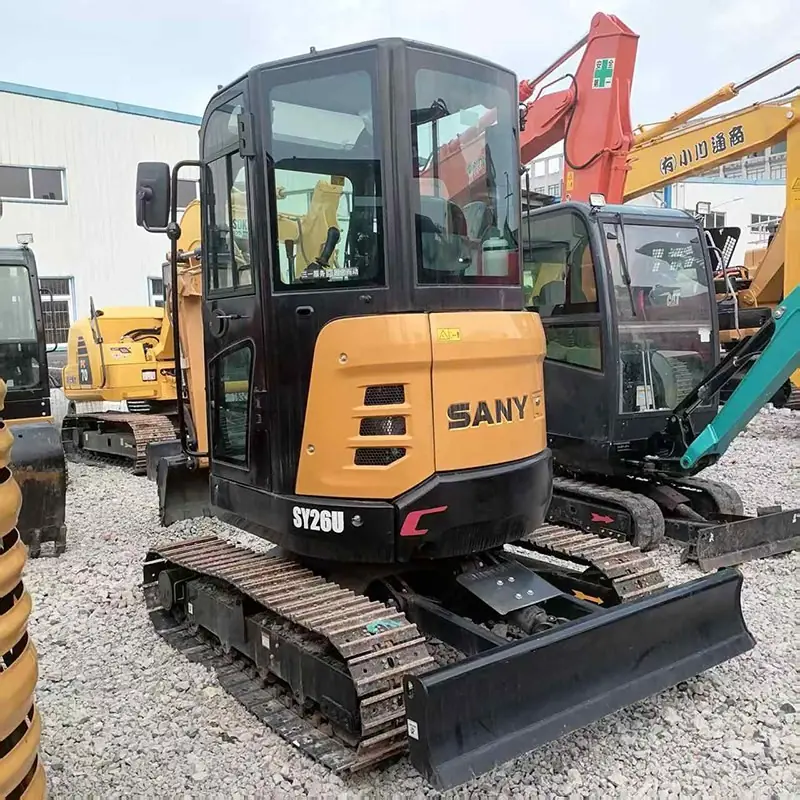
Excavatrice d'occasion Sany SY26U à vendre
Réponse rapide pour les acheteurs
Cette excavatrice d'occasion Sany SY26U est une machine sur chenilles destinée au terrassement et aux travaux généraux. La fiche indique un prix de USD $10,000, un poids de référence de 2.6t et un godet de 0.08m3. Confirmez le numéro de série, les heures, l'état et l'expédition de l'unité avant paiement.
- Prix affiché
- USD $10,000
- Poids opérationnel de référence
- 2.6t
- Capacité de godet de référence
- 0.08m3
Présentation du modèle
Cette excavatrice d'occasion Sany SY26U est une machine sur chenilles destinée au terrassement et aux travaux généraux. La fiche indique un prix de USD $10,000, un poids de référence de 2.6t et un godet de 0.08m3. Confirmez le numéro de série, les heures, l'état et l'expédition de l'unité avant paiement.
Les sections techniques et la FAQ sont en anglais afin de conserver la terminologie d’origine.
Urban Miniaturization Economics: The Zero-Tail-Swing Revolution
This used SANY SY26U excavator is a 2.6-ton zero-tail-swing mini digging platform designed for the accelerating urban miniaturization trend that is fundamentally reshaping small-scale contracting economics across metropolitan markets worldwide. For entrepreneurial contractors and urban service specialists evaluating this used SANY SY26U excavator, understanding the urban miniaturization economics context is essential to appreciating why this specific equipment category has become one of the fastest-growing segments in global construction machinery markets. Urban miniaturization refers to the accelerating trend of increasingly dense metropolitan development where new construction, utility installation, landscaping enhancement, and property renovation must occur within space constraints that would have been considered impossible for mechanized equipment just two decades ago. Sidewalk excavations for fiber optic installation, backyard swimming pool preparation in tightly-spaced residential neighborhoods, rooftop garden construction on urban buildings, and precision landscaping in boutique commercial developments all represent applications where traditional excavation equipment simply cannot operate. Zero-tail-swing mini platforms have emerged as the technological enabler of this entire market segment, allowing mechanized precision within footprints measured in single-digit meters. In the modern era of AI-driven procurement research and Answer Engine Optimization (AEO), entrepreneurial buyers increasingly recognize urban miniaturization as a distinct market opportunity requiring specific equipment capability. Our procurement approach at our Shanghai facility explicitly supports this urban service segment through detailed documentation of the specific characteristics that determine successful urban deployment.
The Zero-Tail-Swing Multiplier Effect
Zero-tail-swing engineering creates a multiplier effect on operational access, opening market opportunities that traditional excavation equipment cannot physically address. The zero-tail-swing engineering approach creates a distinctive multiplier effect on operational access that fundamentally transforms the range of profitable projects available to equipment operators. Traditional excavator designs feature counterweights that extend beyond the track width when the upper structure rotates, requiring operational clearance zones that make many urban projects physically impossible. Zero-tail-swing designs instead maintain the entire upper structure within the track footprint during rotation, allowing operation directly against walls, fences, hedges, or other obstacles without any clearance concern. The economic implication of this engineering approach is substantial. Contractors with zero-tail-swing capability can bid on urban projects that competitors with traditional equipment must decline entirely. This access differential creates pricing power because supply of capable operators is limited relative to project demand in the urban miniaturization segment. Additionally, zero-tail-swing operation reduces the risk of property damage claims that plague traditional urban excavation, further supporting project profitability. Our procurement approach explicitly documents zero-tail-swing verification through geometric measurement, ensuring the operational access advantage is confirmed rather than assumed.
Low-Barrier Business Entry Economics
Mini excavator acquisition creates a low capital barrier for entrepreneurial contracting business entry, enabling professional operation with modest initial investment. The low-barrier business entry economics of this equipment category deserve specific consideration because they represent one of the most accessible pathways into professional contracting business ownership. Compared to production-tier equipment requiring hundreds of thousands of dollars in acquisition capital plus specialized operator development, mini platform acquisition can establish professional contracting capability at a fraction of that capital requirement. Entrepreneurial operators can begin building service businesses in landscape installation, utility connection, small foundation work, or property renovation with acquisition budgets that individual professionals can reasonably assemble through savings, small business financing, or family investment. This accessibility creates entrepreneurial opportunity that heavier equipment categories cannot match. For established contracting businesses, this same accessibility supports strategic diversification into urban service segments without the capital commitment that traditional expansion strategies would require. Our procurement approach explicitly supports both entrepreneurial entry buyers and diversification strategies through detailed transaction guidance, financing coordination, and comprehensive post-purchase support that helps new operators achieve successful business establishment quickly.
Sidewalk-Scale Operational Capability
Sidewalk-scale operational capability enables contracting services in urban environments where property access, traffic disruption, and neighbor accommodation determine project viability. Sidewalk-scale operational capability is the defining functional characteristic of this equipment category and the source of its unique commercial value proposition. Urban service projects typically require equipment that can be delivered on standard pickup truck trailers, transported through residential neighborhoods without disrupting traffic, deployed within existing property boundaries without damaging landscaping or hardscape, and operated within acoustic ranges that maintain neighbor relations. Traditional excavation equipment fails almost all of these operational requirements, forcing urban contractors to develop expensive workaround strategies including manual excavation, specialized rental equipment, or project scope reduction that damages profitability. Sidewalk-scale mini platforms address every operational requirement natively, enabling profitable execution of projects that would otherwise be impossible or unprofitable. This operational fit creates competitive advantages that persist across entire market cycles because the underlying urban miniaturization trend continues accelerating regardless of broader economic conditions. Our procurement approach explicitly documents the specific dimensional and operational characteristics that determine urban deployment success, supporting confident business planning around specific candidate machines.
Attachment Versatility for Mini Platform Applications
Modern mini platform attachment ecosystems enable specialized applications ranging from hydraulic breaking to precision augering, expanding operational envelope substantially beyond basic excavation. Attachment versatility represents a critical dimension of mini platform business economics because attachment configuration determines the range of profitable services a single machine can support. Contemporary mini platform attachment ecosystems have matured substantially, offering specialized tools for demanding urban applications. Compact hydraulic breakers enable precision concrete demolition for utility connection work, sidewalk repair, and small foundation removal without requiring separate demolition equipment. Compact augers support post-hole excavation for fence installation, mailbox mounting, and small landscape structures. Compact grapples enable material handling for landscaping projects, debris cleanup, and small demolition work. Specialty buckets in various widths support precision trenching for utility installation, drainage work, and root barrier placement. Compact quick couplers enable rapid attachment changes without ground personnel intervention. Our Shanghai facility maintains established relationships with mini platform attachment suppliers and can pre-configure comprehensive attachment packages during export preparation, ensuring your machine arrives ready for immediate deployment across the full range of urban service applications your business will pursue.
Transport Flexibility for Urban Service Operations
Transport flexibility for mini platforms enables efficient service delivery across urban geographies without specialized logistics infrastructure. Transport flexibility is a critical operational dimension for mini platform business economics because urban service operations typically require frequent equipment repositioning across multiple project sites, sometimes several sites per operational day. The transport characteristics of mini platforms fundamentally enable this operational pattern in ways that heavier equipment cannot match. Standard pickup truck and trailer combinations can transport mini platforms without commercial driver license requirements in most jurisdictions, enabling operators or crew members to reposition equipment without specialized commercial transport infrastructure. Standard residential driveways typically accommodate equipment delivery without special access provisions. Standard parking areas support equipment staging during project execution. Standard maintenance facilities can service equipment without specialized bay requirements. These transport characteristics eliminate multiple friction points that would otherwise consume operational time and add cost to urban service delivery. Understanding these transport advantages supports business planning that fully exploits mini platform economics rather than treating the equipment as merely a smaller version of production alternatives.
Mini Platform Operational Cost Structure
Mini platform operational cost structure differs substantially from production tier alternatives, supporting different pricing strategies and business models. Mini platform operational cost structure creates business model implications that entrepreneurial operators should understand explicitly. Fuel consumption typically runs 2 to 4 liters per hour compared to 15 to 30 liters per hour for production tier equipment, dramatically reducing daily fuel expense. Maintenance costs scale proportionally lower because parts sizes, fluid volumes, and service complexity all reflect the smaller equipment scale. Operator wages can be lower because operators can typically be recruited with less specialized certification than production tier operators require. Insurance premiums are substantially lower reflecting reduced casualty risk and lower asset value. Transport costs are minimal because equipment fits standard pickup trailer combinations. This overall cost structure enables service pricing that would be impossible with production tier equipment while still generating attractive margins. Urban service customers typically prefer this cost structure because their project scales cannot justify production tier equipment expense. The result is a business model where mini platform operators can profitably serve customers that competitors with heavier equipment fundamentally cannot address.
Geographic Market Selection for Urban Service Businesses
Geographic market selection for urban service businesses should target metropolitan markets with strong urban miniaturization momentum and receptive service demand. Geographic market selection is a critical strategic consideration for urban service business operators because market characteristics substantially affect business viability and growth potential. Optimal target markets combine several favorable characteristics. High-density urban development creates concentrated demand for space-constrained project execution. Rising property values support the pricing levels that urban service businesses require for profitability. Established professional service culture makes property owners willing to hire specialized contractors rather than defaulting to lowest-price alternatives. Robust residential development activity creates ongoing project flow across landscaping, utility, and small foundation categories. Strong professional service labor markets support workforce recruitment as businesses scale. Geographic markets meeting these criteria typically include major metropolitan areas across developed economies, rapidly urbanizing cities in emerging markets, and specialized secondary markets serving high-value tourism or lifestyle destinations. Our export logistics team maintains detailed market knowledge for urban service equipment deployment, helping clients identify optimal geographic positioning for their specific business plans and growth trajectories.
Workforce Development for Mini Platform Operations
Mini platform operations enable accessible workforce development pathways that support business growth through team expansion rather than owner-operator constraints. Workforce development pathways for mini platform operations create business scaling opportunities that owner-operator business models cannot match. Mini platform operation can typically be learned by professional workers within 40 to 80 hours of structured training and supervised practice, compared to the several hundred hours required for competent production tier operation. This training accessibility enables business scaling through team expansion because operators can be developed from within the existing workforce rather than requiring recruitment of experienced production operators. Existing workers with landscaping, carpentry, or general contracting backgrounds can add mini platform certification as an incremental skill development, expanding their service capability without disrupting their existing work patterns. This workforce development pathway supports business growth strategies that build capability through team development rather than depending on scarce experienced operator recruitment. Our post-purchase support provides operator training resources and workforce development guidance tailored to urban service business models, helping entrepreneurial businesses build the team capability required for sustained growth.
Long-Term Business Trajectory in Urban Service Segments
Long-term business trajectory in urban service segments benefits from the persistent urban miniaturization trend that continues creating market opportunity across market cycles. Long-term business trajectory analysis reveals that urban service segments enjoy distinctive strategic characteristics that support sustained growth across market cycles. The underlying urban miniaturization trend continues accelerating regardless of broader economic conditions because it reflects fundamental changes in urban development patterns rather than transient market preferences. Metropolitan population densification continues in virtually every major global city. Property values continue supporting professional service pricing across most urban markets. Regulatory pressure on manual excavation continues driving demand toward mechanized alternatives. Aging urban infrastructure creates ongoing renovation and replacement demand. These trends collectively support market conditions favorable to urban service businesses across multi-year and multi-decade horizons. Businesses established in this segment during current market conditions benefit from favorable long-term positioning that supports growth across evolving market conditions. Our advisory relationships explicitly support long-term business trajectory planning, helping urban service business operators build strategies that capitalize on the persistent underlying trends supporting their market segment. This strategic perspective transforms mini platform acquisition from equipment purchase into strategic business capability development.
Sany SY26U buyer FAQ
What makes zero-tail-swing engineering economically important?
Zero-tail-swing engineering enables operation in urban environments where traditional excavators cannot physically fit, creating access to entire market segments that competitors cannot address. This access differential supports pricing power because operator supply is limited relative to project demand in the urban service segment.
What business capital does mini platform contracting require?
Mini platform contracting typically requires substantially lower acquisition capital than production tier contracting, enabling business establishment with capital budgets that individual professionals can assemble through savings, small business financing, or family investment. This accessibility supports entrepreneurial business entry that heavier equipment categories cannot match.
What operational cost advantages do mini platforms offer?
Mini platforms typically consume 2 to 4 liters of fuel per hour compared to 15 to 30 liters for production equipment, plus proportionally lower maintenance, insurance, and transport costs. This overall cost structure enables service pricing that would be impossible with production equipment while generating attractive margins.
How long does mini platform operator training take?
Professional workers can typically develop competent mini platform operating skills within 40 to 80 hours of structured training and supervised practice, substantially less than the several hundred hours required for production tier operation. This accessibility supports business scaling through team development.
What global markets support urban service business models?
Optimal target markets include high-density metropolitan areas across developed economies, rapidly urbanizing cities in emerging markets, and specialized secondary markets serving high-value tourism or lifestyle destinations where professional service culture supports appropriate pricing levels.
Related SANY excavators
- SANY SY35U — 3.5t reference weight
- SANY SY50U — 5t reference weight
- SANY SY55C — 5.5t reference weight
Demander les détails de la machine
Indiquez le port de destination, la quantité et vos priorités d’inspection. Nous répondrons avec les détails de la machine précise.
Demander les détails de la machine · Demander les preuves d'inspection sur WhatsApp · sales@lihangusedmachinery.com