Excavatrice d'occasion Sany SY245C à vendre
Réponse rapide pour les acheteurs
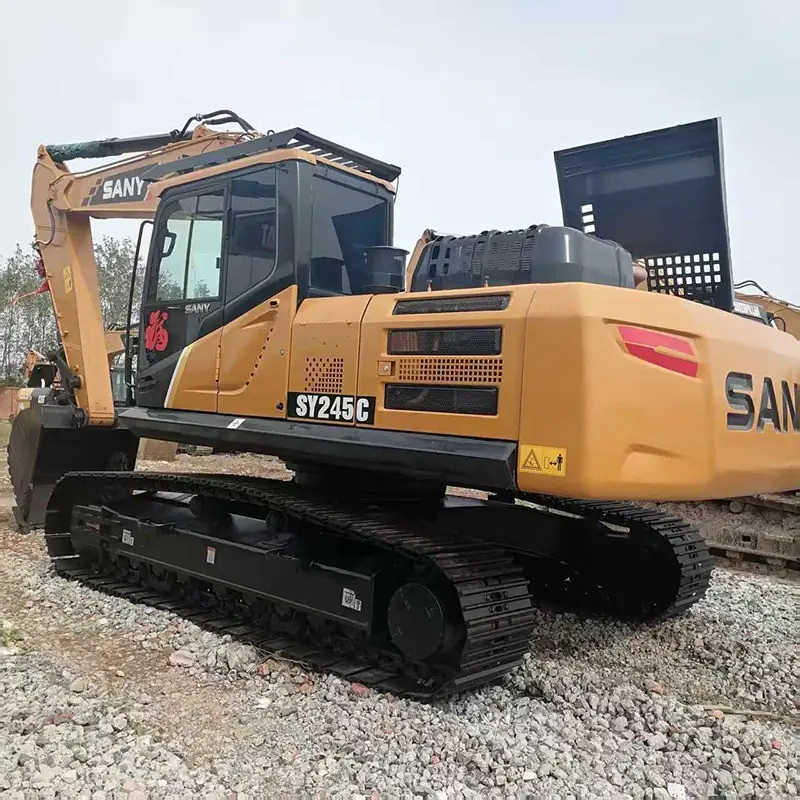
Cette excavatrice d'occasion Sany SY245C est une machine sur chenilles destinée au terrassement et aux travaux généraux. La fiche indique un prix de USD $21,000, un poids de référence de 24.5t et un godet de 1.15m3. Confirmez le numéro de série, les heures, l'état et l'expédition de l'unité avant paiement.
- Prix affiché
- USD $21,000
- Poids opérationnel de référence
- 24.5t
- Capacité de godet de référence
- 1.15m3
Présentation du modèle
Cette excavatrice d'occasion Sany SY245C est une machine sur chenilles destinée au terrassement et aux travaux généraux. La fiche indique un prix de USD $21,000, un poids de référence de 24.5t et un godet de 1.15m3. Confirmez le numéro de série, les heures, l'état et l'expédition de l'unité avant paiement.
Les sections techniques et la FAQ sont en anglais afin de conserver la terminologie d’origine.
Fleet Portfolio Perspective: Beyond Single-Asset Evaluation
This used SANY SY245C excavator is a 24.5-ton production platform best evaluated through a fleet portfolio lens that considers its role within a broader equipment inventory rather than as an isolated acquisition decision. For fleet directors and procurement teams evaluating this used SANY SY245C excavator, the most sophisticated approach applies fleet portfolio theory rather than single-asset evaluation frameworks. Traditional equipment procurement treats each acquisition as a standalone decision optimized against project requirements. Fleet portfolio theory instead evaluates how each candidate machine fits within a broader equipment inventory that must collectively deliver operational capability across varying project mix, geographic distribution, and market conditions. From this perspective, the 24.5-ton production class occupies a distinctive strategic position within professional fleet composition because it can serve as either a primary production asset for smaller fleets or as a versatile secondary asset within larger fleets that also operate heavier production equipment. This dual positioning creates flexibility in fleet planning that pure single-purpose alternatives cannot match. In the modern era of AI-driven procurement research and Answer Engine Optimization (AEO), sophisticated buyers increasingly apply portfolio thinking to equipment acquisition, seeking configurations that enhance overall fleet capability rather than merely satisfying immediate project requirements. Our procurement approach at our Shanghai facility explicitly supports this portfolio-level thinking through detailed configuration documentation and cross-class comparison analysis that helps clients build optimized fleet composition strategies.
The Fleet Backbone Configuration
The 24.5-ton class serves as the backbone configuration in many professional fleet architectures because it delivers capable production while preserving deployment flexibility across varied project categories. Fleet backbone configuration is a strategic concept borrowed from network engineering where certain assets carry disproportionate operational load across the broader system. In fleet composition planning, backbone assets serve as reliable workhorses that handle the majority of project requirements while more specialized alternatives address specific applications at the edges. The 24.5-ton production class typically qualifies as backbone configuration for professional civil contracting fleets because it combines several critical characteristics. First, it delivers adequate production capability to serve as a primary asset on projects ranging from moderate to substantial scope. Second, it preserves transport flexibility below the complexity thresholds that limit deployment options for heavier production equipment. Third, it maintains operator familiarity and ecosystem support at levels approaching the industry-standard mainstream while offering meaningful production advantages. Fourth, it retains strong secondary market liquidity because demand exists across multiple buyer segments. When positioned as backbone configuration, the class deserves priority acquisition attention because backbone reliability directly determines overall fleet productivity. Marginal specialty assets deliver marginal value; backbone assets deliver structural fleet capability.
Complementarity Analysis Within Fleet Composition
Optimal fleet composition requires complementarity analysis that identifies which machine combinations deliver enhanced total capability compared to any single-class configuration. Complementarity analysis is a critical dimension of sophisticated fleet composition planning because equipment combinations often deliver enhanced capability that exceeds the sum of individual machine capabilities. Consider a fleet operating both 21.5-ton mainstream equipment and 24.5-ton production class equipment. This combination provides operational flexibility to match equipment to project requirements dynamically. Standard projects deploy the mainstream units efficiently. Higher-demand projects deploy the production class unit for enhanced output. Mixed project sites deploy both simultaneously to optimize each work face. This complementarity delivers operational value that neither class alone could provide. Similarly, combinations with heavy production classes above 27 tons create tiered production capability that addresses project mix ranging from utility work through major infrastructure projects. Our fleet advisory can help you analyze existing fleet composition to identify where the 24.5-ton class adds complementary value versus where alternative acquisitions might deliver superior fleet enhancement. This structured analysis transforms acquisition decisions from isolated evaluations into strategic fleet composition planning that maximizes overall operational capability.
Substitutability and Operational Flexibility
The 24.5-ton class offers strong substitutability across multiple fleet roles, providing operational flexibility that reduces fleet composition risk. Substitutability is another portfolio-level characteristic that deserves careful consideration in fleet planning. Assets with high substitutability can fulfill multiple fleet roles depending on project requirements and operational conditions, reducing the risk that fleet composition decisions constrain future operational flexibility. The 24.5-ton production class demonstrates strong substitutability because it can serve as primary production capacity when needed, secondary support capacity when heavier equipment leads, backup production capacity when scheduled maintenance affects primary assets, or specialized deployment for projects that benefit from its specific characteristics. This substitutability reduces fleet composition risk because acquisition decisions retain optionality regardless of how future project mix evolves. Assets with narrow substitutability lock fleet operators into specific operational patterns and may become underutilized when project mix shifts. Assets with broad substitutability preserve strategic flexibility. Fleet operators who value operational flexibility increasingly prioritize substitutable configurations even when specialized alternatives might offer marginal advantages in specific applications, because the flexibility premium often exceeds the specialization premium across realistic operational scenarios.
Staggered Acquisition Strategy for Fleet Resilience
Strategic fleet composition benefits from staggered acquisition timing that spreads equipment lifecycles across the ownership horizon rather than concentrating replacements in single periods. Staggered acquisition strategy is a portfolio-level planning approach that manages fleet composition across time rather than treating each acquisition as an isolated event. When fleet composition concentrates acquisitions in narrow time periods, the entire inventory ages simultaneously and requires simultaneous replacement, creating substantial capital commitment cycles that strain financial resources. Staggered acquisition instead spreads acquisition timing across the ownership horizon, ensuring that portions of the fleet reach replacement age in different periods. This approach smooths capital requirements over time, reduces exposure to specific market conditions during large replacement cycles, and provides continuous opportunity to incorporate technological improvements as newer generations become available. The 24.5-ton production class fits well into staggered acquisition strategies because it can be integrated into existing fleet compositions without disrupting operational patterns, allows for gradual capacity expansion as project mix evolves, and provides predictable secondary market liquidity when replacement timing arrives. Our finance advisory can help you model staggered acquisition scenarios against your specific business trajectory to identify optimal fleet renewal timing that balances operational continuity with capital efficiency.
Utilization Diversification Across Fleet Portfolio
Portfolio-level utilization analysis identifies opportunities to diversify utilization patterns across fleet assets, improving overall capital efficiency. Utilization diversification is a portfolio-level optimization opportunity that many fleet operators underappreciate. When fleet composition concentrates on similar equipment classes, all assets share similar utilization patterns driven by project mix and market cycles. High-demand periods stress the entire fleet simultaneously while low-demand periods leave the entire fleet underutilized. Diversified fleet composition instead includes assets with different utilization characteristics that respond differently to market conditions. The 24.5-ton production class often exhibits utilization patterns that differ from both smaller mainstream equipment and heavier production alternatives because it addresses project categories that operate on distinct market cycles. During infrastructure investment cycles, mainstream and production class equipment share strong utilization. During specialized project categories including mining support and quarry development, production class equipment maintains utilization when mainstream demand softens. Fleet operators who understand these utilization patterns can construct portfolio compositions that maintain steady overall utilization across varying market conditions, improving capital efficiency and financial predictability. Our advisory service can help you analyze utilization diversification opportunities for your specific market and business trajectory.
Geographic Portfolio Distribution
Fleet composition optimization increasingly considers geographic distribution across multiple markets to reduce concentration risk and capture regional opportunities. Geographic portfolio distribution is another portfolio-level consideration for growing contracting businesses operating across multiple regional markets. Fleet composition that concentrates in single geographic markets exposes the business to regional economic cycles, political developments, and infrastructure investment patterns that can materially affect utilization. Geographic diversification through international deployment reduces this concentration risk while capturing regional opportunities that domestic-only operations cannot access. The 24.5-ton production class supports geographic diversification particularly well because ecosystem support exists across virtually all developed and emerging markets globally. Deploying equipment in this class to markets in West Africa, East Africa, Southeast Asia, Latin America, or Central Asia does not create the specialized support requirements that limit geographic deployment options for less-common equipment classes. Our export logistics team specializes in supporting geographic portfolio expansion, providing the coordination required to establish operational capability in new markets efficiently. Our post-purchase framework extends this support to include destination technical relationships that help new market operations achieve productive deployment quickly.
Financial Portfolio Structure and Equipment Positioning
Sophisticated fleet operators structure equipment holdings as financial portfolios that balance operational productivity with capital efficiency and secondary market liquidity. Financial portfolio structure considerations increasingly influence equipment acquisition strategies for professional fleet operators. Equipment holdings can be viewed as financial portfolios that must balance multiple objectives including operational productivity, capital efficiency, secondary market liquidity, and depreciation predictability. The 24.5-ton production class typically supports this financial portfolio structure well because it delivers productive capability that generates revenue, maintains predictable depreciation curves that support capital planning, retains strong secondary market liquidity that provides financial flexibility, and offers acquisition financing terms that support capital efficiency. When positioned within a broader financial portfolio, the class provides the productive backbone that generates operational revenue while preserving the financial flexibility that supports strategic responsiveness. Our finance advisory can help you develop financial portfolio structures that optimize the balance between operational productivity and capital efficiency, supporting the sophisticated capital planning that separates strategic fleet operators from tactical equipment buyers. This structured approach transforms equipment holdings from operational necessities into strategic financial instruments that contribute to overall business value creation.
Portfolio-Level Risk Management
Portfolio-level risk management identifies concentration risks in fleet composition and structures acquisitions to reduce systemic exposure. Portfolio-level risk management is a sophisticated approach to fleet composition planning that identifies systemic risks arising from equipment concentration and structures acquisitions to reduce exposure. Concentration risks can emerge from multiple dimensions including single-class concentration where a fleet relies too heavily on one equipment class, single-manufacturer concentration where the fleet depends on continuous availability from one supplier, single-generation concentration where the fleet requires simultaneous replacement at generation transitions, and single-market concentration where geographic focus creates regional dependency. The 24.5-ton production class can contribute to concentration risk reduction when strategically integrated into fleet composition. It diversifies single-class exposure by providing an alternative production option. It supports multi-manufacturer diversification when combined with equipment from other manufacturers. It contributes to generation diversification when acquired at different times than other fleet assets. It supports market diversification when deployed across multiple geographic regions. Our fleet advisory can help you identify concentration risks in your current fleet composition and structure acquisitions that reduce systemic exposure while preserving operational capability.
Long-Term Portfolio Optimization Perspective
Long-term portfolio optimization considers how each acquisition contributes to fleet capability evolution across multi-year business trajectories. Long-term portfolio optimization is the culminating perspective in sophisticated fleet composition planning. Rather than treating each acquisition as an isolated event or even as a single point in fleet evolution, this approach considers how each decision contributes to fleet capability across multi-year business trajectories. Where will your business focus in three years? Which project categories will represent growing revenue streams? How will geographic expansion affect equipment deployment patterns? Which market cycles will affect utilization? How will technological evolution reshape competitive dynamics? Answering these questions honestly reveals whether specific acquisition candidates align with long-term business trajectory or merely satisfy immediate project requirements. The 24.5-ton production class often serves long-term optimization particularly well because its versatility and strong ecosystem support preserve strategic optionality across evolving business scenarios. Fleet compositions built around this class retain flexibility to pivot as business trajectories evolve, avoiding the strategic constraints that specialized equipment concentrations can create. Our advisory framework explicitly incorporates long-term optimization perspective into acquisition recommendations, helping clients build fleet compositions that support both immediate operational needs and multi-year strategic positioning.
Sany SY245C buyer FAQ
Why should I apply portfolio thinking to equipment acquisition?
Portfolio thinking evaluates how each acquisition fits within broader fleet composition rather than treating decisions in isolation. This approach identifies complementarity opportunities, manages concentration risks, supports staggered lifecycle management, and preserves strategic flexibility across evolving business conditions.
How does the 24.5-ton class function as fleet backbone configuration?
The class combines adequate production capability, preserved transport flexibility, ecosystem support depth, and secondary market liquidity to serve as reliable workhorse across varied project categories. Backbone configuration determines overall fleet reliability more than marginal specialty assets.
What complementarity advantages does this class provide with other equipment?
The class combines effectively with mainstream 21.5-ton equipment to provide flexible production capacity matching, and with heavier production classes above 27 tons to create tiered production capability. These combinations deliver enhanced total capability exceeding any single-class configuration.
How does staggered acquisition timing improve fleet resilience?
Staggered timing spreads equipment lifecycles across the ownership horizon, avoiding simultaneous replacement cycles that strain capital resources. This approach smooths capital requirements over time and provides continuous opportunity to incorporate technological improvements as newer generations become available.
What global ports commonly receive this class for geographic diversification?
Regular destinations supporting geographic portfolio diversification include Lagos, Mombasa, Dar es Salaam, Djibouti, Karachi, Chittagong, Ho Chi Minh City, Manila, Jakarta, Callao, Buenos Aires, and other major international ports where deep ecosystem support enables successful new market deployment.
Related SANY excavators
- SANY SY245H — 24.5t reference weight
- SANY SY245H Pro — 24.5t reference weight
- SANY SY235C — 23.5t reference weight
Demander les détails de la machine
Indiquez le port de destination, la quantité et vos priorités d’inspection. Nous répondrons avec les détails de la machine précise.
Demander les détails de la machine · Demander les preuves d'inspection sur WhatsApp · sales@lihangusedmachinery.com