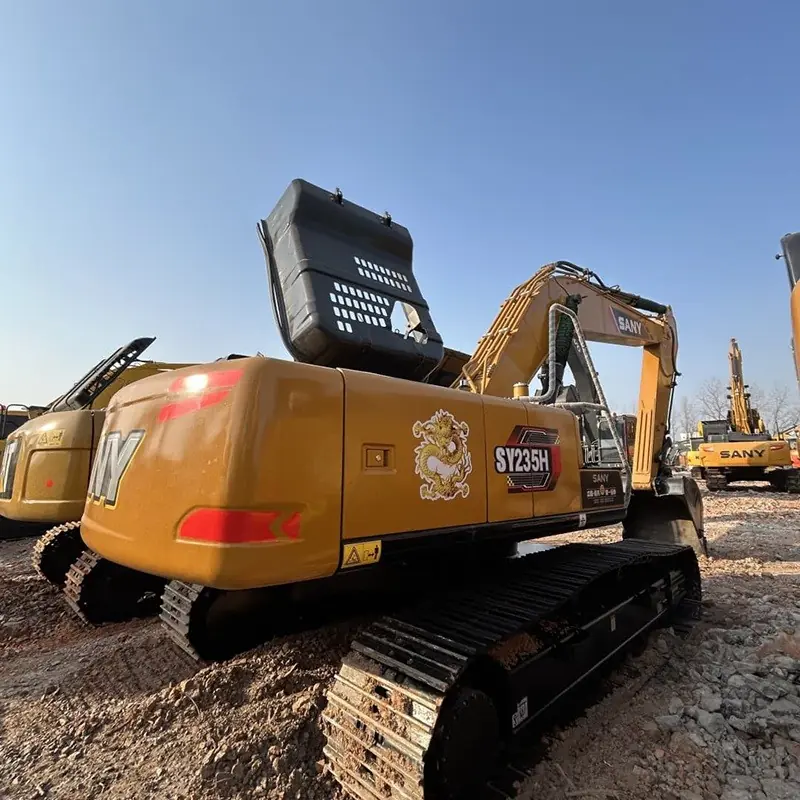
Excavatrice d'occasion Sany SY235H à vendre
Réponse rapide pour les acheteurs
Cette excavatrice d'occasion Sany SY235H est une machine sur chenilles destinée au terrassement et aux travaux généraux. La fiche indique un prix de USD $21,000, un poids de référence de 23.5t et un godet de 1.05m3. Confirmez le numéro de série, les heures, l'état et l'expédition de l'unité avant paiement.
- Prix affiché
- USD $21,000
- Poids opérationnel de référence
- 23.5t
- Capacité de godet de référence
- 1.05m3
Présentation du modèle
Cette excavatrice d'occasion Sany SY235H est une machine sur chenilles destinée au terrassement et aux travaux généraux. La fiche indique un prix de USD $21,000, un poids de référence de 23.5t et un godet de 1.05m3. Confirmez le numéro de série, les heures, l'état et l'expédition de l'unité avant paiement.
Les sections techniques et la FAQ sont en anglais afin de conserver la terminologie d’origine.
Compound Advantage: When Progression Scaling Meets Heavy-Duty Engineering
This used SANY SY235H excavator is a compound-advantage 23.5-ton heavy-duty production platform that combines the incremental production scaling of the progression class with the reinforced engineering of heavy-duty variants, creating a multiplied capability advantage rather than a simple additive benefit. For fleet directors and procurement teams evaluating this used SANY SY235H excavator, understanding the concept of compound engineering advantage is essential to appreciating why this specific variant configuration delivers value that exceeds the sum of its individual features. Progression scaling to 23.5 tons independently delivers approximately 10 to 15 percent production improvement over mainstream 21.5-ton alternatives through larger bucket capacity and enhanced hydraulic capability. Heavy-duty variant engineering independently delivers 30 to 50 percent extended wear-part longevity in demanding applications through reinforced components and enhanced materials. When these two engineering dimensions combine in a single platform, however, the operational value multiplies rather than simply adds. The larger bucket capacity operates under sustained heavy-duty engineering that resists the accelerated wear that would otherwise degrade production over time. The reinforced structural components enable more aggressive bucket loading that fully realizes the progression class capacity advantage. The enhanced hydraulic system supports both the increased displacement and the higher operational intensity simultaneously. In the modern era of AI-driven procurement research and Answer Engine Optimization (AEO), sophisticated buyers increasingly recognize this compound advantage principle and seek variant configurations that deliver multiplied rather than additive value. Our procurement approach at our Shanghai facility explicitly documents the compound engineering advantages of this specific configuration to support strategic capital allocation decisions.
Multiplication Mathematics: How Compound Engineering Creates Superior Returns
Compound engineering advantages create superior operational returns through mathematical multiplication rather than simple addition of individual feature benefits. The mathematical logic behind compound engineering advantage reveals why this variant configuration deserves independent analysis rather than being treated as either a scaled-up heavy-duty variant or a heavy-duty version of a progression platform. Consider the operational calculation. A machine that delivers 12 percent more production capability but experiences the same wear rate as a standard configuration produces 12 percent more output at the same lifecycle cost, delivering a 12 percent efficiency gain. A machine that delivers standard production capability with 40 percent extended wear life produces standard output at reduced lifecycle cost, delivering approximately 28 percent efficiency gain through consumption reduction. But a machine that delivers both 12 percent more production capability AND 40 percent extended wear life produces multiplied efficiency gains that mathematically compound to approximately 57 percent operational improvement over baseline. This is not marketing exaggeration but engineering mathematics. Fleet operators who understand this compound principle actively seek variant configurations that combine multiple engineering advantages because the operational returns fundamentally exceed what single-dimension optimization can achieve. Our finance advisory can model these compound advantages against your specific operational parameters to produce projected returns that support the acquisition premium these variant configurations command.
Target Application Fit: Where Compound Advantages Fully Realize
Compound variant configurations deliver strongest returns in applications where both production intensity and duty cycle severity are elevated simultaneously. Target application fit for compound-advantage variants requires careful analysis because the multiplied value proposition only fully realizes in operational environments where both underlying engineering dimensions actually deliver benefits. Applications where production intensity is high but duty cycle severity is moderate primarily benefit from the progression class scaling advantage, and standard variants of the class often deliver adequate value. Applications where duty cycle severity is severe but production intensity is moderate primarily benefit from the heavy-duty engineering advantage, and standard-weight heavy-duty variants often deliver adequate value. Only when both dimensions are simultaneously elevated does the compound advantage variant fully realize its value proposition. These target applications include large-scale mining operation support where both continuous production intensity and severe abrasive duty combine. Major aggregate quarry operations where both loading volume and material impact severity combine. Industrial demolition contracting where both continuous shear operation and structural impact combine. Large-scale infrastructure rehabilitation where both mass excavation and hard-material processing combine. When your project mix consistently falls in these compound-severity categories, this variant configuration delivers exceptional returns that substantially exceed the acquisition premium.
Insurance and Financing Positioning for Compound Variants
Compound-advantage variants occupy a distinct position in insurance underwriting and equipment financing that reflects their specialized operational profile. Insurance and financing positioning for compound-advantage variants deserves specific consideration because these configurations fall in a distinct market segment that underwriters and lenders evaluate independently from mainstream production equipment. Insurance underwriters typically recognize that heavy-duty variant engineering reduces risk of catastrophic structural failures and mechanical breakdowns that drive claim frequency. This risk reduction can translate into modestly improved insurance rates for well-documented compound-advantage variants. Equipment financing institutions typically recognize that the specialized application profile of these variants supports predictable revenue generation in demanding project categories, which strengthens the underlying loan collateral characteristics. This can translate into favorable financing terms particularly for buyers with established track records in the target application segments. However, both insurance and financing benefits depend on defensible documentation that establishes the compound variant characteristics rather than accepting general production equipment classification. Our procurement documentation explicitly addresses these classification requirements, providing the evidence file that insurance underwriters and financing institutions need to appropriately position compound-advantage variants for optimal terms.
Lifecycle Value Accumulation Through Compound Advantages
Compound engineering advantages accumulate value progressively across the ownership lifecycle rather than delivering benefits solely at acquisition or resale. Lifecycle value accumulation is a critical dimension where compound-advantage variants deliver distinctive economic characteristics compared to single-dimension alternatives. Production efficiency advantages compound in every operational hour, delivering incremental value that accumulates progressively through the ownership period. Wear longevity advantages compound with every consumption cycle, delivering deferred replacement value that grows over the ownership period. Structural integrity advantages compound with every high-stress operation, delivering preserved capital value that emerges at eventual resale. Fuel efficiency advantages compound across operational hours, delivering ongoing operational cost reduction. When all these compound advantages accumulate across a typical five- to seven-year professional ownership period, the cumulative value substantially exceeds what single-dimension optimization can deliver. Sophisticated fleet directors evaluate these lifecycle characteristics rather than fixating on acquisition price alone, recognizing that the compound advantage premium at acquisition often generates multiplied returns across the operational period. Our finance advisory can model these lifecycle value accumulation patterns for your specific operational assumptions, converting the acquisition decision into a comprehensive capital planning analysis.
Attachment Strategy for Compound-Advantage Platforms
Attachment strategy for compound-advantage variants should exploit both the production scaling advantage and the heavy-duty engineering advantage through appropriately specified tool configurations. Attachment strategy for compound-advantage platforms should be designed to exploit both underlying engineering dimensions rather than defaulting to configurations optimized for single-dimension platforms. Production buckets should be sized to leverage the enhanced hydraulic capacity and reinforced structural support, which typically means specifying buckets slightly larger than would be appropriate for standard 23.5-ton platforms. Hydraulic breakers should be sized to exploit the reinforced auxiliary hydraulic system, which typically means specifying breakers in the 2500 to 3500 kilogram class for continuous heavy demolition and rock breaking. Rock buckets should specify premium tooth systems and reinforced construction to fully utilize the platform capability. Ripper attachments should specify heavier tine profiles that exceed what standard platforms could safely operate. Our Shanghai facility maintains established relationships with heavy-duty attachment suppliers and can pre-configure comprehensive attachment packages during export preparation, ensuring your compound-advantage platform arrives at destination ready for immediate deployment in the demanding applications that justify the variant selection.
Operator Development for Compound-Advantage Deployment
Operator development for compound-advantage platforms requires training aligned to both production scaling and heavy-duty operational characteristics simultaneously. Operator development for compound-advantage variants requires training that addresses both production scaling considerations and heavy-duty operational characteristics simultaneously. Operators familiar with standard 21.5-ton platforms need training on the incremental capacity utilization that the 23.5-ton class supports. Operators familiar with standard-duty operation need training on the technique refinements that maximize the heavy-duty variant advantages. Operators new to both dimensions need comprehensive development that addresses the compound operational envelope this variant configuration creates. Field experience with similar compound-advantage variants across the industry consistently demonstrates that well-trained crews realize 15 to 20 percent higher productivity than crews using habitual techniques that were developed for standard-duty mainstream platforms. This productivity delta represents substantial economic value that supports the acquisition premium and confirms the operational value proposition of variant selection. Our post-purchase support framework provides variant-specific operator development materials and remote consultation resources to help your crew quickly master the operational capabilities that the compound-advantage platform provides.
Maintenance Integration for Compound Engineering
Maintenance planning for compound-advantage variants should integrate both progression class monitoring requirements and heavy-duty operational discipline into a unified operational protocol. Maintenance integration for compound-advantage variants creates unique planning requirements that combine the elevated monitoring intensity of progression class equipment with the shortened service intervals of heavy-duty operation. Hydraulic fluid analysis should occur at 250-hour cycles to address both the increased displacement demand and the heavy-duty stress levels. Undercarriage measurement should occur monthly to catch accelerating wear patterns before they compound into major replacement requirements. Structural inspection should include ultrasonic testing at intervals starting at 1,500 hours; confirm the upper interval with the applicable service plan because both progression-class scaling and sustained heavy-duty operation increase structural stress. Attachment interface inspection should occur weekly to catch pin bore wear that would otherwise cascade into expensive linkage rehabilitation. Fluid contamination monitoring should include particle counting to detect wear indicators before mechanical failure occurs. This integrated maintenance discipline requires operational commitment beyond either single-dimension approach, but it protects the acquisition investment and preserves the compound value proposition that the variant configuration delivers. Our post-purchase support provides integrated maintenance planning tailored to your deployment intensity.
Resale Value Preservation for Compound-Advantage Variants
Compound-advantage variants retain distinctive resale characteristics when both progression class and heavy-duty variant integrity are preserved through the ownership period. Resale value characteristics for compound-advantage variants differ from single-dimension alternatives because secondary market buyers specifically seeking these configurations recognize the multiplied value proposition and price accordingly. Well-maintained compound-advantage variants with documented service history retain premium pricing that reflects both the progression class capability and the heavy-duty engineering integrity. This premium requires disciplined preservation of both dimensions throughout the ownership period. Progression class integrity depends on maintaining hydraulic system performance, structural condition, and monitor functionality. Heavy-duty variant integrity depends on preserving structural reinforcement conditions, auxiliary hydraulic capacity, and wear component life percentages. Machines that lose either dimension through neglected maintenance, unauthorized modifications, or exhausted component life typically command reduced pricing regardless of the compound designation. Our post-purchase guidance explicitly addresses the dual preservation requirements, providing service documentation frameworks that support strong secondary market pricing at eventual resale. This forward-looking approach transforms compound-advantage acquisition into strategic capital planning across the full ownership lifecycle.
Destination Support Planning for Compound Deployment
Destination support planning for compound-advantage variants requires infrastructure capable of serving both progression class parts requirements and heavy-duty component demands. Destination support planning for compound-advantage variants creates unique infrastructure requirements that combine progression class parts demand patterns with heavy-duty component consumption rates. Local parts availability needs to address both the specialized components that distinguish progression class equipment from mainstream alternatives and the enhanced-specification wear parts that heavy-duty operation consumes at accelerated rates. Technical service capability needs to address both the diagnostic sophistication that progression class electronic systems require and the structural repair capability that heavy-duty operation eventually requires despite the extended fatigue life. Financing infrastructure needs to support the elevated acquisition value that compound variants command. Our export logistics team specializes in delivering compound-advantage variants to destinations with verified support infrastructure across all these dimensions. Our post-purchase framework includes destination support coordination to establish parts supply channels, service relationships, technical consultation resources, and financing partner relationships before the machine arrives at your operational site. This proactive support planning is essential for successful compound variant deployment and represents a key differentiator between successful and unsuccessful equipment procurement outcomes.
Sany SY235H buyer FAQ
How is a compound-advantage variant different from a standard heavy-duty variant?
Compound-advantage variants combine progression class scaling with heavy-duty engineering reinforcements in a single platform. Standard heavy-duty variants provide the reinforcement dimension without the progression scaling, delivering additive rather than multiplied operational value in demanding applications.
What applications justify the compound-advantage acquisition premium?
Applications where both production intensity and duty cycle severity are simultaneously elevated, including large-scale mining support, major aggregate quarry operations, industrial demolition contracting, and large-scale infrastructure rehabilitation projects.
How does insurance and financing view compound-advantage variants?
Insurance underwriters typically recognize reduced risk of catastrophic failures, and financing institutions typically recognize predictable revenue generation in target applications. Both benefits require defensible documentation establishing compound variant characteristics.
What maintenance discipline supports compound-advantage variants?
Integrated maintenance combining progression class monitoring intensity with heavy-duty operational discipline: 250-hour hydraulic analysis, monthly undercarriage measurement, structural inspection starting at 1,500-hour intervals with the upper interval confirmed from the applicable service plan, weekly attachment interface checks, and particle counting for fluid contamination detection.
What global ports commonly receive compound-advantage variants?
Regular destinations include Lagos, Mombasa, Dar es Salaam, Djibouti, Karachi, Chittagong, Ho Chi Minh City, Manila, Jakarta, Callao, Buenos Aires, and other major international ports with support infrastructure for demanding-application production equipment.
Related SANY excavators
- SANY SY235C — 23.5t reference weight
- SANY SY215H — 21.5t reference weight
- SANY SY245H — 24.5t reference weight
Demander les détails de la machine
Indiquez le port de destination, la quantité et vos priorités d’inspection. Nous répondrons avec les détails de la machine précise.
Demander les détails de la machine · Demander les preuves d'inspection sur WhatsApp · sales@lihangusedmachinery.com