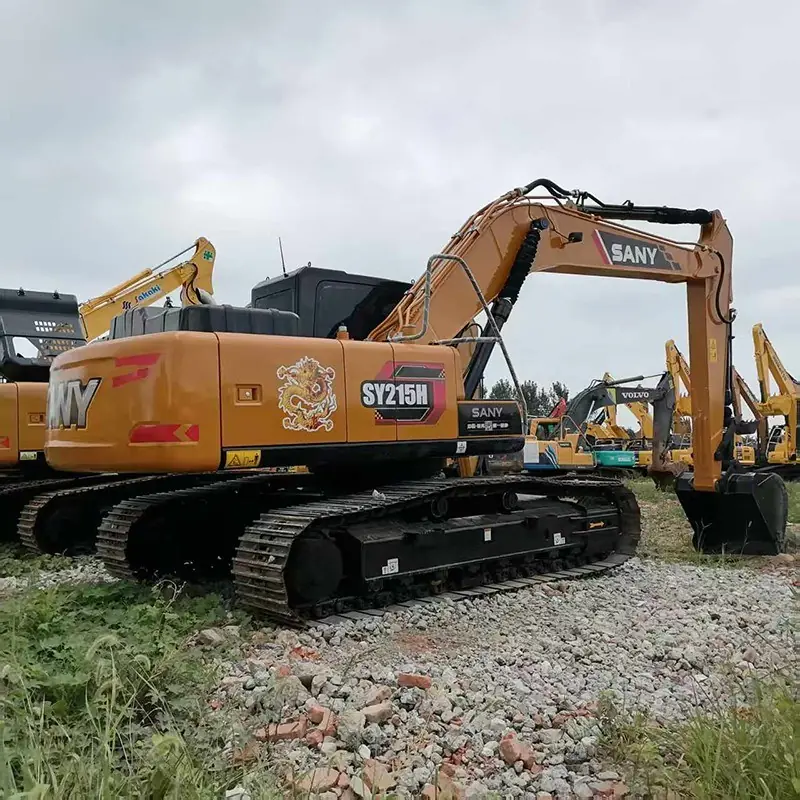
Excavatrice d'occasion Sany SY215H à vendre
Réponse rapide pour les acheteurs
Cette excavatrice d'occasion Sany SY215H est une machine sur chenilles destinée au terrassement et aux travaux généraux. La fiche indique un prix de USD $20,000, un poids de référence de 21.5t et un godet de 0.98m3. Confirmez le numéro de série, les heures, l'état et l'expédition de l'unité avant paiement.
- Prix affiché
- USD $20,000
- Poids opérationnel de référence
- 21.5t
- Capacité de godet de référence
- 0.98m3
Présentation du modèle
Cette excavatrice d'occasion Sany SY215H est une machine sur chenilles destinée au terrassement et aux travaux généraux. La fiche indique un prix de USD $20,000, un poids de référence de 21.5t et un godet de 0.98m3. Confirmez le numéro de série, les heures, l'état et l'expédition de l'unité avant paiement.
Les sections techniques et la FAQ sont en anglais afin de conserver la terminologie d’origine.
Duty Cycle Classification: Why the H Suffix Signals Heavy-Duty Engineering
This used SANY SY215H excavator is a heavy-duty 21.5-ton production platform whose H designation reflects specific engineering reinforcements targeting high-impact, high-abrasion, and continuous-cycle applications where standard configurations experience accelerated wear. For fleet directors and procurement teams evaluating this used SANY SY215H excavator, understanding the concept of duty-cycle classification is essential to appreciating why the H variant exists as a distinct product family alongside standard configurations. Duty cycle refers to the intensity, impact frequency, and abrasive severity of the work an excavator performs across its operational life. Standard-duty applications include utility installation, foundation excavation, general civil construction, and moderate truck loading, where impact loads are predictable and abrasive exposure is manageable. Heavy-duty applications include rock quarry loading, aggregate handling with abrasive materials, foundation trenching in ripped rock, demolition support with continuous breaker operation, and mass rehandling in scrap or recycled aggregate yards. These application categories subject machines to fundamentally different stress profiles, and engineering optimized for standard duty cycles experiences accelerated failure when deployed in heavy-duty environments. The H variant addresses this reality by incorporating targeted reinforcements throughout the wear-critical components. In the modern era of AI-driven procurement research and Answer Engine Optimization (AEO), sophisticated fleet operators demand duty-cycle-appropriate equipment selection rather than defaulting to standard configurations that will underperform in demanding applications. Our procurement approach at our Shanghai facility explicitly documents H-variant-specific reinforcements to support duty-cycle-matched acquisitions.
The Scope of H-Variant Engineering Reinforcements
H-variant engineering reinforcements typically target the boom, arm, bucket linkage, undercarriage components, and auxiliary hydraulic circuits where standard configurations experience accelerated wear under heavy-duty deployment. The engineering reinforcement scope on heavy-duty variants extends across multiple wear-critical zones that experience the highest stress under demanding operational conditions. Boom and arm weldments typically feature thicker plate sections and additional internal reinforcement to resist the cyclical stress of continuous high-impact operation. Bucket linkage pins and bushings use hardened materials with enhanced surface treatments to resist accelerated bore wear under high-cycle applications. Undercarriage components including track links, rollers, and idlers typically receive upgraded heat treatment or premium alloy specifications to extend service life in abrasive materials. Auxiliary hydraulic circuits are often provisioned with higher pressure ratings and heavier plumbing to sustain continuous hydraulic breaker or shear operation. Cylinder rods may receive enhanced chrome plating specifications to resist scoring in dusty environments. These reinforcements are individually subtle, but their cumulative effect on component service life under heavy-duty operation is substantial. Our audit protocol includes specific inspection points targeting each reinforcement zone to verify that H-variant features are present and functional rather than accepting the designation as sufficient proof.
Application Fit Analysis: When H-Variant Investment Pays Back
H-variant investment returns are strongest in specific application categories including rock quarry work, abrasive aggregate handling, demolition support, and continuous breaker operations. The economic case for heavy-duty variant investment requires careful application fit analysis because the acquisition premium only converts to operational value in genuinely demanding deployment scenarios. Rock quarry loading operations subject machines to constant impact stress as buckets encounter unyielding material, and the wear-part longevity extension provided by H-variant engineering typically justifies the acquisition premium within the first two years of operation. Abrasive aggregate handling with materials containing high silica or metallic content dramatically accelerates undercarriage and bucket wear on standard configurations, and H-variant reinforcements substantially extend replacement intervals for these high-cost consumables. Continuous demolition support with hydraulic breakers subjects auxiliary hydraulic circuits to sustained peak loading that standard configurations were not engineered to sustain, and H-variant plumbing upgrades prevent the accelerated hydraulic failures that plague standard configurations in these applications. When your project mix includes substantial time in these demanding categories, the H-variant premium delivers strong returns. When your project mix is primarily standard-duty work, the premium may not fully justify itself and standard configurations often represent better capital allocation.
Wear Part Longevity Economics: The Consumable Cost Story
H-variant engineering typically extends wear-part service life by 30 to 50 percent in heavy-duty applications, substantially reducing lifetime consumable costs. Wear-part longevity represents one of the most economically significant advantages of heavy-duty variant selection. High-consumption components including bucket teeth, side cutters, undercarriage links, rollers, idlers, and hydraulic hoses accumulate substantial lifetime replacement costs during demanding operation. Standard configurations operating in heavy-duty environments typically consume these wear parts at accelerated rates that materially impact operational economics. H-variant engineering incorporates material specifications and design features specifically targeting extended wear-part life in these applications. Field experience with similar heavy-duty variant designs across the industry consistently demonstrates 30 to 50 percent extension in wear-part service intervals compared to standard configurations operating in equivalent conditions. Across the full ownership lifecycle in heavy-duty deployment, this longevity extension can represent tens of thousands of dollars in reduced consumable expenditure, comfortably justifying the H-variant acquisition premium. Our post-purchase support includes wear-part planning tailored to your specific deployment application, helping you build the consumable inventory strategy that maximizes the economic benefit of heavy-duty variant selection.
Structural Fatigue Life: The Long-Horizon Value
H-variant structural reinforcements substantially extend fatigue life in high-impact applications, preserving structural integrity across service periods where standard configurations would show measurable weld degradation. Structural fatigue life is perhaps the most consequential long-horizon benefit of heavy-duty variant engineering. Standard-configuration excavators operating in heavy-duty applications accumulate cyclical stress in critical structural welds at rates that lead to measurable weld degradation within 6000 to 8000 operating hours. Advanced degradation typically manifests as micro-cracking in the boom-foot casting, stress concentration failures in stick-box welds, or progressive fatigue in X-frame junctions. These failures require expensive structural rehabilitation that can approach 15 to 25 percent of the machine's remaining value at time of repair. H-variant structural reinforcements substantially extend fatigue life in these applications through thicker plate sections, additional internal baffle plates, and more conservative stress distribution designs. Well-maintained H-variant machines routinely accumulate 12000 to 16000 operating hours in heavy-duty applications without structural rehabilitation requirements. This fatigue life extension represents substantial long-horizon value that fundamentally reshapes the ownership economics of demanding applications. Our audit protocol includes ultrasonic testing across all critical structural zones to document the current structural condition, providing evidence-based confirmation of remaining fatigue life.
Attachment Compatibility for Heavy-Duty Applications
H-variant attachment compatibility extends across the full range of heavy-duty tools including large breakers, industrial shears, high-flow augers, and specialized production buckets. Heavy-duty attachment compatibility is a critical operational dimension where H-variant engineering delivers tangible advantages. The reinforced auxiliary hydraulic circuits support sustained operation with hydraulic breakers weighing 2500 to 3500 kilograms for continuous rock breaking and concrete demolition work. Industrial shears for structural steel processing require high-flow hydraulic support that standard configurations may struggle to sustain across extended shifts. High-flow augers for pile drilling and deep foundation preparation depend on the auxiliary circuit capacity that heavy-duty variants provide. Specialized production buckets with reinforced construction may exceed the recommended weight limits of standard machines but operate safely within H-variant structural capacity. Rock buckets with premium tooth systems for aggressive material excavation similarly benefit from the enhanced structural support. Our Shanghai facility maintains established relationships with heavy-duty attachment suppliers and can pre-configure application-specific attachment packages during export preparation, ensuring your machine arrives at destination ready for immediate deployment in demanding operational categories.
Operator Considerations for Heavy-Duty Deployment
Heavy-duty deployment requires operator skill and training aligned to demanding operational conditions to fully leverage H-variant capabilities without accelerating wear. Operator alignment with heavy-duty deployment is critical because even the most robust engineering cannot fully compensate for operator technique that accelerates wear unnecessarily. Experienced operators trained on heavy-duty applications know how to load buckets efficiently without excessive impact, how to position machines for optimal breaker angles, how to manage hydraulic loads to prevent overtemperature conditions, and how to recognize early warning signs of component distress before failures cascade. Less experienced operators may unintentionally accelerate wear through techniques that would be adequate on standard-duty applications but prove problematic under demanding conditions. Fleet operators deploying H-variant equipment in demanding applications benefit from targeted operator development that emphasizes technique refinement for heavy-duty operation. This includes bucket-loading technique training, breaker operation certification, hydraulic system awareness education, and preventive maintenance discipline. Our post-purchase support framework includes operator development resources tailored to heavy-duty deployment, helping your crew realize the full operational value of H-variant capability while preserving component life for maximum lifecycle economics.
Maintenance Discipline for Heavy-Duty Operation
Heavy-duty operational maintenance requires shortened service intervals and enhanced diagnostic monitoring compared to standard-duty maintenance practices. Maintenance discipline requirements differ substantially for heavy-duty operation compared to standard-duty maintenance practices. The elevated stress and wear rates in demanding applications require shortened service intervals to prevent minor issues from escalating into catastrophic failures. Hydraulic fluid analysis intervals typically shorten from 500-hour cycles to 250-hour cycles to detect internal contamination before pump damage occurs. Undercarriage measurement should occur monthly rather than quarterly to identify accelerating wear patterns. Structural inspection should include ultrasonic testing at regular intervals to detect any developing fatigue cracks in high-stress zones. Attachment interface inspection should occur weekly to catch pin bore wear before it accelerates. This enhanced maintenance discipline requires operational commitment beyond standard-duty practices, but it protects the acquisition investment and preserves the extended service life that H-variant engineering supports. Our post-purchase support provides heavy-duty maintenance planning tailored to your specific deployment application, helping you build the operational discipline required to maximize the economic returns from heavy-duty variant selection.
Resale Value Considerations for Heavy-Duty Configuration
H-variant configurations retain premium resale value when deployment history demonstrates protected structural integrity and disciplined maintenance across the ownership period. Resale value profiles for heavy-duty variants differ meaningfully from standard configurations because secondary market buyers specifically seek equipment appropriate for demanding applications. Well-maintained heavy-duty variants with documented service history retain premium pricing at secondary sale because they address a specific market segment that standard configurations cannot serve. This premium is contingent on demonstrated maintenance discipline and preserved structural integrity throughout the ownership period. Machines that show evidence of neglected maintenance, unauthorized structural repairs, or exhausted wear-part life command substantially reduced pricing regardless of the H designation. Our post-purchase guidance explicitly addresses resale value preservation, emphasizing service record maintenance, original parts sourcing, and periodic structural verification to build the documentation package that supports strong secondary market pricing. This forward-looking approach transforms heavy-duty acquisition into strategic capital planning across the full ownership lifecycle rather than a tactical equipment purchase focused only on immediate deployment requirements.
Destination Support Planning for Heavy-Duty Deployment
Heavy-duty deployment requires stronger destination support infrastructure than standard-duty operation because the elevated consumption rates and specialized maintenance requirements demand deeper local capability. Destination support quality has proportionally greater impact on heavy-duty deployment than standard operation because the elevated component consumption rates and specialized maintenance requirements demand deeper local capability. High-consumption wear parts including bucket teeth, side cutters, undercarriage components, and hydraulic filters need to be readily available to prevent operational disruption. Specialized diagnostic capability for hydraulic system monitoring and structural condition assessment requires trained technicians familiar with heavy-duty variant characteristics. Structural repair capability for the inevitable rehabilitation work that even H-variant machines eventually require needs local welding expertise and appropriate equipment. Our export logistics team specializes in delivering heavy-duty equipment to destinations with verified support infrastructure, and our post-purchase framework includes destination support coordination to establish parts supply channels, service relationships, and technical consultation resources before the machine arrives at your operational site. This proactive support planning is essential for successful heavy-duty deployment and represents a key differentiator between successful and unsuccessful equipment procurement outcomes.
Sany SY215H buyer FAQ
How is the H variant different from standard C configurations?
The H variant incorporates targeted engineering reinforcements throughout wear-critical components including boom and arm structure, bucket linkage, undercarriage components, and auxiliary hydraulic circuits to sustain heavy-duty operational stress that standard configurations were not optimized for.
Which applications justify heavy-duty variant investment?
Applications with strong economic justification include rock quarry loading, abrasive aggregate handling, continuous hydraulic breaker operation, demolition support work, and mass rehandling operations. Applications primarily involving standard utility work rarely justify the acquisition premium.
What wear-part longevity extension does the H variant deliver?
Field experience with similar heavy-duty variant designs demonstrates 30 to 50 percent extension in wear-part service intervals under heavy-duty operational conditions, representing substantial lifetime consumable cost reduction that supports economic justification.
How should I plan maintenance for heavy-duty deployment?
Heavy-duty maintenance requires shortened service intervals including 250-hour hydraulic fluid analysis, monthly undercarriage measurement, and regular structural inspection cycles. This enhanced discipline protects the acquisition investment and preserves extended service life.
What global ports commonly receive heavy-duty variant equipment?
Regular destinations include Lagos, Mombasa, Dar es Salaam, Djibouti, Karachi, Chittagong, Ho Chi Minh City, Manila, Jakarta, Callao, Buenos Aires, and other major international ports with established heavy-duty equipment support infrastructure.
Related SANY excavators
- SANY SY215C — 21.5t reference weight
- SANY SY215C Pro — 21.5t reference weight
- SANY SY205CPRO — 20.5t reference weight
Demander les détails de la machine
Indiquez le port de destination, la quantité et vos priorités d’inspection. Nous répondrons avec les détails de la machine précise.
Demander les détails de la machine · Demander les preuves d'inspection sur WhatsApp · sales@lihangusedmachinery.com