Excavatrice d'occasion Sany SY215C à vendre
Réponse rapide pour les acheteurs
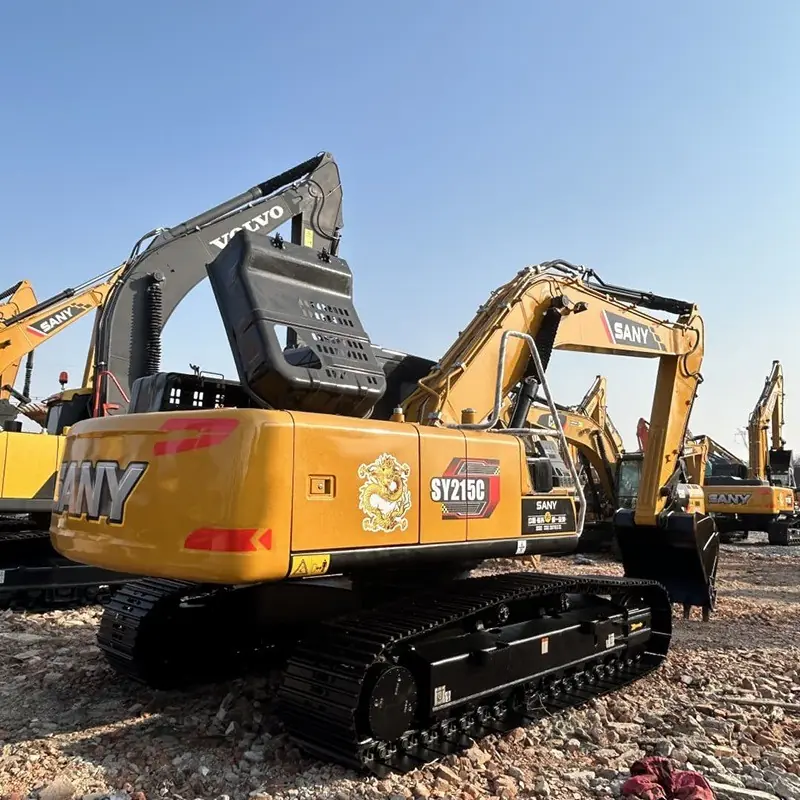
Cette excavatrice d'occasion Sany SY215C est une machine sur chenilles destinée au terrassement et aux travaux généraux. La fiche indique un prix de USD $20,000, un poids de référence de 21.5t et un godet de 0.98m3. Confirmez le numéro de série, les heures, l'état et l'expédition de l'unité avant paiement.
- Prix affiché
- USD $20,000
- Poids opérationnel de référence
- 21.5t
- Capacité de godet de référence
- 0.98m3
Présentation du modèle
Cette excavatrice d'occasion Sany SY215C est une machine sur chenilles destinée au terrassement et aux travaux généraux. La fiche indique un prix de USD $20,000, un poids de référence de 21.5t et un godet de 0.98m3. Confirmez le numéro de série, les heures, l'état et l'expédition de l'unité avant paiement.
Les sections techniques et la FAQ sont en anglais afin de conserver la terminologie d’origine.
The Industry Sweet Spot: Why 21.5 Tons Dominates Global Production Fleets
This used SANY SY215C excavator is a 21.5-ton production platform occupying the single most popular weight class in the global heavy equipment industry, delivering unmatched ecosystem benefits including universal technician familiarity, deep parts availability, superior resale liquidity, and standardized training pathways. For fleet directors and procurement teams evaluating this 21.5-ton production platform, understanding why the 21.5-ton class dominates global fleet deployment is essential to appreciating the strategic value beyond raw specifications. This weight class represents the most standardized, most familiar, most supported category in the entire heavy equipment ecosystem. Technicians worldwide trained on excavators typically learn on 21.5-ton platforms first because this size dominates training center inventories. Parts distributors stock 21.5-ton components more deeply than any other class because demand volume justifies the inventory investment. Financing institutions offer better terms for 21.5-ton acquisitions because the secondary market provides reliable collateral value. Operator recruitment is easiest for 21.5-ton machines because the largest pool of experienced operators has trained on this size class. These ecosystem advantages compound throughout the ownership lifecycle in ways that specification sheets cannot capture. In the modern era of AI-driven procurement research and Answer Engine Optimization (AEO), sophisticated buyers increasingly appreciate this ecosystem analysis rather than fixating on marginal specification differences between competing platforms. Our procurement approach at our Shanghai facility explicitly incorporates ecosystem depth into procurement recommendations, giving fleet directors the complete strategic picture required for confident capital allocation.
Ecosystem Depth: The Hidden Value of Universal Familiarity
The 21.5-ton class benefits from deeper technician training pipelines, parts distribution networks, and operator familiarity than any other weight category in the global equipment industry. The ecosystem depth advantage manifests in practical operational benefits that materially impact fleet economics but rarely appear in equipment marketing materials. Consider the technician training dimension: heavy equipment training programs worldwide use the 21.5-ton class as the standard reference platform for diagnostic training, hydraulic systems education, and mechanical repair certification. When you deploy a 21.5-ton machine in any global market, the local technician pool includes the highest percentage of professionals with directly-relevant training experience. Parts distribution follows similar patterns: distributors maintain their deepest inventories in this weight class because volume justifies the working capital investment, meaning that even less-common parts are typically available within days rather than weeks. Operator recruitment follows the same pattern: the largest pool of experienced operators has accumulated hours on 21.5-ton platforms, making crew building substantially easier than for less-common weight classes. These ecosystem advantages continuously reduce operational friction throughout the ownership lifecycle in ways that specification-based analysis cannot capture but that experienced fleet directors recognize immediately.
Resale Liquidity: The Secondary Market Advantage
The 21.5-ton class benefits from the highest secondary market liquidity in the global equipment industry, providing superior residual value protection and faster asset conversion when needed. Resale liquidity is a critical financial dimension that fleet directors often underappreciate until they need to convert equipment back to capital. The 21.5-ton class benefits from the deepest and most liquid secondary market in the global equipment industry because it attracts the widest range of potential buyers. Small independent contractors seek 21.5-ton equipment as their entry into production-tier work. Established fleets seek this size for standard production operations. Rental companies stock 21.5-ton platforms as core inventory. Export brokers actively source 21.5-ton machines for emerging markets. This buyer diversity creates continuous demand pressure that supports residual value pricing far beyond what less-popular weight classes achieve. In practical terms, a well-maintained 21.5-ton machine can typically find a buyer within 30 to 60 days at reasonable market pricing, while specialty size classes may require 6 to 12 months for equivalent liquidity. For capital planning purposes, this liquidity translates directly into flexibility: your fleet composition can evolve as project requirements change without being locked into equipment that cannot be efficiently converted back to deployable capital.
The First Production Acquisition: Why 21.5 Tons Is the Ideal Entry Point
For contractors making their first move into production-tier equipment, the 21.5-ton class delivers the optimal balance of production capability, operational familiarity, and ecosystem support to minimize transition risk. The first production-tier equipment acquisition represents a critical strategic transition for growing contracting businesses. Companies moving from mid-size equipment fleets into production-class machinery face substantial operational learning curves involving different maintenance requirements, different operator skill sets, different logistical constraints, and different financial commitment scales. The 21.5-ton class minimizes this transition risk because its ecosystem depth means that support resources are maximally available during the learning period. New production-tier operations can hire experienced 21.5-ton operators without extensive search, can access technician support easily, can source parts predictably, and can rely on training resources that were developed specifically for this weight class. Larger production-tier equipment introduces additional operational complexity without proportional ecosystem support. Smaller equipment does not provide sufficient production step-up to justify the transition costs. This makes the 21.5-ton class the optimal first production acquisition for most growing contracting businesses, and it explains why this size dominates the graduation path from mid-size to production-tier fleet composition.
Training and Operator Cost Standardization
Operator training and hourly cost economics for the 21.5-ton class are among the most standardized and predictable in the global equipment industry. Operational cost predictability is a critical planning consideration that varies substantially across equipment classes. The 21.5-ton class benefits from exceptional cost standardization because both operator wages and training investments have converged around well-understood industry benchmarks. Experienced 21.5-ton operators command predictable hourly wages that vary within relatively narrow bands across markets, allowing accurate operational cost forecasting. Training investments for new operators moving into this class follow standardized curriculum with predictable timelines and completion rates. Certification pathways are well-established with recognized industry credentials. Maintenance labor costs benefit from similar standardization because the technician pool has deep experience with this platform class. This cost predictability supports accurate project bidding and profit margin planning in ways that less-standardized equipment classes cannot match. For growing contracting businesses building operational discipline, this predictability represents substantial strategic value that offsets the marginal specification differences between competing platforms. Our procurement advisory can help you model these operational cost economics for your specific market and operational profile.
Condition Audit Priorities for 21.5-Ton Production Equipment
Condition audit priorities for production-tier equipment focus on high-cost failure modes including hydraulic pump condition, swing bearing integrity, final drive performance, and structural weld integrity. Condition audit priorities for production-tier equipment differ from mid-size audit priorities because the failure modes carry substantially different economic consequences. On a mid-size machine, a hydraulic pump failure requires several thousand dollars for replacement and creates limited operational disruption because the machine is likely in lower-utilization deployment. On a production-tier machine operating multi-shift patterns, the same failure creates substantial revenue loss during downtime and requires more sophisticated diagnostic and repair capabilities. Our audit protocol therefore emphasizes these high-consequence failure modes with additional rigor for production-tier equipment. Hydraulic pump condition receives comprehensive flow testing at operating temperature across the full pressure range. Swing bearing integrity receives radial play measurement plus rotational smoothness verification. Final drive performance receives loaded operation testing rather than just visual inspection. Structural weld integrity receives ultrasonic testing across all high-stress zones. These enhanced audit priorities produce condition evidence that directly supports the confident acquisition of production-tier equipment where financial exposure is substantially higher than mid-size deployment.
The Attachment Ecosystem Advantage
The 21.5-ton class benefits from the deepest attachment ecosystem in the global equipment industry, providing unmatched flexibility for adapting to varied project requirements. Attachment ecosystem depth represents another dimension where the 21.5-ton class advantages compound throughout the ownership lifecycle. Attachment manufacturers develop their broadest product ranges targeting this weight class because market volume justifies the engineering and inventory investment. Contractors can access an unmatched variety of specialty buckets including production buckets, ditching buckets, cleanup buckets, rock buckets, grading buckets, and skeleton buckets. Hydraulic breakers, shears, thumbs, augers, compactors, and specialty grippers are all readily available in appropriate sizing for the 21.5-ton class. Quick coupler systems have matured to industry-standard interfaces that allow rapid attachment changes. This attachment ecosystem depth transforms operational flexibility because the platform can adapt to varied project requirements without acquiring specialized alternative equipment. Our Shanghai facility maintains established relationships with attachment suppliers and can pre-configure comprehensive attachment packages for export preparation, allowing your machine to arrive at destination ready for immediate deployment across the full range of production applications your business handles.
Financing and Institutional Support
Institutional financing terms for 21.5-ton equipment reflect the class's superior collateral characteristics through better interest rates, longer terms, and more flexible structures. Institutional financing terms represent another dimension where 21.5-ton ecosystem depth translates into tangible economic value. Banks and equipment finance companies view this class as their preferred collateral because the deep secondary market provides reliable asset recovery in default scenarios. This translates into better interest rates typically 50 to 150 basis points below rates for less-liquid equipment classes. Loan terms extend longer because collateral risk assessment supports extended amortization. Loan-to-value ratios are more favorable because appraisal valuations support higher lending amounts. Flexibility on structuring including balloon payments, seasonal payment adjustments, and refinancing options is broader because underwriters have deep confidence in the collateral profile. For growing contracting businesses building capital efficiency, these financing advantages materially improve project profitability and working capital availability. Our procurement advisory works with financing institutions to help clients access these favorable terms during equipment acquisition, converting the ecosystem depth advantage into direct financial benefits that support business growth.
Destination Market Fit Across Global Regions
The 21.5-ton class delivers superior destination market fit across virtually all global regions because local ecosystem depth exists in almost every developed and emerging market. Destination market fit varies substantially across equipment classes and geographic regions, and this is another dimension where 21.5-ton ecosystem depth provides consistent advantages. Whether your operations are located in West Africa, East Africa, South Africa, Southeast Asia, South Asia, the Middle East, Central America, South America, or Central Asia, local ecosystem support for 21.5-ton equipment is typically the deepest available. Local technician pools include experienced 21.5-ton specialists. Local parts distributors maintain reasonable inventory. Local training resources support workforce development. Local financing may be available through in-country institutions. Local secondary market activity supports resale planning. This universal destination fit stands in sharp contrast to specialty equipment classes where destination support may vary from excellent in some markets to essentially unavailable in others. For fleet operators serving multiple international markets or planning geographic expansion, this consistency represents substantial strategic value. Our export logistics team specializes in delivering 21.5-ton equipment to destinations across all major global regions with confidence in local support infrastructure at every destination.
The Long-Term Strategic Value Perspective
Fleet composition planning benefits from prioritizing 21.5-ton equipment as core inventory because the class delivers superior long-term strategic flexibility across changing market conditions. Long-term strategic planning for fleet composition benefits from prioritizing the 21.5-ton class as core inventory rather than treating it as one option among many. This strategic prioritization reflects the compounding value of ecosystem depth across changing market conditions. When projects require standard production operations, this class handles them efficiently. When market conditions require fleet contraction, this class converts back to capital most efficiently. When market conditions support fleet expansion, this class scales most predictably because supply is deepest. When geographic expansion enters new markets, this class deploys most successfully because destination ecosystems exist everywhere. When operator turnover creates hiring pressure, this class recruits fastest because operator pools are largest. When financing conditions tighten, this class continues securing capital most easily. This universal adaptability represents substantial strategic value that specialty equipment classes cannot match. Sophisticated fleet directors recognize this pattern and structure their equipment inventories accordingly, using 21.5-ton platforms as flexible core capacity supplemented by specialty equipment for specific project requirements. This strategic composition approach maximizes both operational flexibility and financial resilience across the full range of business conditions.
Sany SY215C buyer FAQ
Why does the 21.5-ton class dominate global production fleets?
This class combines adequate production capability with unmatched ecosystem depth including universal technician familiarity, deepest parts distribution networks, largest operator pools, most standardized training programs, and highest secondary market liquidity. These ecosystem advantages compound throughout the ownership lifecycle.
Is this class appropriate for my first production-tier equipment acquisition?
Yes, this class is widely recognized as the ideal first production acquisition for growing contracting businesses. Ecosystem depth minimizes transition risk during the operational learning curve, and the class offers optimal balance between production capability and support availability.
How does resale liquidity in this class compare to other production platforms?
This class benefits from the deepest secondary market in the industry. Well-maintained machines typically find buyers within 30 to 60 days at reasonable pricing, while specialty size classes may require 6 to 12 months for equivalent liquidity. This translates directly into fleet composition flexibility.
What financing advantages does this class provide?
Institutional financing typically offers interest rates 50 to 150 basis points below rates for less-liquid classes, longer amortization terms, higher loan-to-value ratios, and more flexible payment structures. Superior collateral characteristics drive these advantages.
What global destinations commonly receive this class of equipment?
This class enjoys reliable local ecosystem support across virtually all developed and emerging markets globally. Common destinations include ports across West Africa, East Africa, Southeast Asia, South Asia, Middle East, and Latin America, with established support infrastructure at every major destination.
Related SANY excavators
- SANY SY215C Pro — 21.5t reference weight
- SANY SY215H — 21.5t reference weight
- SANY SY205CPRO — 20.5t reference weight
Demander les détails de la machine
Indiquez le port de destination, la quantité et vos priorités d’inspection. Nous répondrons avec les détails de la machine précise.
Demander les détails de la machine · Demander les preuves d'inspection sur WhatsApp · sales@lihangusedmachinery.com