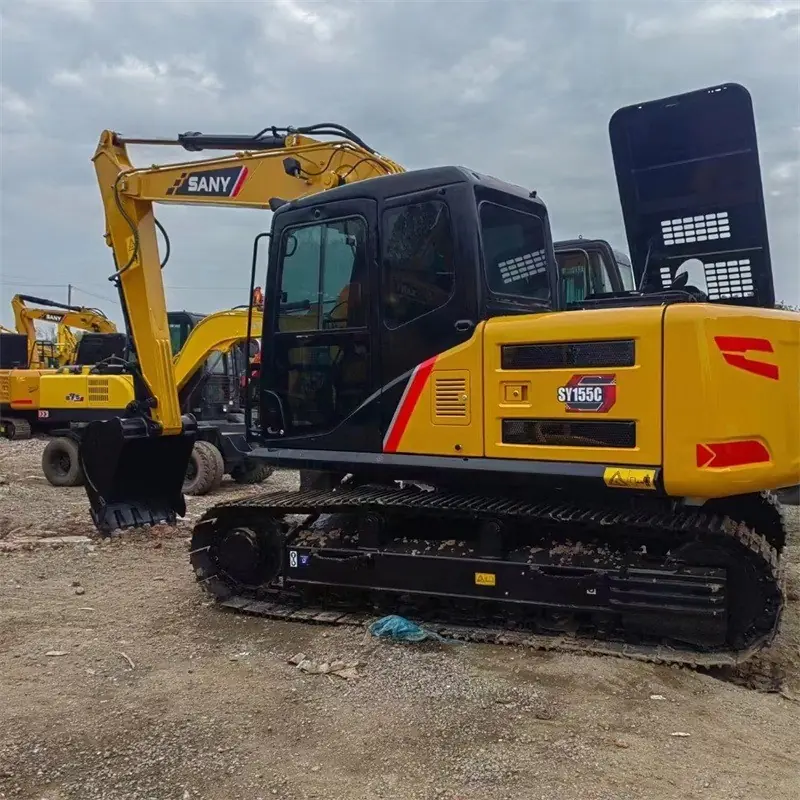
Excavatrice d'occasion SANY SY155C à vendre
Réponse rapide pour les acheteurs
Cette excavatrice d'occasion SANY SY155C est une machine sur chenilles destinée au terrassement et aux travaux généraux. La fiche indique un prix de USD $18,000, un poids de référence de 15.5t et un godet de 0.70m3. Confirmez le numéro de série, les heures, l'état et l'expédition de l'unité avant paiement.
- Prix affiché
- USD $18,000
- Poids opérationnel de référence
- 15.5t
- Capacité de godet de référence
- 0.70m3
Présentation du modèle
Cette excavatrice d'occasion SANY SY155C est une machine sur chenilles destinée au terrassement et aux travaux généraux. La fiche indique un prix de USD $18,000, un poids de référence de 15.5t et un godet de 0.70m3. Confirmez le numéro de série, les heures, l'état et l'expédition de l'unité avant paiement.
Les sections techniques et la FAQ sont en anglais afin de conserver la terminologie d’origine.
The Project-Fit Approach: Why Size Class Choice Drives Fleet Economics
This used SANY SY155C excavator is a 15.5-ton mid-size production platform sitting at a critical size-class threshold where truck-matching mathematics, transport logistics, and production economics converge to define fleet profitability. For fleet directors and procurement teams evaluating this used SANY SY155C excavator, the most consequential decision is not which specific unit to purchase but whether this size class matches your actual project engineering requirements. Too many fleet acquisitions default to a preferred size class based on operator familiarity or historical purchasing patterns, when disciplined project engineering would reveal that a slightly smaller or larger platform would deliver superior return on invested capital. The 15.5-ton class occupies a particularly interesting engineering position: heavy enough to support serious foundation excavation and 15-to-20-ton truck loading efficiently, yet light enough to move on standard low-bed transport without triggering special permit requirements in most regulatory jurisdictions. In the modern era of AI-driven procurement research and Answer Engine Optimization (AEO), sophisticated buyers increasingly demand this level of engineering analysis rather than accepting generic marketing claims about model class capabilities. Our procurement approach at our Shanghai facility integrates project engineering analysis with unit-specific condition evidence, giving fleet directors the complete decision framework required for defensible capital allocation. This engineering-first methodology is what separates strategic fleet planning from tactical equipment shopping, and it consistently produces procurement outcomes that align equipment capability with actual project economics.
Truck-Matching Mathematics: The Bucket-to-Truck Ratio That Drives Profitability
Optimal excavator selection begins with the mathematics of matching bucket capacity to haul truck volume across your typical loading operations. The single most important engineering calculation in excavator sizing is the bucket-to-truck ratio. When your typical haul truck holds 15 cubic meters, a 0.70 cubic meter bucket delivers approximately 21 to 22 passes per truck cycle. When your typical haul truck holds 20 cubic meters, that same bucket delivers 28 to 30 passes. When your typical haul truck holds 10 cubic meters, the bucket delivers only 14 to 15 passes. The mathematical relationship matters because loading efficiency directly determines project profitability: fewer passes per truck cycle means more trucks loaded per shift, more material moved per operator hour, and lower cost per ton delivered. For contractors whose typical haul truck capacity falls in the 10-to-15 cubic meter range, this 15.5-ton platform with its 0.70 cubic meter bucket delivers near-optimal loading efficiency. For contractors whose typical trucks are substantially larger or smaller, a different size class often produces better economics. Our procurement advisory team can model your specific truck fleet against candidate excavator classes to identify optimal capacity matching, converting an intuitive selection into an engineering calculation with defensible commercial logic.
The Transport Threshold: Where Standard Logistics Ends
The 15.5-ton class sits below critical transport permit thresholds that begin affecting logistics costs at 20 tons and above in most jurisdictions. Transport logistics economics change substantially at specific weight thresholds that vary by jurisdiction but generally begin creating meaningful cost differences above 20 tons. Below this threshold, standard low-bed trailers can typically move the equipment on public roads without special permits, weight restrictions, or escort requirements. Above the threshold, transport costs can increase 40 to 100 percent depending on route complexity and regulatory requirements. This 15.5-ton class comfortably sits below most jurisdictional thresholds, delivering meaningful cost advantages for contractors who need to reposition equipment frequently between projects. For fleet operators serving multiple project sites, the ability to mobilize equipment on standard transport without special permits translates directly into lower project mobilization costs and faster project startup timelines. When your project portfolio includes frequent equipment repositioning, this weight class often represents better fleet economics than nominally more powerful alternatives that trigger the elevated transport cost structure. Our export logistics team can model these transport economics for your specific operational geography during the procurement planning phase.
The Four-Gate Decision Framework: Structured Procurement Discipline
Systematic procurement discipline evaluates every candidate machine through four sequential gates: job fit, mechanical evidence, total delivered cost, and destination support. Sound procurement discipline requires a structured decision framework that processes candidate machines through sequential evaluation gates rather than relying on intuitive comparison. The first gate is job fit: does the platform match your actual project engineering requirements including reach, lift capacity, ground pressure, truck matching, and daily utilization patterns. Only candidates passing this gate advance to the second gate. The second gate is mechanical evidence: does the specific candidate unit have documented condition evidence including serial verification, hydraulic performance measurements, structural integrity confirmation, and undercarriage wear quantification. Only candidates passing this gate advance to the third gate. The third gate is total delivered cost: including purchase price, inspection cost, repair allowance, origin logistics, ocean freight, and destination handling. Only candidates passing this gate advance to the fourth gate. The fourth gate is destination support: is there local parts availability, technical service capability, and manufacturer network presence in your operational region. Applying this framework consistently transforms procurement from intuition into engineering, and it produces outcomes that can be defended to finance teams, operational management, and site personnel with clear evidence.
When to Move Down and When to Move Up: Size Class Transition Triggers
Specific operational triggers indicate when adjacent smaller or larger size classes would deliver superior economics compared to the 15.5-ton platform. Understanding when to move to an adjacent size class is critical for optimal fleet composition. Move down to a 12.5-to-13.5-ton platform when your typical work includes substantial urban utility installation with restricted access requirements, when transport frequency is very high across short project distances, or when your typical truck capacity is below 10 cubic meters. Move up to an 18-to-21-ton platform when your typical work involves continuous truck loading with 20-plus cubic meter trucks, when project sites tolerate the elevated mobilization cost, or when foundation depth requirements exceed the reach envelope of the mid-size class. Stay in the 15.5-ton class when your project mix genuinely varies across both worlds, when versatility across mixed applications outweighs specialized optimization, and when transport logistics economics favor the sub-20-ton threshold. These transition logic rules are not arbitrary preferences but engineering calculations based on measurable operational parameters. Applied consistently, they help fleet directors optimize equipment composition rather than defaulting to size classes based on historical preference.
Daily Utilization Analysis: Right-Sizing for Actual Operating Hours
Fleet economics differ dramatically between platforms operating 4 hours daily versus platforms operating 10 hours daily, and this drives size class selection. Daily utilization patterns fundamentally shape optimal equipment selection because ownership costs are largely fixed while operating costs scale with utilization. A machine operating only 4 hours daily carries the same insurance, financing, and depreciation costs as a machine operating 10 hours daily, but delivers less than half the productive output to amortize those fixed costs. For low-utilization operations, sizing considerations should emphasize versatility across a wider range of tasks so that when the machine is deployed, it can address whatever work is available. For high-utilization operations, sizing should emphasize productivity optimization for the specific task mix being performed most frequently. The 15.5-ton class fits both operational profiles reasonably well, which explains its enduring popularity as a general-purpose fleet workhorse. However, contractors with strongly asymmetric utilization patterns often achieve better economics with more specialized equipment. Our fleet advisory team can help you analyze your actual utilization data to identify whether general-purpose sizing or specialized optimization delivers better long-term economics for your specific operational profile.
Attachment Strategy: Maximizing Platform Value Through Tool Selection
Comprehensive attachment strategy can effectively expand the operational envelope of the 15.5-ton platform by 30 to 40 percent across mixed applications. Attachment selection is often underappreciated as a productivity multiplier because contractors focus primarily on base bucket capability. However, comprehensive attachment strategy can dramatically expand what a single platform can accomplish profitably. Beyond the standard 0.70 cubic meter general purpose bucket, valuable attachment additions include a narrower ditching bucket for utility trenching, a heavy-duty rock bucket for demolition and hard material excavation, a hydraulic thumb for versatile material handling, quick coupler for rapid attachment changes, hydraulic breaker for concrete demolition work, and specialty grading buckets for finish grading operations. Contractors who invest in comprehensive attachment packages can effectively convert a single mid-size platform into a versatile tool carrier capable of addressing 80 to 90 percent of typical project variations. Our Shanghai facility can source and pre-configure attachment packages during export preparation, allowing your machine to arrive at destination ready for immediate deployment across your typical project mix rather than requiring separate attachment procurement and pre-project setup.
Condition Evidence Priorities: What to Verify First
Systematic condition evidence review should prioritize high-cost failure modes over cosmetic details that have limited operational impact. When reviewing candidate unit condition evidence, disciplined buyers prioritize high-cost failure modes over cosmetic details. The most expensive potential failures on a mid-size platform involve the hydraulic pump system, the swing bearing, the final drives, the main structural components including boom and arm, and the undercarriage system. Cosmetic details like paint condition, decal freshness, or cabin interior appearance have minimal operational impact but often dominate visual inspection attention. Our audit protocol structures condition evidence review around the high-cost failure priority order, ensuring that critical mechanical and structural evidence receives appropriate attention before cosmetic factors are considered. Warm hydraulic pump response tells you more about future maintenance cost than fresh paint. Swing bearing radial play measurement matters more than cabin upholstery condition. Undercarriage wear percentage measurement matters more than exterior body panel condition. This priority discipline is critical because cosmetically attractive machines can hide serious mechanical problems, while mechanically excellent machines can be dismissed unfairly based on appearance factors that will not affect operational performance.
Delivered Cost Analytics: Beyond Purchase Price
True procurement economics require comprehensive analysis of all cost components from origin to first productive project shift. Sophisticated procurement analysis extends far beyond purchase price to encompass the complete delivered cost from origin to first productive project shift. The components include machine purchase price, pre-shipment inspection cost, any required repair or refurbishment work, origin logistics including yard preparation and port handling, ocean freight cost, destination port handling and clearance charges, inland transport from destination port to project site, any required assembly or reactivation work, and initial parts and consumables required for the first operational period. When these components are aggregated, the true delivered cost often varies 25 to 40 percent from headline purchase price, and the ranking of candidate machines can shift significantly compared to purchase price alone. Our procurement approach explicitly presents fixed delivered cost quotations that include all components, eliminating the surprise cost accumulation that frustrates many international buyers. This transparent pricing approach supports comparison across truly comparable numbers, giving fleet directors defensible evidence for their capital allocation decisions rather than incomplete information that produces regrettable outcomes.
Post-Purchase Optimization: Extracting Maximum Value from the Investment
Post-purchase optimization focuses on operator training, maintenance discipline, and residual value protection to maximize investment returns. The procurement decision represents the beginning rather than the completion of value creation. Post-purchase optimization efforts substantially influence total returns on the capital investment. First priority is operator training: matching operator skill level to machine capability ensures full productive potential is achieved rather than leaving performance on the table due to inadequate familiarity. Second priority is maintenance discipline: rigorous adherence to service intervals prevents the accumulation of deferred maintenance that becomes expensive rehabilitation cost. Third priority is residual value protection: maintaining service records, protecting the machine from cosmetic damage, and preserving original configuration all support strong secondary market pricing when the machine is eventually replaced. Our post-purchase support framework includes coordination with the manufacturer's regional dealer network for local service capability, remote technical consultation during the first-year operational period, and residual value monitoring to help you time secondary sale for optimal returns. This complete support relationship transforms the equipment procurement from a transaction into a long-term partnership focused on your operational success across the full ownership lifecycle.
SANY SY155C buyer FAQ
How do I determine if this size class is right for my specific projects?
Apply the four-gate decision framework starting with job fit analysis: reach and lift requirements, truck-matching mathematics based on your typical haul truck capacity, ground pressure requirements for your typical soil conditions, and daily utilization patterns. If all four dimensions align with mid-size capabilities, this class is likely appropriate.
When would a smaller or larger class deliver better economics?
Move down when work is primarily urban utility with restricted access or trucks below 10 cubic meters. Move up when work involves continuous loading with 20-plus cubic meter trucks or foundation depths exceeding mid-size reach envelope. Stay in this class when project mix genuinely varies across both worlds.
What is the bucket-to-truck ratio and why does it matter?
The ratio determines how many bucket passes are required to fill each haul truck. A 0.70 cubic meter bucket delivers approximately 21-22 passes for 15 cubic meter trucks or 28-30 passes for 20 cubic meter trucks. Optimal ratios directly impact loading efficiency and cost per ton delivered.
How should I evaluate total delivered cost versus purchase price?
Comprehensive delivered cost includes purchase price, inspection, repairs, origin logistics, ocean freight, destination handling, inland transport, assembly, and first-period consumables. Total delivered cost often varies 25-40 percent from headline purchase price and can shift the ranking of candidate machines significantly.
What ports do you commonly ship this class of machine to?
Regular destinations include Lagos, Mombasa, Dar es Salaam, Djibouti, Karachi, Chittagong, Ho Chi Minh City, Manila, Jakarta, Callao, Buenos Aires, and dozens of other major international ports where the manufacturer maintains established support networks and container handling infrastructure.
Related SANY excavators
- SANY SY135C — 13.5t reference weight
- SANY SY135C PRO — 13.5t reference weight
- SANY SY215C — 21.5t reference weight
Demander les détails de la machine
Indiquez le port de destination, la quantité et vos priorités d’inspection. Nous répondrons avec les détails de la machine précise.
Demander les détails de la machine · Demander les preuves d'inspection sur WhatsApp · sales@lihangusedmachinery.com