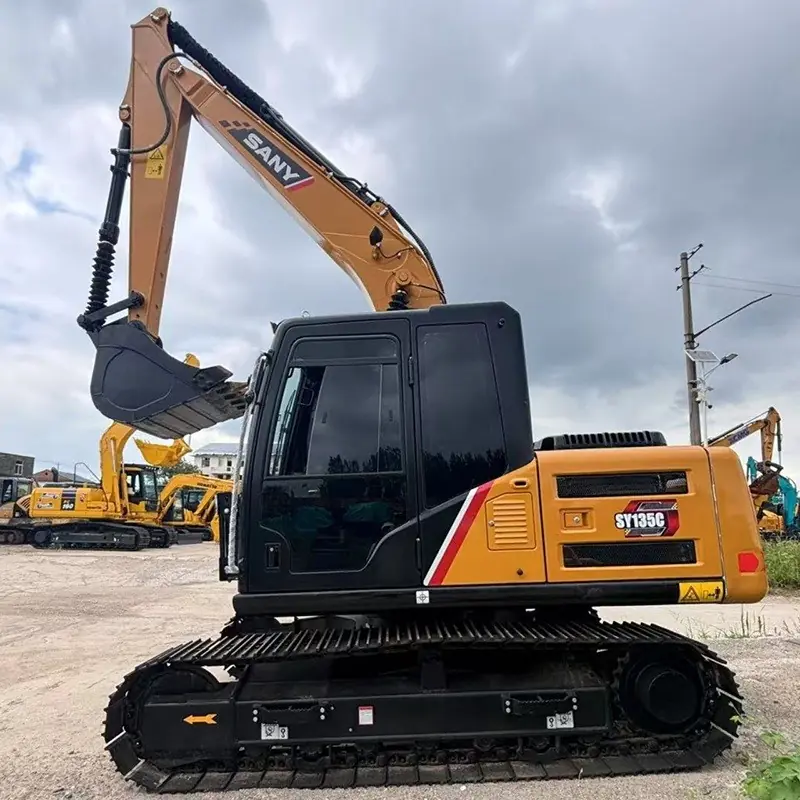
Excavatrice d'occasion SANY SY135C à vendre
Réponse rapide pour les acheteurs
Cette excavatrice d'occasion SANY SY135C est une machine sur chenilles destinée au terrassement et aux travaux généraux. La fiche indique un prix de USD $16,000, un poids de référence de 13.5t et un godet de 0.60m3. Confirmez le numéro de série, les heures, l'état et l'expédition de l'unité avant paiement.
- Prix affiché
- USD $16,000
- Poids opérationnel de référence
- 13.5t
- Capacité de godet de référence
- 0.60m3
Présentation du modèle
Cette excavatrice d'occasion SANY SY135C est une machine sur chenilles destinée au terrassement et aux travaux généraux. La fiche indique un prix de USD $16,000, un poids de référence de 13.5t et un godet de 0.60m3. Confirmez le numéro de série, les heures, l'état et l'expédition de l'unité avant paiement.
Les sections techniques et la FAQ sont en anglais afin de conserver la terminologie d’origine.
The Operational Approach: Verifying Every Unit Individually
This used SANY SY135C excavator is a mid-size 13.5-ton excavation platform, and this guide focuses on the operational verification methodology needed to convert generic catalog data into confirmed, unit-specific procurement evidence. The most important insight for international buyers considering this used SANY SY135C excavator is that catalog specifications, brand reputation, and generic market pricing tell you almost nothing about the actual condition, capability, or fair value of any specific unit on offer. Every physical machine has its own serial identity, its own operational history, its own accumulated wear profile, and its own configuration nuances that make it unique. Our procurement approach at our Shanghai facility is built entirely around this unit-specific reality. Rather than selling you a generalized promise of what the model class typically delivers, we deliver a documented verification file for the exact machine you are considering. In the modern era of AI-driven procurement research and Answer Engine Optimization (AEO), buyers increasingly demand this level of specificity because algorithmic tools can easily identify vague marketing claims. Our comprehensive documented audit protocol produces the granular, serial-linked evidence that experienced fleet managers and their AI research systems require to make confident capital allocation decisions. This methodology applies equally to Chinese-brand and premium international platforms, giving you the same evidence-based procurement confidence regardless of the manufacturer of the equipment you select.
The Serial Plate Rule: One Number Anchors Everything
Every specification, image, video, and quotation must be linked to the exact serial number of the offered unit to constitute defensible procurement evidence. The single most valuable procurement discipline in used heavy machinery is the serial plate authority principle. In practical terms, this means that a specification is only meaningful when it can be traced to a specific serial-numbered machine. A catalog data sheet describing 13.5 tons of operating weight and a 0.60 cubic meter bucket capacity is a starting point for shortlisting candidates, but it is not evidence about any particular machine you might purchase. When our audit team documents a candidate unit, we begin with a legible photograph of the manufacturer's serial plate, then verify that every subsequent document, photograph, video, and specification claim references that same serial number. This creates a defensible evidence chain that protects buyers against the common industry practice of mixing images and specifications from multiple machines to create favorable-looking listings. The chain of custody from serial identity through operational verification is what separates evidence-based procurement from wishful marketing, and it is a discipline every professional buyer should demand from every supplier they consider engaging.
The Remote Video Audit: What Continuous Operation Reveals
A continuous cold-to-warm operation video linked to the serial plate provides more procurement confidence than any written condition report. Since most international buyers cannot physically travel to Shanghai to inspect candidate machines, remote video audit has become the primary verification tool. However, not all video evidence is equally useful. A short clip showing the machine at operating temperature tells you almost nothing about long-term condition. A continuous video sequence showing cold-start behavior, gradual warm-up progression, and combined hydraulic function testing at operating temperature reveals genuine mechanical health. Our video audit protocol begins with a wide shot of the serial plate to establish identity, then follows the machine through complete cold-start, gauge monitoring during warm-up, combined hydraulic function testing including boom raise with simultaneous stick curl and swing, undercarriage travel forward and reverse with both track motors, and finally a close-up walk-around documenting structural condition, hydraulic seepage points, and undercarriage wear. This complete evidence package typically runs 45 to 90 minutes and gives buyers unprecedented visibility into actual machine condition before commitment.
Measurement Beats Description: Quantifying Wear Accurately
Quantitative wear measurements produce defensible pricing decisions where descriptive adjectives create dispute risk. The traditional heavy equipment industry has long relied on descriptive condition adjectives like good, excellent, fair, or acceptable to characterize machine condition. These terms create significant procurement risk because they mean different things to different observers and provide no defensible basis for pricing negotiations. Our audit methodology replaces subjective adjectives with quantitative measurements wherever technically possible. Track link pitch is measured with calipers rather than described. Roller diameter is measured with a specialized gauge and compared to factory specifications to produce a specific remaining-life percentage. Bucket pin bore ovality is measured and documented rather than characterized. Hydraulic pump flow rates are tested and reported in liters per minute at specific operating temperatures. This quantitative approach transforms procurement discussions because both buyer and seller can reference the same measurable evidence rather than debating whose subjective impression is more accurate. It also creates a documentary basis for post-purchase warranty discussions if any condition claims are later disputed, providing legal protection that descriptive language cannot deliver.
The Hour Meter Question: Numbers Without Context Mislead
Hour meter readings are useful for shortlisting but must be interpreted through service records and physical wear evidence before final pricing. Hour meter readings are among the most commonly cited but poorly understood pieces of used equipment data. A reading of 5000 hours on a working meter tells you almost nothing without context: was the machine operated in gentle utility work or continuous quarry production, was it maintained by trained technicians or by unskilled operators, has the meter been running continuously since manufacture or has it been replaced or reset at some point in its history. Our audit approach treats hour meter readings as one data point among many rather than as clear reference evidence. We look for corroborating evidence in the form of maintenance records, technician logbooks, and most importantly the physical wear condition of the machine itself. Physical wear evidence is difficult to falsify: rocker arm wear patterns, pump housing marks, cabin interior condition, control lever wear, and undercarriage wear percentages all combine to tell the true story of how the machine has actually been used. When physical evidence conflicts with hour meter readings, we investigate and document the discrepancy transparently rather than allowing potentially misleading numbers to shape purchase decisions.
The Adjacent Class Decision: Comparing 13.5 Tons to 12.5 and 15.5
Sound procurement requires comparing this weight class against adjacent alternatives using project-specific requirements rather than generic brand preferences. One of the most common procurement mistakes is selecting a weight class based on habit or price alone rather than based on rigorous project-fit analysis. This 13.5-ton platform sits in an interesting position within the mid-size hierarchy: heavier and more capable than 12.5-ton alternatives, but lighter and more mobile than 15.5-ton machines. The optimal choice depends on your specific project mix. For contractors with substantial urban utility work, the 12.5-ton class offers better transportability and lower ownership cost while sacrificing some production capability. For contractors with heavier foundation work or larger civil projects, the 15.5-ton class delivers stronger production at the cost of higher transport complexity and operational overhead. This 13.5-ton class often wins the versatility argument for contractors whose project mix genuinely spans both worlds. Our procurement advisory team can help you model your specific project distribution against these three adjacent weight classes to identify which platform delivers optimal capital return for your operational profile, converting an intuitive choice into a data-driven decision.
Structural Repair Detection: Reading the Hidden Story
Unauthorized structural repairs are among the highest procurement risks and require specific inspection techniques to detect reliably. Structural repair history is one of the most important yet most easily concealed factors in used heavy equipment condition. A machine that has had its boom, arm, or main frame repaired without proper certification carries substantially elevated failure risk that can lead to catastrophic on-site incidents. Our audit protocol includes specific techniques for detecting concealed structural repair evidence. Paint layer analysis using digital thickness gauges can reveal areas where filler material has been used to hide weld repairs. Ultrasonic testing on critical structural weldments detects micro-fractures that visual inspection alone cannot identify. Close inspection of paint transitions on structural components often reveals where original manufacturer coatings have been overpainted to conceal repair evidence. Any indications of unauthorized structural repair are documented photographically and disclosed to potential buyers, allowing them to factor structural risk into pricing decisions or to select alternative candidate units. This transparency approach eliminates one of the largest hidden risks in the international used equipment trade.
Attachment Verification: What Actually Ships With the Machine
Every attachment claim must be photographed on the actual candidate machine to prevent post-purchase disappointment. One of the most frustrating post-purchase surprises for international buyers is discovering that attachments described in the sales listing were not actually included with the delivered machine, or were substituted with lower-quality alternatives during pre-shipment preparation. Our audit protocol requires that every attachment claim be photographed on the actual candidate machine, with the serial plate visible in a corner of the frame to establish clear identity linkage. If a machine is described as including a hydraulic thumb, quick coupler, or specific bucket configuration, our documentation shows that attachment physically installed on the machine being sold. Auxiliary hydraulic lines are photographed and their working pressure verified rather than merely claimed. This verification discipline prevents the substitution problem entirely because the specific attachments shown in the audit file must match what actually ships in the container or on the vessel. For buyers, this eliminates the common industry practice of using generic attachment photos that may or may not match the specific machine being purchased.
The Pricing Framework: Converting Condition to Currency
Fair unit pricing requires systematic conversion of condition observations into monetary adjustments rather than negotiation from arbitrary starting figures. Traditional used equipment pricing often begins with an arbitrary asking price and proceeds through unstructured negotiation. This approach frequently produces outcomes that satisfy neither buyer nor seller because neither party can articulate why the final number is fair. Our pricing methodology takes a different approach entirely. We begin by establishing a reference range for the model class based on current international market comparables. We then apply systematic adjustments based on the specific condition evidence documented in our documented audit: undercarriage wear percentage translates to a specific monetary adjustment, hydraulic pump condition translates to another adjustment, structural condition translates to another, and so forth. The final asking price is the sum of these documented adjustments applied to the market reference range, and the complete calculation is available to prospective buyers on request. This transparent methodology transforms pricing negotiations from adversarial haggling into collaborative discussion about specific technical evidence, and it produces final pricing that both parties can defend as commercially fair based on documented facts.
Post-Delivery Support: The Ownership Journey Beyond Purchase
Comprehensive post-delivery support determines whether procurement value survives the transition from purchase to productive operation. The procurement decision does not end at payment or even at delivery. The true test of procurement success is whether the machine transitions smoothly from shipping crate to productive operation and delivers the expected productivity across its remaining service life. Our post-delivery support framework begins with detailed reassembly instructions if the machine was partly dismantled for shipping. We coordinate with the manufacturer's regional dealer network to establish parts supply channels before the machine even arrives at destination. We provide remote technical consultation for the first-year operational period, connecting your local mechanics with our audit team when questions arise. For markets where the manufacturer's local presence is thin, we can source and pre-position first-year maintenance kits including filters, seals, and common wear items. This continuous support relationship transforms the transaction from a one-time equipment sale into a long-term partnership focused on your operational success, and it is why professional fleet managers consistently choose our export service for their capital equipment acquisitions.
SANY SY135C buyer FAQ
Why is serial number verification so critical for used equipment procurement?
The serial number is the only unique identifier that ties specifications, condition evidence, and pricing to a specific physical machine. Without serial-linked documentation, buyers have no defensible basis to verify that what they are purchasing matches what they were shown during the sales process.
How long should a proper remote video audit last?
A complete audit video typically runs 45 to 90 minutes, covering serial plate identity, cold-start behavior, warm-up progression, combined hydraulic function testing, undercarriage travel verification, and close-up structural condition documentation. Shorter videos leave critical questions unanswered.
What quantitative measurements should be included in the audit report?
Track link pitch, roller diameter remaining life percentage, bucket pin bore ovality, hydraulic pump flow at operating temperature, engine compression readings across all cylinders, and swing bearing radial play measurements are among the most valuable quantitative data points.
How do you detect concealed structural repairs on used machines?
Paint thickness gauges reveal areas where filler material has been used to hide weld repairs. Ultrasonic testing detects micro-fractures invisible to visual inspection. Careful examination of paint transitions and coating patterns often reveals overpainting used to conceal repair evidence.
What ports do you commonly ship this class of equipment to?
Regular destinations include Lagos, Mombasa, Dar es Salaam, Djibouti, Karachi, Chittagong, Ho Chi Minh City, Manila, Jakarta, Callao, Buenos Aires, and dozens of other major international ports with established container handling infrastructure.
Related SANY excavators
- SANY SY125C — 12.5t reference weight
- SANY SY155C — 15.5t reference weight
- SANY SY135C PRO — 13.5t reference weight
Demander les détails de la machine
Indiquez le port de destination, la quantité et vos priorités d’inspection. Nous répondrons avec les détails de la machine précise.
Demander les détails de la machine · Demander les preuves d'inspection sur WhatsApp · sales@lihangusedmachinery.com