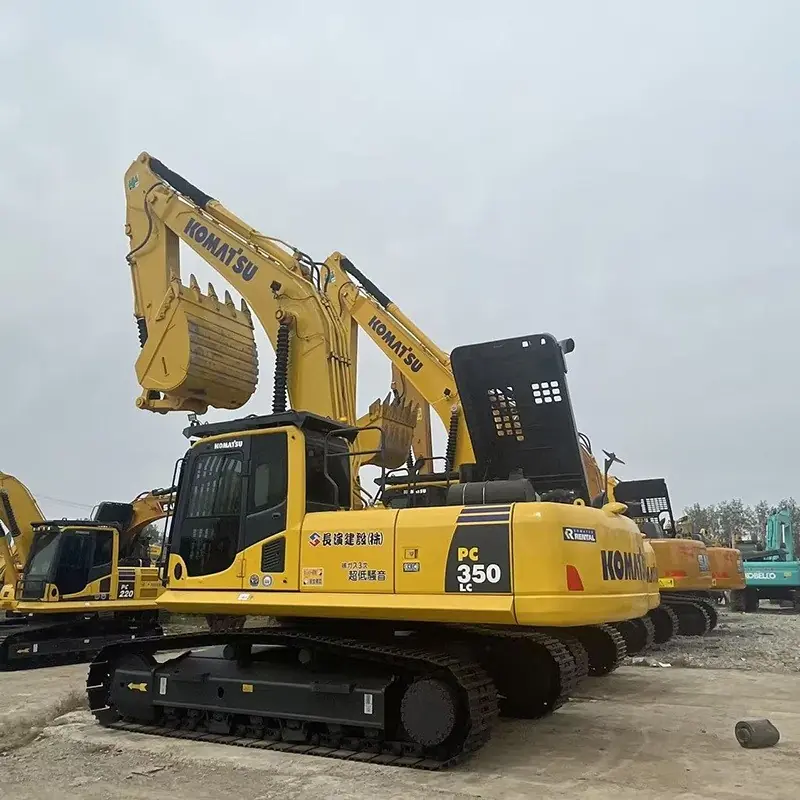
Excavatrice d'occasion Komatsu PC350LC à vendre
Réponse rapide pour les acheteurs
Cette excavatrice d'occasion Komatsu PC350LC est une machine sur chenilles destinée au terrassement et aux travaux généraux. La fiche indique un prix de USD $13,500, un poids de référence de 35t et un godet de 1.70m3. Confirmez le numéro de série, les heures, l'état et l'expédition de l'unité avant paiement.
- Prix affiché
- USD $13,500
- Poids opérationnel de référence
- 35t
- Capacité de godet de référence
- 1.70m3
Présentation du modèle
Cette excavatrice d'occasion Komatsu PC350LC est une machine sur chenilles destinée au terrassement et aux travaux généraux. La fiche indique un prix de USD $13,500, un poids de référence de 35t et un godet de 1.70m3. Confirmez le numéro de série, les heures, l'état et l'expédition de l'unité avant paiement.
Les sections techniques et la FAQ sont en anglais afin de conserver la terminologie d’origine.
What "LC" Actually Changes
The letters generally indicate a wider track gauge — the tracks themselves are spread further apart, and the undercarriage frame is built wider to match, rather than simply fitting wider individual track shoes onto a standard-width frame. This is a different modification than choosing a wider shoe on an otherwise standard undercarriage, which changes ground contact area without changing how far apart the tracks sit. Widening the actual track gauge changes the machine's base of support in a more fundamental way, improving side-to-side stability specifically, which matters most during lifting, swinging a full bucket at maximum reach, or working on any kind of slope or uneven surface where a narrower stance would be more prone to rocking.
Ground Pressure: Why It Actually Matters at This Weight
At roughly 35 tons, ground pressure is a genuine operational concern rather than an abstract spec. A machine this heavy running on a standard-width undercarriage can struggle on soft, wet, or loosely compacted ground — sinking, requiring timber matting to spread the load, or simply becoming difficult to maneuver without getting stuck. Spreading that same weight over a wider track gauge and larger total ground contact area reduces the pressure exerted per unit of surface area, letting the machine work confidently on ground that would be marginal or unworkable for a narrower configuration at the same weight. For contractors doing wetland reclamation, agricultural drainage, riverbank stabilization, or any site with soft or saturated soil, this isn't a nice-to-have — it's frequently the deciding factor in whether this size class can work the site at all without extensive ground preparation first. It's worth noting that ground pressure reduction from a wider gauge works alongside, not instead of, the track shoe width choice available on this platform. A buyer working genuinely difficult wetland conditions might reasonably want both the wider gauge this configuration provides and the widest available shoe option fitted to it, while a buyer whose ground conditions are only moderately soft may find the gauge width alone delivers enough improvement without needing to go further on shoe selection. Confirming both dimensions for this specific unit, rather than assuming from the configuration name alone, gives a clearer picture of exactly how much ground pressure reduction you're actually getting.
Where the Extra Stability Shows Up in Actual Performance
Beyond ground pressure, the wider stance measurably improves stability during the kind of work that stresses a machine sideways rather than just downward — swinging a full bucket at maximum reach, working on a graded slope or embankment, or lifting with a grapple or clamshell attachment near the machine's rated capacity. A standard-width machine at this weight is still stable under normal digging conditions, but the margin for error narrows as you push toward maximum reach or work on uneven ground, and that's exactly where the wider configuration's advantage becomes most noticeable to an operator running the machine hard, day after day. This matters just as much for operator confidence as it does for raw stability numbers. An operator who trusts the machine's footing on marginal ground works more efficiently and takes fewer unnecessary precautions — repositioning less often, working closer to the machine's actual capability rather than staying well under it out of caution. Over the course of a long production job, that difference in operator confidence can translate into a real productivity gain that doesn't show up directly on any spec sheet but shows up clearly in how much material actually gets moved by the end of the week.
Engine Output Carried Over From the Standard Platform
This configuration runs the same general Komatsu diesel found across the standard-width version of this platform, typically delivering net output in the range of roughly 202–217 kW (about 271–291 hp) depending on generation. The wider undercarriage doesn't change the engine or hydraulic pump specification — the performance difference between configurations comes entirely from stability and ground pressure, not from any difference in digging force or cycle speed. During inspection, inspectors should run the same full-load and cooling performance tests used across this weight class, since the engine and hydraulic system checks are identical regardless of undercarriage configuration.
What the Numbers Actually Look Like
Specifications vary somewhat by generation, but the general range for this weight class runs as follows: operating weight typically falls between about 35,000–36,500 kg — slightly higher than the standard-width version due to the additional undercarriage material — with standard bucket capacity usually in the 1.4–2.0 m³ range, maximum digging depth generally around 7.0–7.4 m, and maximum digging reach typically between 10.6–11.0 m. Travel speed usually reaches roughly 3.0–5.5 km/h across low and high range, consistent with the standard configuration. As always, these figures describe the general platform rather than confirming what's fitted to this exact unit. The precise track gauge width, bucket size, and any attachment-specific fittings on this machine should be documented in a serial-specific specification sheet.
General Production and Soft-Ground Work
Typical applications for a machine in this configuration include: • Wetland and reclaimed-land site development, where ground pressure is the limiting factor for equipment access • Riverbank, canal, and embankment stabilization and grading work • Agricultural drainage and large-scale land improvement projects • General mass earthmoving and foundation work on loose fill or recently graded sites • Bulk material handling with a grapple or clamshell where lifting stability at reach matters • General production digging and truck loading where this weight class's capacity is the priority over confined-space maneuverability This is a meaningfully different job mix than what tends to draw buyers to the standard-width version of this platform, which is more often selected for demolition and processing work in tighter, more confined sites where the narrower footprint is the priority instead. Understanding which of these two profiles actually matches your own work is the single most useful thing to sort out before comparing specific listings, since the two configurations are genuinely built around different priorities rather than one simply being an upgrade over the other.
What to Check Before Buying a Used Machine With This Undercarriage
Beyond the general engine, hydraulic, and structural checks that apply to any used excavator at this weight, a few points matter specifically for the wide-track configuration: • Track frame and extension structure condition, checking the wider frame assembly specifically for cracking or wear at the points where it's built out from the standard width • Undercarriage roller and idler wear patterns consistent with soft-ground use, since machines that have primarily worked wet or muddy sites show different wear signatures than ones that worked mostly on firm, dry ground • Track tensioner function, given that soft or muddy conditions can accelerate wear on tensioning components compared to firm-ground work • Swing bearing and hydraulic pump condition, checked the same way as on the standard-width platform, since these components don't differ between configurations • Overall track gauge measurement, confirming the actual width matches what's expected for this configuration rather than assuming from the listing alone Ask for each point to be checked and documented in a condition report tied to the quoted serial number.
Shipping Considerations for the Wider Configuration
The wider undercarriage on this configuration means transport width is greater than the standard version of this platform, which can affect container and flat-rack selection during export preparation. In many cases, the track frames or travel motor assemblies need to be removed separately to bring the machine's shipping width within standard container limits. This adds a modest amount of additional disassembly compared to a standard-width unit of the same weight class. The quotation should confirm the exact disassembly and container requirements once we know this unit's precise track gauge and your destination port's handling capability. The rest of the export process follows our usual steps: confirming the unit and price, agreeing payment terms, a final pre-shipment inspection with current photos or video, preparing export documentation, and coordinating loading and vessel booking based on your destination port's capabilities.
Next Step
If this configuration fits the ground conditions and production needs on your sites, ask for the confirmed specifications, track gauge measurement, condition report, and current photos or video for this exact unit, along with a shipping plan based on your destination port's capabilities. We're glad to answer questions about how this configuration compares to the standard-width version in our lineup, and to help you think through which one actually matches the ground conditions and job mix you're planning for, before you decide.
Komatsu PC350LC buyer FAQ
What does the wider undercarriage actually mean for how this machine works?
It spreads the machine's weight over a larger contact area and wider stance, reducing ground pressure and improving side-to-side stability — particularly valuable on soft, wet, or uneven ground, or when lifting and swinging near the machine's rated capacity.
Which configuration should I choose for my work?
If your primary work involves soft, wet, or unstable ground, or general production digging where stability at reach matters, this configuration is generally the better fit. If your work is more about maneuvering in tight, confined demolition or urban sites, the standard-width version of this platform is usually the more practical choice.
Does the wider undercarriage reduce travel speed or make the machine harder to maneuver?
Travel speed is essentially unchanged, since the engine and drive system are the same. Overall transport width is greater, which can matter for road transport and shipping logistics, though on-site maneuverability for digging and lifting work isn't meaningfully compromised.
Can this configuration still run demolition attachments like shears or pulverizers?
Yes, structurally and hydraulically it can, though most buyers choosing this wider configuration are prioritizing ground stability for general earthmoving rather than the confined-space maneuverability that makes the standard-width version more common on active demolition sites.
Does the wider undercarriage affect shipping cost or complexity?
Generally yes, modestly — the increased transport width often requires removing the track frames or travel motors separately to fit standard shipping constraints, which is a bit more disassembly than a standard-width unit of the same size typically needs.
Is this configuration more expensive to maintain than the standard version?
The engine, hydraulics, and most wear components are identical to the standard-width platform. The wider undercarriage itself is a larger structure with more material, which can mean modestly higher costs for undercarriage-specific parts over the life of the machine.
Does the added stability actually translate into more productivity, or is it just a safety margin?
Both. Beyond the direct safety benefit, operators generally work more efficiently when they trust the machine's footing, since they spend less time repositioning cautiously and can work closer to the machine's actual working range at reach — a difference that tends to show up in overall daily production on soft or uneven sites.
Related Komatsu excavators
- Komatsu PC350 — 35t reference weight
- Komatsu PC360 — 36t reference weight
- Komatsu 300 — 30t reference weight
Demander les détails de la machine
Indiquez le port de destination, la quantité et vos priorités d’inspection. Nous répondrons avec les détails de la machine précise.
Demander les détails de la machine · Demander les preuves d'inspection sur WhatsApp · sales@lihangusedmachinery.com