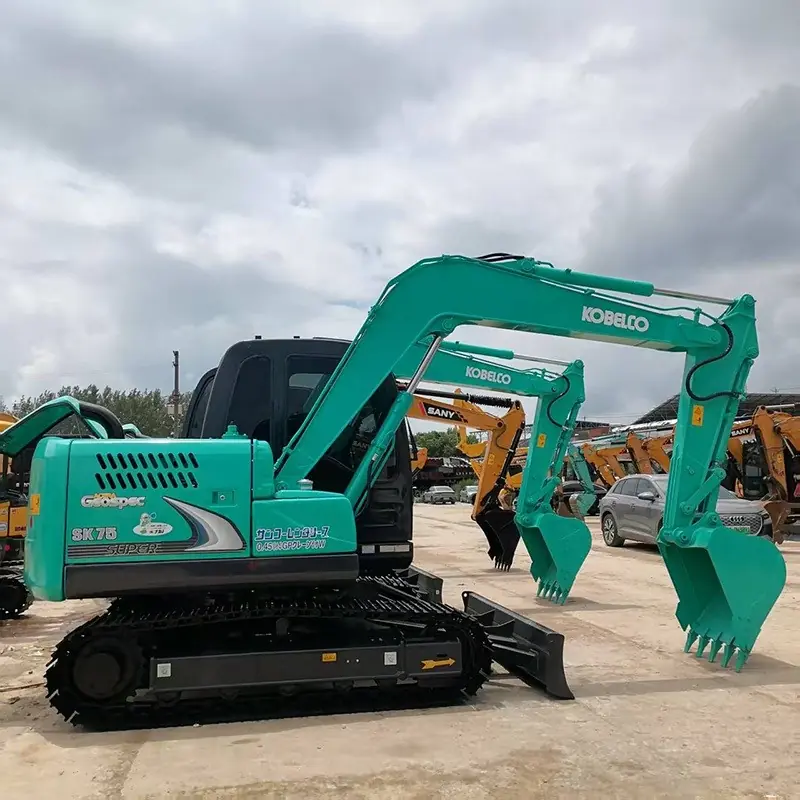
Excavatrice d'occasion Kobelco Sk75 à vendre
Réponse rapide pour les acheteurs
Cette excavatrice d'occasion Kobelco Sk75 est une machine sur chenilles destinée au terrassement et aux travaux généraux. La fiche indique un prix de USD $13,500, un poids de référence de 7.5t et un godet de 0.3m3. Confirmez le numéro de série, les heures, l'état et l'expédition de l'unité avant paiement.
- Prix affiché
- USD $13,500
- Poids opérationnel de référence
- 7.5t
- Capacité de godet de référence
- 0.3m3
Présentation du modèle
Cette excavatrice d'occasion Kobelco Sk75 est une machine sur chenilles destinée au terrassement et aux travaux généraux. La fiche indique un prix de USD $13,500, un poids de référence de 7.5t et un godet de 0.3m3. Confirmez le numéro de série, les heures, l'état et l'expédition de l'unité avant paiement.
Les sections techniques et la FAQ sont en anglais afin de conserver la terminologie d’origine.
Why this size is common in mixed contractor and rental work
The class can cover trenching, grading, landscaping and attachment tasks while remaining easier to mobilize than a full-size production excavator. A versatile carrier earns its place by moving between different work cycles rather than by being optimized for one maximum-output task. Utility crews may excavate, manage spoil and backfill. Landscapers may grade, handle material and prepare drainage. General contractors may use the machine for foundations, site cleanup or confined portions of a larger project. That variety also means two examples with similar hours can have very different histories. One may have spent steady shifts with a grading bucket; another may have changed operators and attachments frequently. Begin the buying process with the buyer's routine jobs, not the longest list of possible applications. Record access, digging range, attachment demand, surface conditions and transport frequency. Then ask whether the actual machine and its evidence support those needs without operating close to its limit for most of the day.
How to assess possible rental or multi-operator history
Fleet history should lead to better questions about records, controls, coupler use and attachment circuits—not an automatic conclusion about condition. A professionally managed fleet may follow scheduled service intervals and retain useful work orders, while a machine exposed to many operators may show accelerated wear at controls, access panels, couplers, pins and work-tool circuits. Neither pattern can be assumed from paint or a seller's description. Ask whether prior ownership is known and request records that identify the same serial number. Look for dates, meter entries, parts replaced and recurring repairs rather than accepting a generic maintenance statement. Compare those records with filter markings, fluid condition, cab wear and current operation. If fleet history is unknown, classify it as unknown instead of inventing a single-owner or rental narrative. The decision should rest on present condition and supported history. A well-used unit with coherent service evidence can be a stronger purchase than a cleaner-looking machine with missing identity and maintenance information.
Interpret the listed 7.5t weight and 0.3m3 bucket
The website figures are model-level references; actual mass, bucket and working dimensions depend on the serial-numbered build and installed equipment. Track type, cab, arm, blade, coupler, bucket, auxiliary plumbing, guarding and other options can move operating weight away from the catalog number. Bucket capacity should be considered together with width, material density, fill factor and carrier stability. Obtain an identification-plate photograph, full configuration images and measurements of transport length, width and height. Confirm what attachment is included and whether its markings or dimensions support the stated capacity. When digging depth, reach, lift or hydraulic data matters, use documentation for the correct serial range and market. Do not assemble a specification table from several marketplace listings that may describe different generations. For freight, trailer or site planning, use measured values and the chosen carrier's legal limits. This approach keeps the page useful for comparison without turning a reference number into an unsupported promise.
Connect the plate, monitor, records and offered machine
Identity evidence should show that catalog fields, service documents, current media and quotation all refer to the same unit. The year and 500 hour-meter labels are not independently verified. Ask for one continuous video beginning with the machine exterior and serial plate, moving to the monitor before start-up, and continuing into operation. Compare the meter with wear on the seat, levers, pedals, door or canopy access, blade linkage, bucket pins, coupler and undercarriage. Review service records when available, but confirm that serial numbers and meter progression are coherent. Digital fleet reports can add context only when they can be linked to the same identity. A safety or inspection sticker from another market may be a historical clue; it is not proof of current condition or destination compliance. Put confirmed identity and configuration in the quotation. Keep unsupported claims and remaining questions visible so they can be resolved before payment rather than absorbed into marketing language.
Read maintenance records for decisions, not decoration
Useful service evidence shows dates, hours, work performed and parts used in a sequence that can be compared with present condition. A folder of invoices is valuable only when it identifies the machine and forms a plausible history. Arrange records by meter reading and look for routine oil and filter service, cooling-system work, hydraulic repairs, track or roller replacement, pin and bushing attention and repeated fault complaints. A gap does not prove neglect, but it should affect confidence and the inspection scope. Check whether claimed recent work is visible: new hoses should match the stated location, replaced track parts should show compatible wear, and a service date should align with the current meter. Ask who performed major repairs and whether supporting measurements exist. When records are unavailable, price the unit based on current evidence and a conservative commissioning plan. Do not advertise “full service history” unless the documentation is genuinely complete and tied to the exact serial number.
Cold-start and variable-use engine checks
A cold-to-warm demonstration helps reveal starting, smoke, cooling and response behavior that a polished walkaround cannot show. Request a recording before the engine has been started that day. Show warning lamps and monitor, cranking duration, initial exhaust, idle quality and gradual acceleration. Continue while the machine performs hydraulic work so temperature and response can be observed under realistic load. Inspect oil and coolant where safe, visible leaks, wiring, intake, belts, radiator and cooler cleanliness. Different operators may use idle and power modes differently, making cooling cleanliness and consistent response important. Engine model and rated power can vary across generation and market; identify the installed engine from the plate and appropriate literature. A remote video supports screening but does not replace fault-code analysis, fluid sampling or measurements when symptoms warrant them. Avoid promises such as original engine or no repair needed unless the inspection evidence actually supports the exact statement.
Coupler, attachment and auxiliary-circuit wear
Frequent tool changes can concentrate wear at coupler pins, locking components, hydraulic connections and the boom-end linkage. Identify the coupler brand or pattern and photograph its hooks, pins, locking mechanism, hoses and controls. Test engagement using the manufacturer's procedure and appropriate safety controls; never rely on a visual latch assumption. Measure movement at the bucket and linkage under controlled conditions and separate coupler play from pin-and-bushing wear. Ask which attachments were previously used and inspect auxiliary lines, connectors and controls for leakage, impact or improvised modification. For a planned breaker, auger, compactor or grapple, match carrier flow, pressure, circuit direction, return, case drain, coupler geometry and attachment mass. Regional attachment standards are not universal, so existing tools should be measured before assuming compatibility. Include every supplied bucket or tool in the quotation and condition record. The value of an attachment package depends on condition and fit, not simply the number of items.
Warm hydraulics, pin joints and repaired structure
Observe the full machine after warm-up and inspect high-use joints and steel independently from exterior presentation. Demonstrate travel, swing, boom, arm, bucket and blade, then combine functions to simulate a digging cycle. Note delay, drift, chatter, unusual noise, weak response and leaks as temperature increases. Examine cylinder rods and seals, hose crimps, valve areas, swivel region and exposed lines. Check boom-foot, arm, bucket and blade pins under load. Review the boom, arm, upper frame and lower frame for cracks, distortion, reinforcement plates and welds. Rental fleets and contractors may repaint for presentation or corrosion control; paint alone neither proves concealment nor verifies condition. Ask about known repairs and request close images before and after cleaning where practical. A qualified inspector can perform pressure, flow or structural assessment within agreed safe limits. The buyer needs an evidence-based repair outlook, not a binary label such as good or bad condition.
Undercarriage wear and surface-use clues
Measure both sides of the running gear because pavement, slopes, turning habits and operator variation can create expensive uneven wear. Photographs should show tracks, sprockets, idlers, rollers, guards and final-drive areas on both sides. Observe straight travel, steering, speed changes and unusual noise. Rubber tracks need inspection for cuts, chunking and exposed internal material; steel systems require component measurements using the appropriate reference. Look for side-to-side differences and for wear patterns consistent with frequent counter-rotation on hard surfaces. Check oil leakage around final drives and ask about prior replacement when components look significantly newer than surrounding parts. Remaining-life percentages should be accompanied by measurements and method. Undercarriage condition influences purchase price, downtime planning and the cost of moving the machine onto its first project. It should be assessed before cosmetic appearance or a low meter figure is allowed to dominate the buying decision.
Operator environment and safety-history review
Controls, access equipment and protective structures should be checked for current functionality, regardless of any old inspection sticker or rental label. Review the seat and restraint, joysticks, pedals, monitor, horn, lights, mirrors, glass, wipers, handholds, steps and door or canopy structure. Test heating and air conditioning where fitted. Look for active warnings and compare control wear with the hour-meter story. Verify that labels and protective structures are present where required, but do not assume a certification from another country remains legally valid at destination. Lifting, roadside, demolition and breaker work may require different guarding, alarms or inspection regimes. The destination owner should confirm current requirements with qualified local sources. Ask whether keys, manuals or other operator items are included. A usable operator station supports productivity and reduces fatigue, while damaged access points or inconsistent controls can create daily risk even when the main hydraulic functions appear strong.
Value the machine, attachments and logistics together
Compare total delivered cost after adjusting for supported history, measured wear, included tools and the work required before first use. List machine price, buckets, coupler and other attachments separately. Add inspection, initial service, immediate repairs, origin haulage, dismantling or packing, loading, freight, insurance when requested, destination handling, duties and inland delivery. Use the same Incoterm and named place for competing quotations. Give maintenance history value only when documents are serial-linked and coherent. Estimate wear costs using destination parts and labor, not the seller's market. For transport, confirm actual dimensions, weight and component layout, protect hydraulic connections and photograph the machine before loading. On arrival, check serial identity, attachments and damage before commissioning. The best purchase is the unit whose evidence, expected repairs, delivered economics and local support fit the project. A low advertised price or fresh paint should not replace that analysis.
Final approval checklist for a fleet-capable compact crawler
Proceed only after job fit, identity, maintenance evidence, mechanical condition, attachment compatibility and destination support have been reviewed together. Translate planned work into access, range, lift and tool requirements. Confirm serial identity and classify hours correctly. Review maintenance records without assuming completeness. Inspect cold start, warm hydraulics, coupler, auxiliary circuit, pin joints, blade, undercarriage, structure and cab. Calculate risk-adjusted delivered cost and a commissioning budget. Confirm access to technicians, routine service parts, track components and compatible attachments at destination. Write down every unknown and decide whether it requires evidence, inspection, price allowance or rejection. This framework works whether the machine came from a rental fleet, a contractor or an unknown owner because it separates the story surrounding the unit from facts that can be observed and supported.
Kobelco Sk75 buyer FAQ
Is a used Kobelco SK75 excavator from a rental fleet a bad purchase?
Not automatically. Fleet maintenance may be well documented, while multi-operator use may increase wear at controls, couplers and attachment circuits. Verify ownership claims, records and present condition for the exact serial-numbered unit.
What weight and bucket references are shown?
The website lists 7.5t operating weight and 0.3m3 bucket capacity as references. Actual figures vary with configuration, so confirm serial-specific information, the fitted bucket and measured shipping values.
Are and 500 hours verified?
No. They are catalog labels until plate, monitor, continuous video, wear evidence and available serial-linked records support them. Keep them separate from confirmed unit facts in the purchase file.
Does repainting mean damage is hidden?
Not necessarily. Fleets and contractors may repaint for presentation or corrosion control. Fresh paint should lead to a careful structural and repair-history review, not an automatic conclusion in either direction.
How do I confirm attachment compatibility?
Identify and measure the coupler or pin arrangement, then match hydraulic flow, pressure, direction, return, case drain and attachment mass to the serial-specific carrier data and work-tool requirements.
What maintenance records are useful?
Useful records identify the serial number, date, meter reading, work completed and parts used. Look for a coherent progression and compare claimed repairs with current components and condition.
What should be included in the price comparison?
Include machine, tools, inspection, service, repairs, origin haulage, packing, loading, freight, insurance when requested, destination handling, duties and delivery under the same Incoterm and named place.
Can an independent inspection be arranged?
An inspection may be arranged when the parties agree on access, inspector, scope, safe test limits, timing and costs. Its report should identify the exact machine and explain unavailable tests or evidence limitations.
Related Kobelco excavators
- Kobelco SK55SR — 5.5t reference weight
- Kobelco SK60 — 6t reference weight
- Kobelco SK70SR — 7t reference weight
Demander les détails de la machine
Indiquez le port de destination, la quantité et vos priorités d’inspection. Nous répondrons avec les détails de la machine précise.
Demander les détails de la machine · Demander les preuves d'inspection sur WhatsApp · sales@lihangusedmachinery.com