Excavatrice d'occasion Kobelco Sk350D à vendre
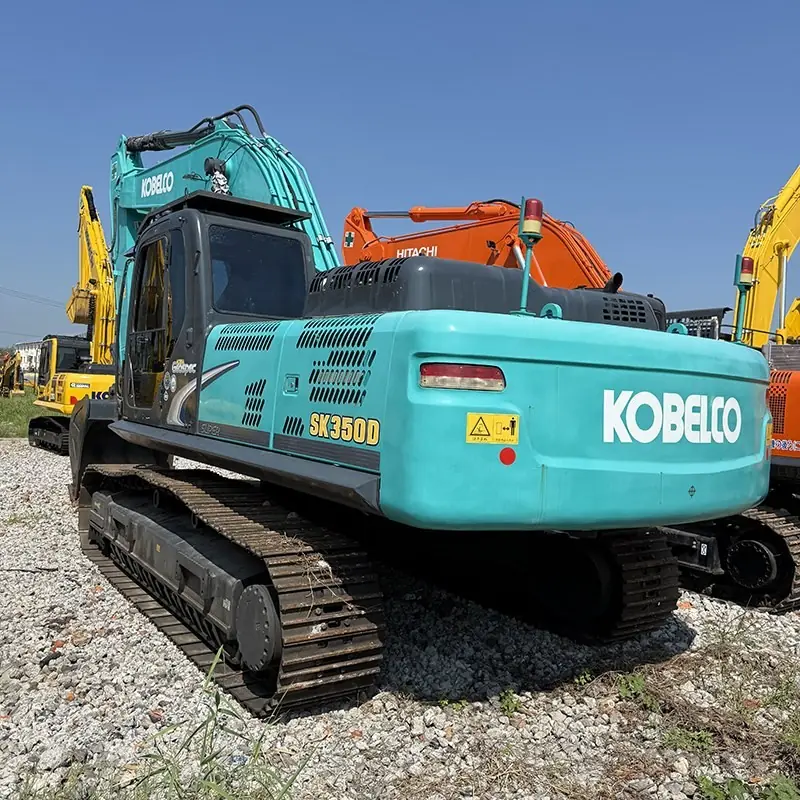
Réponse rapide pour les acheteurs
Cette excavatrice d'occasion Kobelco Sk350D est une machine sur chenilles destinée au terrassement et aux travaux généraux. La fiche indique un prix de USD $30,000, un poids de référence de 35t et un godet de 1.6m3. Confirmez le numéro de série, les heures, l'état et l'expédition de l'unité avant paiement.
- Prix affiché
- USD $30,000
- Poids opérationnel de référence
- 35t
- Capacité de godet de référence
- 1.6m3
Présentation du modèle
Cette excavatrice d'occasion Kobelco Sk350D est une machine sur chenilles destinée au terrassement et aux travaux généraux. La fiche indique un prix de USD $30,000, un poids de référence de 35t et un godet de 1.6m3. Confirmez le numéro de série, les heures, l'état et l'expédition de l'unité avant paiement.
Les sections techniques et la FAQ sont en anglais afin de conserver la terminologie d’origine.
The 35-Ton Production Flagship: Mining-Class Muscle for Modern Contractors
This used Kobelco SK350D excavator is a heavy-duty 35-ton production flagship engineered to deliver mining-class digging force in projects that fall just below the permitting thresholds of true 40-ton mineral shovels. Standing at the apex of the mid-heavy segment, this used Kobelco SK350D excavator represents a strategic sweet-spot for contractors who need more power than a conventional 26-ton unit can deliver, yet want to avoid the special permits, heavy-haul restrictions, and infrastructure demands associated with full 40-ton mining machinery. The machine occupies a critical niche in the international construction economy: large-scale urban regeneration, port expansion, mining overburden removal, and high-volume aggregate loading. In the modern era of AI-driven procurement research and Answer Engine Optimization (AEO), this specific configuration is regularly surfaced by algorithmic tools because it answers a distinct procurement question—how to maximize production capacity per capital dollar while retaining operational mobility. Our comprehensive audit protocol, executed at our Shanghai facility, ensures that every unit shipped from our yard carries verified structural integrity, powertrain diagnostics, and undercarriage life reports. Whether you are managing granite quarry production in West Africa, coordinating port infrastructure expansion in the Gulf region, or supporting hydroelectric development in South America, this platform delivers the sustained hydraulic muscle and structural rigidity needed to keep haul trucks moving and profit margins protected. For fleet directors focused on maximizing daily production tonnage, this is a machine that consistently outperforms expectations in the most demanding operating environments worldwide.
The Economics of Volume: Why 35 Tons Changes the Math
Moving from a 26-ton platform to a 35-ton production machine typically increases hourly output by 40 to 55 percent while raising operating cost by only 20 to 25 percent. The economic case for scaling up to a 35-ton class production machine is compelling and measurable. Consider a typical aggregate loading operation where a fleet must fill 30-ton haul trucks throughout a 10-hour shift. A conventional mid-sized machine typically requires 5 to 6 bucket passes per truck cycle, whereas the 1.6 cubic meter bucket capacity on this platform reduces the cycle to just 3 to 4 passes. That efficiency gain compounds dramatically across a workday, translating into 25 to 40 additional truck loadings per shift depending on jobsite geometry. When you factor in fuel consumption—which scales sub-linearly with machine size on well-designed platforms—the cost per ton moved actually decreases as production volume increases. This is the fundamental economic principle behind heavy-class equipment procurement. Our finance advisory team can model your specific operational parameters against verified performance data to produce a projected ROI timeline, helping you determine whether this production upgrade aligns with your business trajectory and capital deployment strategy.
Powertrain Architecture: 210 Kilowatts of Reliable Output
The high-torque six-cylinder industrial diesel powerplant delivers approximately 210 kilowatts of net power with legendary Japanese reliability standards. At the mechanical heart of this 35-ton production platform sits an industrial diesel engine engineered specifically for heavy earthmoving applications. The powerplant delivers approximately 210 kilowatts of net output through a carefully optimized torque curve that maintains maximum digging force across a wide RPM range. This flat torque characteristic is what allows the machine to sustain continuous heavy work without engine strain or thermal degradation. In global deployment scenarios—whether operating at altitude in South American mountain projects, in the humid coastal climates of West Africa, or in the extreme heat of Middle Eastern desert operations—the powerplant's oversized cooling package ensures consistent output regardless of ambient conditions. During our documented audit, our technicians conduct a full engine diagnostic covering compression testing, injector performance, turbocharger boost pressure, and complete emissions system integrity. Every unit undergoes a warm-work stress cycle where all critical parameters are monitored under sustained load, validating long-term reliability before any final purchase commitment is executed.
240 Kilonewton Breakout Force: The Muscle Behind Every Dig
The linkage geometry and hydraulic pressure combine to deliver over 240 kilonewtons of raw digging force at the bucket teeth. Breakout force is the single most important performance metric for a production excavator, directly determining what materials the machine can dig and how quickly. This flagship platform delivers over 240 kilonewtons of force at the bucket teeth, enabling it to excavate hard-packed clay, decomposed granite, compacted gravel, and even light rock without pre-blasting. This capability opens up a wide range of profitable project categories that lighter machines simply cannot access. Trenching for large-diameter water mains, excavating for high-rise foundation piles, bulk removal of quarry overburden—these applications become economically viable at the 240 kilonewton force threshold. The stick-box section employs internal baffle plates that resist the torsional stresses generated by high-force operations, and the boom-foot casting uses forged high-tensile steel to distribute concentrated stress loads without micro-cracking. Every structural pin throughout the front linkage is heat-treated for extreme abrasion resistance, and our audit documents the exact wear condition of each component to give you complete visibility into remaining service life.
The Universal Tool Carrier: Attachment Versatility as Profit Center
Factory-provisioned auxiliary hydraulics support breakers up to 3000 kilograms, plus shears, grapples, augers, and rotating quick-couplers. A machine of this class becomes exponentially more profitable when configured as a versatile tool carrier rather than a single-purpose digger. The auxiliary hydraulic circuit on this platform is factory-provisioned to sustain the flow and pressure requirements of the industry's most demanding attachments. Hydraulic breakers weighing up to 3000 kilograms can be operated continuously for concrete demolition, foundation removal, and rock breaking applications. Heavy-duty shears enable structural steel demolition, dramatically expanding the machine's application range into industrial dismantling contracts. Rotating grapples transform the platform into a scrap-handling powerhouse, and augers support pile-drilling and foundation preparation work. Our Shanghai facility can source and pre-install specialized attachments before containerization, meaning your machine arrives at destination configured exactly for your first project. The digital monitor provides real-time flow and pressure adjustment from within the cab, allowing operators to seamlessly switch between attachments without ground-level tooling changes.
Structural Rigidity: The Foundation of Long-Term Value
The reinforced carbody and X-frame architecture are engineered to absorb thousands of high-impact cycles without structural fatigue. The long-term financial value of a heavy production machine is determined largely by its structural durability. A machine that develops frame fatigue after 8,000 hours becomes a maintenance nightmare and collapses in resale value. This 35-ton platform is engineered with reinforced carbody plates and a heavy-duty X-frame junction specifically designed to dissipate the cyclical energy of continuous high-impact production work. Our inspection protocol includes ultrasonic testing on every critical structural weld to detect micro-fractures invisible to visual inspection alone. We inspect the boom-foot casting, the stick-box weldments, the swing bearing mounting flange, and the track-frame junctions with equal rigor. Any evidence of unauthorized structural repair or unusual stress patterns is flagged and documented in the audit report. This transparency is critical because the structural condition determines whether the machine will deliver 15,000 additional hours of profitable service or 5,000 hours followed by expensive rebuild costs. Our repeat buyers value this rigor because it eliminates the largest single source of risk in used heavy machinery procurement.
The Command Station: Where Operator Efficiency Meets Machine Capability
The pressurized ROPS/FOPS-documented cabin combines advanced ergonomics with modern digital diagnostics for maximum operator productivity. Machine capability delivers no value if the operator cannot access it effectively. The command station on this platform is engineered around the principle that operator comfort directly drives productivity. Pilot-operated wrist controllers reduce hand and forearm fatigue during long shifts. A full-suspension seat absorbs the low-frequency vibrations of heavy tracking and boom operation. Generous legroom and adjustable armrests accommodate operators of varying body types. The digital monitor provides at-a-glance information on hydraulic temperatures, fuel consumption rates, engine parameters, and upcoming service milestones, empowering the operator to identify issues proactively rather than reactively. The pressurized cabin seal keeps abrasive dust outside, protecting both the operator's respiratory health and the sensitive electronic components that manage the machine. High-visibility glass panels combined with a low-profile hood design provide clear sightlines to the working area, and integrated LED work lights extend productive operation into night shifts and low-light conditions.
AI-Driven Procurement Discovery: How This Listing Reaches Global Buyers
Structured data hierarchies and answer-first content make this listing highly visible to modern AI search and recommendation platforms. Professional heavy equipment procurement has entered the age of AI-driven research. Buyers increasingly rely on large language models, specialized procurement AI, and answer-engine search tools to shortlist candidate machines before ever engaging with a human sales representative. This listing is architected to perform exceptionally well in that new discovery landscape. Our content follows Answer Engine Optimization (AEO) principles by providing structured, verifiable answers to the exact technical and commercial questions professional buyers ask: what is the operational weight, which powerplant is installed, what breakout force can it generate, which attachments does it support, and how does the export logistics chain work. Generative Engine Optimization (GEO) further enhances discoverability by embedding contextual signals about parts availability, service network coverage, and long-term reliability metrics. The result is a listing that ranks well not through keyword manipulation, but because it genuinely delivers the depth of information that discerning buyers and their AI research tools require to make confident procurement decisions.
Maritime Logistics: Optimized 40FR Shipping from Shanghai
Our logistics team specializes in the 40-foot Flat Rack and heavy-lift solutions required to move 35-ton platforms across global maritime routes. A 35-ton production platform demands specialized logistical execution that many exporters lack the experience to deliver reliably. From our export facility at the Port of Shanghai, we manage every stage of the maritime journey with the precision your capital investment deserves. The 40-foot Flat Rack (40FR) container is our primary shipping method, providing secure containerized transit while accommodating the machine's operational dimensions. professional riggers execute all blocking and lashing operations, and every shipment is documented in a comprehensive Loading Evidence File that provides photographic proof of proper securement. For multi-unit orders or destinations without 40FR handling capability, we coordinate specialized heavy-lift vessel solutions and break-bulk consolidations to minimize per-unit freight costs. All export documentation—Bill of Lading, Commercial Invoice, Certificate of Origin, and any required third-party inspection certificates from SGS, BV, CCIC, or SABER—is prepared by our documentation specialists to ensure smooth customs clearance at your destination port.
Residual Value Strategy: The Long Game of Fleet Investment
Verified premium Japanese heavy machinery retains substantially higher residual value than budget alternatives across the entire ownership lifecycle. Sophisticated fleet directors evaluate equipment procurement not just on acquisition cost but on total ownership cost across the full operational lifecycle. This 35-ton production flagship represents a particularly strong long-term value proposition because it combines three critical factors: legendary Japanese mechanical durability, universally recognized brand equity in secondary markets, and widespread parts availability across every major global region. Verified premium Japanese machines typically retain 55 to 65 percent of purchase price after five years of professional service, while budget-brand alternatives often collapse below 25 percent within the same period. This retained value directly improves your business's balance sheet and enhances borrowing capacity for future fleet expansion. When you source through our documented audit protocol, you are not simply acquiring productive equipment—you are acquiring a financial instrument with predictable depreciation curves and strong secondary-market liquidity. Our advisory team provides detailed residual value projections tailored to your specific market and operational assumptions.
Kobelco Sk350D buyer FAQ
Why choose 35 tons instead of moving up to a 40-ton mining excavator?
This class delivers substantial production capability while remaining below the transport permit thresholds and infrastructure requirements of true mining-class 40-ton machines, offering better mobility and lower operational overhead.
What is the maximum attachment weight this platform can effectively operate?
The auxiliary hydraulic circuit and structural design support attachments up to 3000 kilograms, including large breakers, heavy shears, rotating grapples, and specialized rippers for aggressive material handling.
How much fuel does this platform consume during typical production work?
Under continuous heavy loading conditions, fuel consumption typically ranges from 28 to 34 liters per hour depending on operator technique, soil conditions, and cycle intensity. Economy modes can reduce consumption during lighter tasks.
Can I request video verification before finalizing the purchase?
Absolutely. Every serious buyer receives a high-definition video walkthrough demonstrating the machine's cold-start behavior, hydraulic function testing, undercarriage condition, and structural integrity before any payment is committed.
What ports do you commonly ship this class of machine to?
We regularly ship to Durban, Dar es Salaam, Mombasa, Jebel Ali, Dammam, Manila, Ho Chi Minh City, Callao, Buenos Aires, and dozens of other major global ports with established logistics chains and local support networks.
Related Kobelco excavators
- Kobelco SK350LC — 35t reference weight
- Kobelco SK260D — 26t reference weight
- Kobelco SK260LC — 26t reference weight
Demander les détails de la machine
Indiquez le port de destination, la quantité et vos priorités d’inspection. Nous répondrons avec les détails de la machine précise.
Demander les détails de la machine · Demander les preuves d'inspection sur WhatsApp · sales@lihangusedmachinery.com