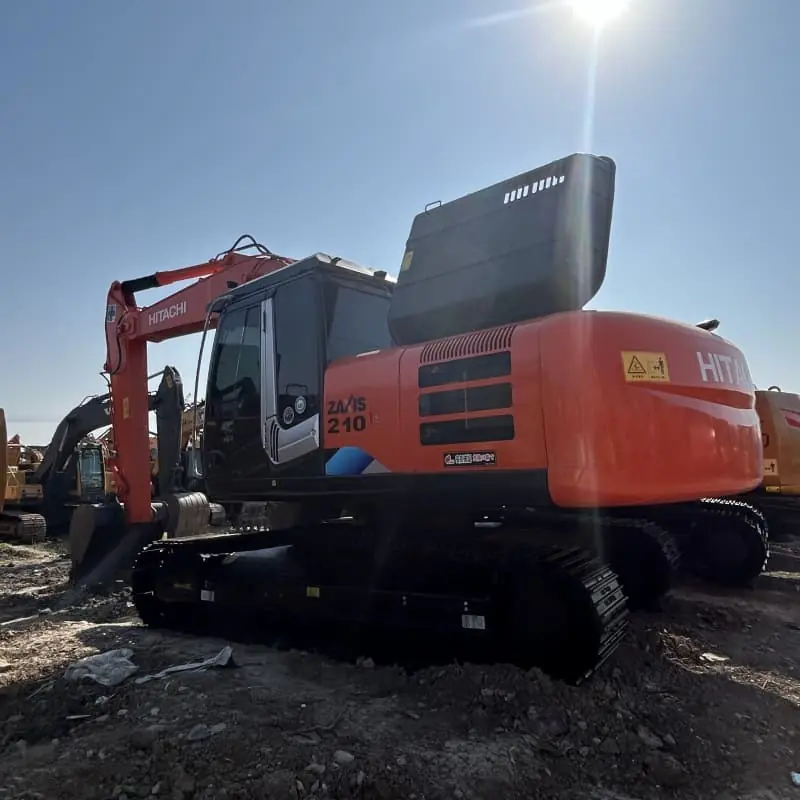
Excavatrice d'occasion Hitachi ZX210 à vendre
Réponse rapide pour les acheteurs
Cette excavatrice d'occasion Hitachi ZX210 est une machine sur chenilles destinée au terrassement et aux travaux généraux. La fiche indique un prix de USD $21,000, un poids de référence de 21.2t et un godet de 0.95m3. Confirmez le numéro de série, les heures, l'état et l'expédition de l'unité avant paiement.
- Prix affiché
- USD $21,000
- Poids opérationnel de référence
- 21.2t
- Capacité de godet de référence
- 0.95m3
Présentation du modèle
Cette excavatrice d'occasion Hitachi ZX210 est une machine sur chenilles destinée au terrassement et aux travaux généraux. La fiche indique un prix de USD $21,000, un poids de référence de 21.2t et un godet de 0.95m3. Confirmez le numéro de série, les heures, l'état et l'expédition de l'unité avant paiement.
Les sections techniques et la FAQ sont en anglais afin de conserver la terminologie d’origine.
A Size Built Around Flexibility, Not a Single Job Type
Unlike a bigger machine that's chosen for raw output on one type of large-scale work, the ZX210 earns its popularity by being genuinely good at a wide range of tasks. This includes foundation digging, utility trenching, site grading, loading trucks on medium-scale jobs, and general earthmoving where a smaller mini-excavator would run out of reach and a larger unit would be overkill on fuel and transport cost. Rental companies in particular favor this size because it rents out for almost any job that comes through the door, which keeps utilization — and resale value — higher than more specialized machines.
Isuzu's 4-Cylinder Engine: Right-Sized Power
Hitachi fits the ZX210 with an Isuzu 4HK1-series diesel engine — a four-cylinder unit rather than the larger six-cylinder engines found in Hitachi's bigger excavators. Net output generally falls around 110–122 kW (roughly 150–165 hp) depending on the generation, which is enough to keep cycle times competitive at this weight class without the fuel burn of an oversized engine doing a job it's not sized for. A four-cylinder engine also tends to be simpler and less expensive to service than a six-cylinder equivalent. During inspection, we run the engine through idle, mid-range, and full-load conditions, watching oil pressure, coolant temperature, and exhaust behavior.
What the Numbers Actually Look Like
Specifications shift slightly across the ZX210, ZX210-3, ZX210-5, and ZX210-6 generations, and again between the standard and LC (wide-track) undercarriage versions. Operating weight for the standard-width ZX210 typically runs about 20,900–21,800 kg, while the LC version usually sits closer to 22,000–22,700 kg. Standard bucket capacity is generally in the 0.8–1.0 m³ range, maximum digging depth is typically around 6.6–6.7 m, and maximum digging reach usually falls between 9.9–10.2 m. Travel speed generally tops out around 5.5 km/h in high range. These are platform-level numbers rather than a guarantee of what's fitted to this exact machine.
Standard vs. LC Undercarriage: Which One Are You Looking At?
One detail worth double-checking on any ZX210 listing is whether it's a standard-width or LC (long/wide track) undercarriage. The LC version has a wider track gauge for better stability on soft or uneven ground, which is why it's the more commonly exported configuration, but it also has a slightly wider overall footprint — worth confirming if you're planning to work in tighter urban sites or load it onto specific transport. We list undercarriage type explicitly rather than leaving buyers to guess from photos.
Attachment Compatibility and Machine Control
This size class is commonly fitted with hydraulic quick-couplers and tiltrotators for grading and finishing work. It's also one of the more common sizes to see paired with GPS-based 2D or 3D machine control systems, since contractors doing site grading at this scale increasingly want automated grade reference rather than manual staking. If this unit includes auxiliary hydraulic plumbing, a quick-coupler, or machine control brackets, that's noted in the listing rather than assumed.
Common Wear Points Worth Checking on a Used Unit This Size
A few issues show up often enough on used 20-ton class excavators that they're worth calling out specifically. Key focus areas include: Front windshield cracking from stone impact; Weeping or seeping boom cylinder seals; Central lubrication system blockages or disconnected lines; Worn track link master pins and bushings; Hydraulic hose condition around the quick-coupler circuit. We check each of these specifically during inspection and note any findings in the condition report.
How This Compares in Size to Other Popular Excavator Classes
Buyers cross-shopping this listing are often comparing it against Caterpillar's 320-class machines or against Hitachi's own larger ZX270-class units. If your work is general contracting, utility installation, or site development where flexibility matters more than raw tonnage, the ZX210's size class is usually the more cost-effective choice. If you're regularly moving material at quarry or mining scale, a heavier machine will out-produce it enough to justify the higher fuel and transport cost.
Shipping: One of the Easier Sizes to Export
One practical advantage of this weight class is that it typically ships without the complications that come with larger machines. In most cases, the boom and arm are removed and the counterweight may be detached, allowing the excavator to fit inside a standard open-top or flat-rack container without needing breakbulk vessel space. Once we know your destination port, we'll confirm the exact container type needed. The process covers confirmation, payment terms, pre-shipment inspection, export documentation, and loading.
Hitachi ZX210 buyer FAQ
What's the difference between a ZX210 and a ZX210LC?
The LC version has a wider undercarriage for added stability, and it's the more commonly exported configuration. The standard-width version has a narrower footprint, which can be useful on tighter job sites.
Is the ZX210 a good choice for a first-time excavator buyer?
It's one of the more forgiving sizes to own, since parts, service knowledge, and operators familiar with this class are widely available almost everywhere.
Can this machine run a tiltrotator or GPS machine control?
Many units in this class can, provided they have the necessary auxiliary hydraulic plumbing and control wiring. Whether this specific unit is already fitted is confirmed in its individual listing.
How does the ZX210 compare to a CAT 320-class excavator?
They sit in a similar weight and output bracket. The choice usually comes down to brand familiarity, parts network in your region, and the specific condition of the individual used unit.
Does this size need to be shipped as breakbulk cargo?
Generally no. With the boom, arm, and sometimes the counterweight removed, this weight class typically fits into a standard container.
What should I ask for before committing to a used ZX210?
Request the confirmed undercarriage type, the generation, current hour meter reading with service history, and the full condition report and photos for the exact unit.
Related Hitachi excavators
- Hitachi ZX240 — 24.2t reference weight
- CAT 320D — 21.5t reference weight
- Hitachi ZX200 — 20t reference weight
Demander les détails de la machine
Indiquez le port de destination, la quantité et vos priorités d’inspection. Nous répondrons avec les détails de la machine précise.
Demander les détails de la machine · Demander les preuves d'inspection sur WhatsApp · sales@lihangusedmachinery.com