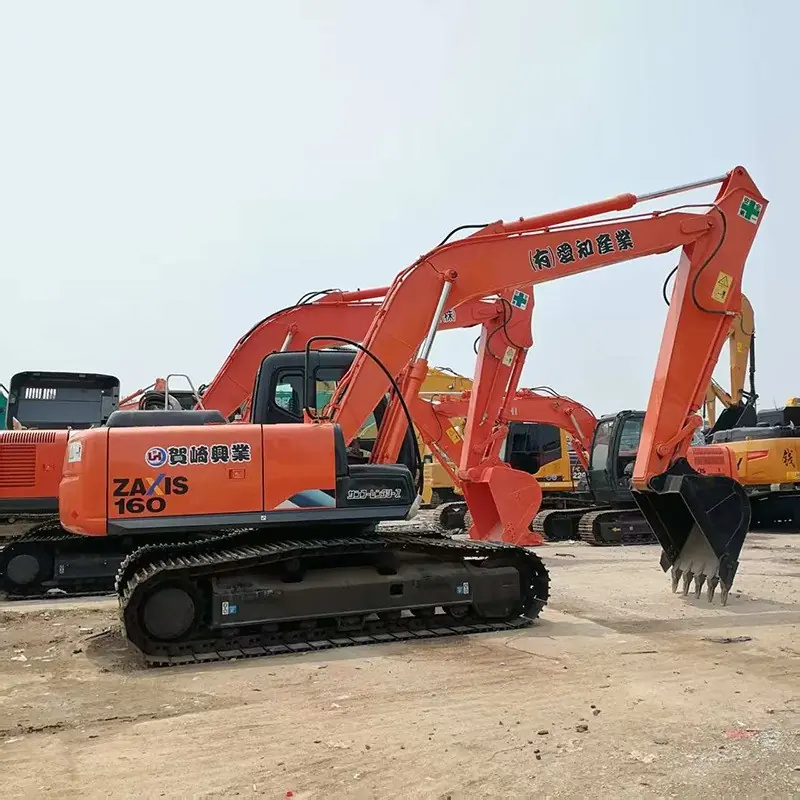
Excavatrice d'occasion Hitachi ZX160 à vendre
Réponse rapide pour les acheteurs
Cette excavatrice d'occasion Hitachi ZX160 est une machine sur chenilles destinée au terrassement et aux travaux généraux. La fiche indique un prix de USD $18,000, un poids de référence de 16.8t et un godet de 0.65m3. Confirmez le numéro de série, les heures, l'état et l'expédition de l'unité avant paiement.
- Prix affiché
- USD $18,000
- Poids opérationnel de référence
- 16.8t
- Capacité de godet de référence
- 0.65m3
Présentation du modèle
Cette excavatrice d'occasion Hitachi ZX160 est une machine sur chenilles destinée au terrassement et aux travaux généraux. La fiche indique un prix de USD $18,000, un poids de référence de 16.8t et un godet de 0.65m3. Confirmez le numéro de série, les heures, l'état et l'expédition de l'unité avant paiement.
Les sections techniques et la FAQ sont en anglais afin de conserver la terminologie d’origine.
Built for Access, Not Just Output
Where a 20-ton-and-up excavator earns its keep by moving the most material per hour, a machine in the ZX160's class earns its keep by fitting where bigger equipment can't. This includes narrow residential lots, sites bordered by existing structures, cemetery and park maintenance, or utility work along streets where a wider swing radius would mean closing an extra lane of traffic. Buyers looking at this size are usually solving for space and maneuverability first, with digging performance as a secondary consideration.
Reduced Tail Swing: The Feature That Sells This Size Class
One of the more genuinely useful engineering details on excavators in this size range is a reduced or minimal tail-swing design. This allows the counterweight to sit close enough to the tracks that the rear doesn't extend meaningfully past the width of the undercarriage when it rotates. On a full-size 20-ton machine, swinging near a wall or vehicle means constant awareness of counterweight travel. On a reduced-swing ZX160, that risk drops significantly, perfect for jobs between buildings or along active roadways.
Isuzu's Smaller-Displacement Engine
The ZX160 is generally powered by an Isuzu 4JJ1-series diesel — a smaller-displacement four-cylinder engine delivering roughly 84–93 kW (113–125 hp). This size class is built to do precise, moderate-scale digging efficiently without burning excess fuel. A smaller engine also runs quieter at idle, which matters on job sites near occupied buildings. During inspection, we check full-load performance, oil/coolant condition, and turbo response, while also paying attention to idle noise and vibration.
Generations on the Used Market
Machines carrying the ZX160 name have gone through several updates, generally referred to as the base ZX160, ZX160-3, and ZX160-5. Later revisions bring refined hydraulic valve tuning and improved cab monitor displays. While the fundamental size remains consistent, newer generations often offer better fuel economy and smoother operation, affecting running costs and resale value. We confirm the generation for every listing to ensure accurate comparison.
Typical Working Specifications
Operating weight typically falls between 16,000–17,600 kg depending on undercarriage and configuration. Standard bucket capacity usually runs 0.45–0.8 m³, maximum digging depth is generally 5.9–6.4 m, and maximum digging reach sits around 8.9–9.3 m. Travel speed typically reaches up to 5.5 km/h in high range. These platform-level figures help with initial comparison before reviewing machine-specific configuration.
Rubber Pads, Steel Shoes, and a Backfill Blade
Two features come up more often in this size class: rubber track pads and a front backfill/dozer blade. Rubber track pads prevent damage to finished pavement or driveways. The backfill blade is genuinely useful for leveling, backfilling trenches, and site cleanup without needing a separate machine. If this unit includes a blade or rubber pads, it is explicitly confirmed in the listing.
Cab Visibility Matters More When Working Close
Working close to walls, cars, or pedestrians makes all-around visibility a bigger priority than raw cab comfort. The ZX160's cab features a lower beltline on side windows and a narrower front pillar for a clearer view of track edges and swing radius. During inspection, we check all glass, mirrors, and backup systems operators rely on for safety in tight spaces.
Where This Size Actually Gets Used
Buyers typically choose this class for residential and urban site work where full-size excavators won't fit. Common tasks include utility and pipeline work along sidewalks, landscaping, drainage, and interior demolition support. It's generally not the right choice for high-volume earthmoving or quarry work where the capacity of a bigger machine is needed.
What to Check Before Buying a Used Compact-Class Excavator
A few inspection points matter more at this size, such as swing bearing play and rubber pad wear. We also check blade cylinder condition (if fitted), boom/arm pin play, and cab ROPS/FOPS certification. These points are covered specifically in the condition report provided with this listing to ensure you know the exact state of the machine.
Shipping: Often the Most Cost-Efficient Size to Export
This weight class is generally the easiest and most economical of Hitachi's mid-size range to ship internationally. It is sometimes possible to load two smaller excavators into a single standard container, splitting freight costs. For single units, the boom and arm are typically removed for loading. The process includes confirmation, payment terms, pre-shipment inspection, export documentation, and vessel booking.
Hitachi ZX160 buyer FAQ
Does the ZX160 have a reduced tail-swing design?
Many units in this class do, though it depends on the specific model and generation. This unit's configuration is confirmed in the listing details.
Can this excavator work on paved surfaces without causing damage?
Yes, if fitted with rubber track pads. This is a common option for excavators used frequently on finished surfaces like driveways and parking areas.
What is the backfill blade used for?
It's a front-mounted blade for leveling, backfilling trenches, and general site grading, allowing basic dozing without extra equipment.
Is this size big enough for real construction work?
Absolutely. It's a genuine working excavator sized for jobs where access matters as much as output, covering residential, utility, and municipal work.
Can two of these fit in one shipping container?
Depending on exact dimensions and configuration, sometimes yes, which can meaningfully reduce per-unit freight costs for multiple orders.
Does the engine generation matter for hour meter comparison?
Yes. A later-generation engine often offers better fuel economy and hydraulic response even at similar hours, so it's worth confirming the generation.
Related Hitachi excavators
- Hitachi ZX130 — 13.1t reference weight
- Hitachi ZX210 — 21.2t reference weight
- Sany SY135C — 13.5t reference weight
Demander les détails de la machine
Indiquez le port de destination, la quantité et vos priorités d’inspection. Nous répondrons avec les détails de la machine précise.
Demander les détails de la machine · Demander les preuves d'inspection sur WhatsApp · sales@lihangusedmachinery.com