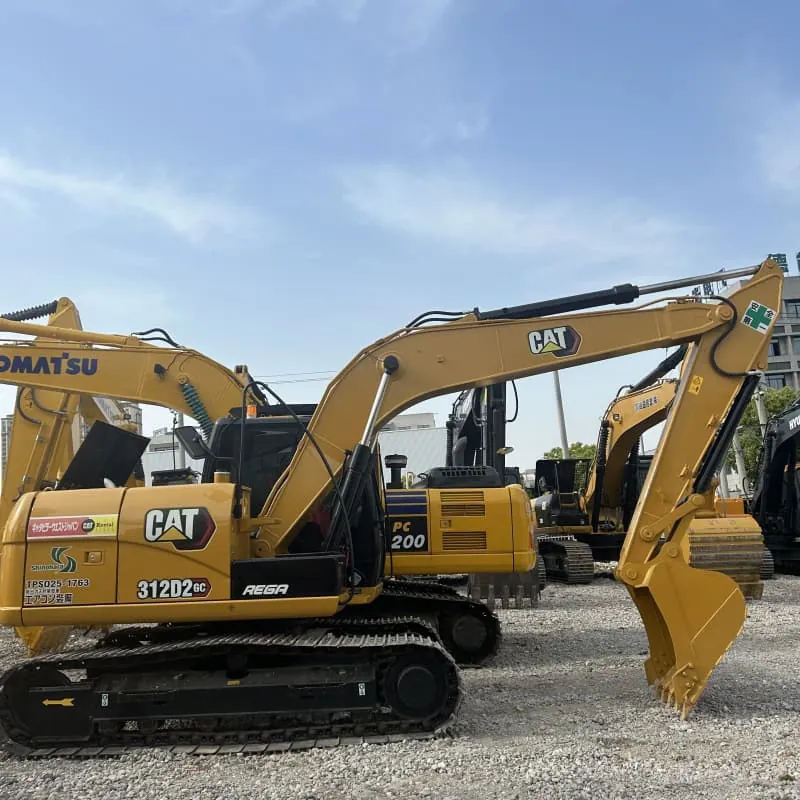
Excavatrice d'occasion CAT 312D2GC à vendre
Réponse rapide pour les acheteurs
Cette excavatrice d'occasion CAT 312D2GC est une machine sur chenilles destinée au terrassement et aux travaux généraux. La fiche indique un prix de USD $16,800, un poids de référence de 13.2t et un godet de 0.58m3. Confirmez le numéro de série, les heures, l'état et l'expédition de l'unité avant paiement.
- Prix affiché
- USD $16,800
- Poids opérationnel de référence
- 13.2t
- Capacité de godet de référence
- 0.58m3
Présentation du modèle
Cette excavatrice d'occasion CAT 312D2GC est une machine sur chenilles destinée au terrassement et aux travaux généraux. La fiche indique un prix de USD $16,800, un poids de référence de 13.2t et un godet de 0.58m3. Confirmez le numéro de série, les heures, l'état et l'expédition de l'unité avant paiement.
Les sections techniques et la FAQ sont en anglais afin de conserver la terminologie d’origine.
Why contractors choose the 13-ton middleweight class
The CAT 312D2GC sits in a practical gap between compact excavators and 20-ton production machines, offering useful reach and stability while retaining a more manageable site footprint. This class is often shortlisted when a contractor handles varied civil work and cannot justify a different carrier for every project. Potential duties include stormwater and sewer installation, road shoulder reconstruction, medium foundations, canal maintenance, commercial site preparation, material handling and support work beside larger equipment. Its value comes from balance, not maximum output. Compared with a smaller unit, it may reach across a wider trench, handle a larger spoil volume and work with heavier attachments. Compared with a 20-ton crawler, it may need less working space and simplify some mobilizations. The correct choice depends on the actual project. Record trench depth and width, pipe or chamber weights, routine lift radius, soil density, loading height, access width, ground conditions and target volume per shift. Include the number of site moves and local low-bed constraints. The final suitability review must use the offered boom, arm, tracks, bucket, coupler, guarding and auxiliary system because those features change working range, weight and tool compatibility.
Plan utility and drainage work as a complete sequence
For pipeline and drainage jobs, excavation speed is only one part of performance; trench control, lifting, bedding, backfill and safe movement around services determine useful productivity. Begin with the entire work cycle. Identify the excavation profile, shoring or trench-box plan, spoil placement, truck access, bedding delivery, pipe handling and compaction method. A bucket that removes soil quickly may be too wide for the required trench or may create unnecessary reinstatement. Ask for the current bucket width, pin dimensions, teeth and cutting-edge condition, then compare them with the design. Where the excavator will lift pipes, covers or shoring components, use the serial-appropriate load chart, exact working radius and local lifting rules; the 13.2t reference is not a lifting certificate. Establish clearance from overhead and underground services and define a spotter or exclusion-zone procedure. Consider whether the blade, track position and upper-structure swing can be used safely along a narrow corridor. Track repositioning and traffic control can dominate cycle time on a road project, so model the expected advance per shift instead of applying a generic cubic-meter figure. This task-level analysis gives buyers a direct answer about job fit without promising production that site conditions may not support.
Use bucket and material information correctly
The 0.58m3 catalog entry identifies a general capacity range, while material density, fill factor, attachment design and operating radius determine practical loading. Request current photographs of the fitted work tool, including its profile, width, visible capacity markings, teeth, adapters, side cutters, floor and repair areas. Confirm whether the sale includes that bucket, a quick coupler or additional attachments. Loose soil, wet clay, gravel and broken concrete load the machine differently, and an oversized bucket can reduce control or increase strain in dense material. Bucket volume also does not predict truck-loading output on its own. Swing angle, bench height, truck position, operator skill and waiting time affect cycles. Count realistic passes for the trucks used at the destination and make sure loading height and reach match their bodies. For grading, evaluate edge condition, controllability and the need for a dedicated finishing bucket. For breakers, grapples or compactors, separate carrier suitability from the bucket reference and verify auxiliary flow, pressure, return configuration, tool mass and coupler dimensions. A buyer who documents the material and attachment first receives a more useful quotation and avoids comparing machines that appear similar online but are prepared for different work.
Protect the full designation and serial identity
The D2 and GC elements should remain attached to the model identity in specifications, media, parts research and commercial documents. Start with a readable identification-plate photograph and a wider view that establishes its position on the machine. Ask the supplier to use the complete plate designation and serial identity in the written quote. A current video should connect the plate, full exterior, monitor and attachments before the operating test begins. This continuity matters because nearby machines can look alike while using different specifications, regional equipment or service information. When researching dimensions, filters, hydraulic settings or high-value components, use the correct serial range instead of relying on a family-level search result. The displayed 1500 values are website catalog labels, not guaranteed unit facts. Ask what evidence supports the manufacture year and what the meter image represents. Compare controls, pedals, bucket linkage, tracks and general wear with the reported history, while understanding that appearance cannot prove operating time. Genuine service records can add context when connected to the same serial number. Unsupported fields should remain unknown in the valuation rather than being repeated as confirmed facts in an inquiry or contract.
Assess engine and cooling performance for stop-start civil work
A credible test begins cold, reaches normal working temperature and includes repeated hydraulic demand instead of ending after a clean idle demonstration. Request one continuous sequence showing the monitor, engine bay and exhaust area before starting. Note ambient conditions, cranking time, warning indicators, idle stability, sound and visible exhaust behavior, but leave diagnosis to qualified technicians. Examine oil, fuel and coolant areas for active leakage, damaged hoses, loose mounts, wiring issues or contamination. Inspect radiator and cooler cores for blockage and physical damage, paying attention to machines that may have worked around dust, vegetation or roadside debris. Continue running until temperature is representative, then combine digging movements, swing and travel while observing response and gauges. A short idle clip cannot show behavior after heat builds. Ask for available maintenance information and identify which serial number it covers. Fluid sampling or diagnostic checks can add useful evidence when carried out and interpreted correctly, but neither guarantees future reliability. If the test reveals smoke, temperature, pressure or response concerns, obtain a technician’s repair scope and price it with destination parts availability and downtime. This turns observations into a commercial decision rather than a vague condition label.
Hydraulic response, fine control and cylinder condition
Mixed civil work demands both cycle speed and controllability, so the warm test should include simultaneous movements, grading-style inputs and safe holding observations. After warm-up, operate boom, arm and bucket through their useful ranges and combine functions such as boom-up, arm-in and swing. Look for delay, hesitation, uneven speed, unusual sound or a marked difference between cold and warm performance. Fine grading movements can reveal control behavior that a rapid full-stroke demonstration misses. Inspect cylinder rods for scoring, corrosion or impact damage and examine glands, hose crimps, pump and valve areas, center swivel and exposed lines for fresh oil. Measure movement at bucket, arm and boom pins when practical rather than relying on words such as tight. Holding or drift assessment must use safe positioning and correct technical limits. If concerns remain, qualified personnel can perform pressure, flow or case-drain checks with the appropriate service procedure. Do not improvise stall tests for a video. For auxiliary tools, confirm the actual circuit, controls, coupler, flow, pressure and return arrangement. Visible pipework alone does not establish that a breaker, grapple or compactor can be connected and operated correctly.
Structure, swing system and high-load joint review
Photograph high-stress areas cleanly and in context because frame or attachment repairs can affect safety, downtime and future resale. Inspect boom foot mounts, cylinder brackets, arm ends, bucket linkage, pin bosses, upper-frame connections and crawler-frame junctions. Look for visible cracks, distortion, plate additions, heat marks, non-uniform welds and paint changes. These are findings that require explanation and professional evaluation; they do not automatically prove a repair is unacceptable. Wider images should show location, while close images show surface detail. Observe alignment during a safe movement sequence and confirm that pin retainers and lubrication points are complete. During swing, listen through acceleration and deceleration, check controlled stopping in both directions and inspect the drive area for leakage. Any bearing movement should be measured with a suitable method instead of estimated from camera movement. Ask about repair history where available, but judge the present structure and workmanship. Where a finding is commercially significant, obtain a specialist assessment and a written repair estimate. A strong evidence package is especially important for a machine expected to alternate between digging and handling, because repeated side loading or poor attachment practice may leave wear that exterior cleanliness cannot explain.
Undercarriage wear and frequent-move economics
Track-system condition affects both immediate repair cost and the machine’s ability to reposition efficiently on linear road or utility projects. Request straight views of both undercarriages and detailed photographs of shoes, chains, pins and bushes, sprockets, idlers, top rollers, bottom rollers, guards and adjuster areas. A useful assessment measures representative components and compares them with correct service limits. Ask how any claimed remaining-life percentage was calculated. Look for uneven wear between sides, seized links, bent or loose shoes, sharp sprocket profiles, leaking rollers, abnormal tension and material that hides inspection points. Travel forward and backward on suitable ground, steer both ways and observe whether one side is slower or noisier. Check final-drive regions for leakage and abnormal sound from a safe position. On a linear project, avoid treating long-distance tracking as free: travel adds wear and may be slower or more disruptive than planned repositioning. Turn inspection results into a forecast using destination costs for parts, freight, labor, tooling and downtime. A higher purchase price can be justified when measurements delay a major running-gear renewal, while a worn system may still be acceptable if its cost is transparent and included in the budget.
Cab, visibility and controls for work near traffic and crews
Roadside and municipal work makes clear visibility, functioning warnings and predictable controls as important as digging performance. Inspect seat adjustment and restraint, joysticks, travel pedals, monitor, gauges, warning indicators, windows, wipers, mirrors or cameras, horn, work lights and travel alarm. Test heating, ventilation and air conditioning under stated conditions when long shifts or climate make them important. Check cab mounts, access steps, handrails and doors for damage or modification. Controls should return normally without unexplained binding, and the safety lockout should be tested by a trained operator using appropriate instructions. Ask for video from the operator’s viewpoint to understand blind areas around the counterweight, boom and right side. The project team must establish exclusion zones, spotter communication, overhead-service controls and traffic-management arrangements. Destination rules may require particular guarding, lighting, object protection, lifting devices or road-work equipment, and presence in a photograph does not prove compliance. List every missing or non-working item in the inspection and quotation. Repairing lights, alarms, glass or climate equipment before shipment may be simpler than discovering those needs during local commissioning.
Compare utilization value rather than machine price alone
The best commercial candidate is the one that covers the planned work reliably at an understandable landed and readiness cost. Estimate monthly utilization by task: trench excavation, lifting support, grading, loading, attachment work and travel or standby. Identify where a smaller machine would be slow and where a larger one would be underused or difficult to mobilize. Build a readiness budget from the actual inspection, including fluids, filters, hoses, pins, bushes, cutting tools, track components, electrical repairs and cab items. Price work using destination parts and labor. Then calculate landed cost from the machine, included attachments, inspection, origin haulage, preparation, dismantling if needed, loading, export services, ocean freight, insurance when requested, destination handling, taxes or duties, broker charges and inland delivery. Use current route-specific quotations and separate fixed values from contingencies. Score local technician familiarity, diagnostic access and lead times for high-cost components because downtime may outweigh a small purchase saving. A clean commercial comparison does not reward unsupported low hours or fresh paint. It rewards documented identity, job fit, measurable condition, clear inclusions and a support plan that the destination operation can actually execute.
Low-bed, container and international shipping decisions
Transport feasibility must be based on measured dimensions and the agreed loading state, not the operating-weight reference or a generic container statement. Ask for overall length, width, height and weight with the actual tracks, arm and bucket in the shipping configuration. Provide those values to the inland carrier and freight partner with the origin, destination and intended route. They can evaluate low-bed movement, Ro-Ro, flat-rack, container or other suitable methods and identify carrier restrictions. If the bucket, arm, handrails or other parts will be removed, define who performs the work, how hoses and openings are protected, how pins and loose components are labeled, and who is responsible for reassembly. Photograph connection points and reconcile accessories against a packing record before loading. Confirm that the machine can travel, steer and stop safely during handling or arrange an alternative method. Cargo declarations and lifting plans should use verified transport values. The destination broker must confirm current import eligibility, documents and local charges before payment because requirements vary and change. Keep loading images, invoice, packing data and transport records connected to the serial identity so the handover remains traceable.
A buyer workflow from first inquiry to deposit decision
Define mandatory job and evidence requirements before negotiation so familiarity, price or a low-hour headline cannot bypass the real decision gates. Send the destination, project type, material, trench or foundation dimensions, routine lift, access limit, attachment requirement, daily target and delivery timing. Ask whether a specific serial-numbered unit is available and request current identity images, meter evidence, installed-equipment list, known defects and location. Specify the media sequence: cold start, warm combined hydraulics, fine control, swing, travel, leaks, linkage, structure and measured undercarriage. If third-party inspection is required, agree on access, scope, test limits, reporting and costs. Request a written quotation separating the machine, attachments, repairs or preparation, inland movement, export charges and route-specific freight under a named delivery term. Verify beneficiary details through an independently confirmed business channel before transferring funds. Apply four pass-or-fail gates: the configuration covers the work, the condition evidence is sufficient, landed and readiness cost is acceptable, and local support is practical. Record unresolved points and decide whether each requires more evidence, a repair commitment, price allowance or rejection. This makes the final choice explainable to operations, management and finance.
CAT 312D2GC buyer FAQ
What is the reference operating weight?
The website lists approximately 13.2t. Actual operating and transport weight can vary with tracks, boom, arm, bucket, coupler, guarding and regional equipment, so verify the serial-specific configuration and measured cargo values.
What bucket capacity is shown?
The catalog uses 0.58m3 as a comparison reference. Confirm the installed bucket from current photographs, width, markings, pin dimensions and condition because used units may be supplied with different tools.
Which projects suit a used CAT 312D2GC excavator?
Typical shortlist work includes utilities, drainage, road rehabilitation, foundations, commercial landscaping and mixed civil projects. Suitability depends on required range, material, lifts, access, attachments and the exact machine condition.
What should the hydraulic test show?
After a documented cold start and warm-up, it should show single and combined boom, arm, bucket and swing movements, fine control, travel and any required auxiliary circuit. Record leaks, delay, sound and temperature conditions.
How should undercarriage condition be valued?
Use measurements from both sides and the correct service limits, then price expected chain, shoe, roller, idler and sprocket work with destination freight, labor and downtime.
Can this size be shipped in a container?
Possibly, but feasibility depends on measured dimensions and weight, dismantling scope, loading equipment, carrier rules and destination handling. The freight partner should approve the exact shipping arrangement before payment.
Why is there no universal online price?
Used-machine value changes with identity evidence, supported age and hours, configuration, attachment, mechanical wear, location, preparation and route-specific freight. Request a unit-level written quotation.
What should a serious quotation request contain?
Provide the job, material, working-range and attachment needs, destination and timing. Ask for serial identity, current inspection media, known defects, inclusions, exclusions and separated origin and shipping costs.
Related CAT excavators
- CAT 312 D — 12.9t reference weight
- CAT 315D2GC — 15t reference weight
- CAT 315D2L — 15.8t reference weight
Demander les détails de la machine
Indiquez le port de destination, la quantité et vos priorités d’inspection. Nous répondrons avec les détails de la machine précise.
Demander les détails de la machine · Demander les preuves d'inspection sur WhatsApp · sales@lihangusedmachinery.com