Accueil / Blog
The Operator's Survival Guide: Community Secrets to Buying a Used Excavator without Going Broke
A practical checklist for reviewing hydraulic response, engine blow-by and undercarriage wear when evaluating a used excavator. Confirm procedures against the manufacturer manual and a qualified inspector.
August 21, 2026 · Survival Guide
Le contenu technique complet est disponible en anglais afin de conserver les termes d’origine.
In the gritty world of heavy iron, there is a massive gap between what the dealer brochure tells you and what a veteran machine operator knows by simply touching a weld. For contractors in 2026, navigating the global market for pre-owned excavators is no longer a matter of luck—it is a matter of technical forensics. Based on thousands of discussions across the most respected machine-operator communities, this survival guide deconstructs the art of buying used excavators. We move past the fresh yellow paint to analyze the volumetric efficiency of hydraulic pumps, the thermal stability of Isuzu and Caterpillar power plants, and the hidden economics of undercarriage wear. Whether you are looking at a 20-ton workhorse in a Shanghai yard or a mini-digger for urban utility, this is your technical roadmap to landing factory-grade performance at a fraction of the capital cost.
1. Structural Forensics: Analyzing the "Stress Map" of the Frame and Boom
The structural integrity of the boom, arm, and carbody defines the safe operational limit and the residual value of the machine. Operators know that steel has a memory; it records every hour of impact loading and every overloaded bucket.
Checking the Boom Foot and Arm Linkage
Every excavator has a "stress map"—specific areas where the high-tensile steel is most likely to fatigue. On a used Caterpillar 320D or a used Hitachi ZX200, your primary focus should be the boom foot and the critical arm-to-bucket linkage. In professional yards, we utilize non-destructive testing (NDT) to identify hairline fractures that the naked eye might miss. Look specifically for "crows-foot" cracks near the main hydraulic cylinder mounts.
Reddit community members frequently warn against machines that show signs of "hammer work." If you see oversized reinforcement plates welded onto the arm, it is a clear indicator that the machine spent thousands of hours with a hydraulic breaker. Hammers transmit intense, high-frequency shockwaves through the boom, which can leads to internal structural micro-cracking and accelerated bearing failure. A machine with a "clean" boom foot and original factory welds is worth a 15% premium in any professional fleet manager's eyes.
Forensic inspection: Identifying original factory welds vs. aftermarket repairs on a boom foot.
2. The Hydraulic Bloodstream: Detecting Internal Pressure Bypass
The engine is the heart, but the hydraulics are the muscle. In modern high-production projects, "cycle time" is the only metric that matters. A machine that moves 10% slower than factory specs is effectively burning 10% more fuel for zero output.
Volumetric Efficiency and the "Stall Test"
The "Stall Test" is the industry-standard method for verifying the health of variable displacement axial piston pumps. With the hydraulic oil at peak operating temperature (55°C to 65°C), the operator must move the boom to its mechanical limit and hold the joystick. A healthy system on a used Komatsu PC200-8 or a Sany SY215C should maintain its relief pressure without excessive engine bogging.
Based on Reddit operator feedback, if the engine RPM drops more than 250 RPM during the stall, or if the main pump begins to "scream" (high-pitched cavitation), the internal piston barrels and valve plates are worn. This wear allows high-pressure oil to bypass the pistons and return to the tank, generating massive amounts of heat. In the tropical climates of Southeast Asia or Africa, a "hot" pump will cause the machine to lose 30% of its digging force within two hours of work.
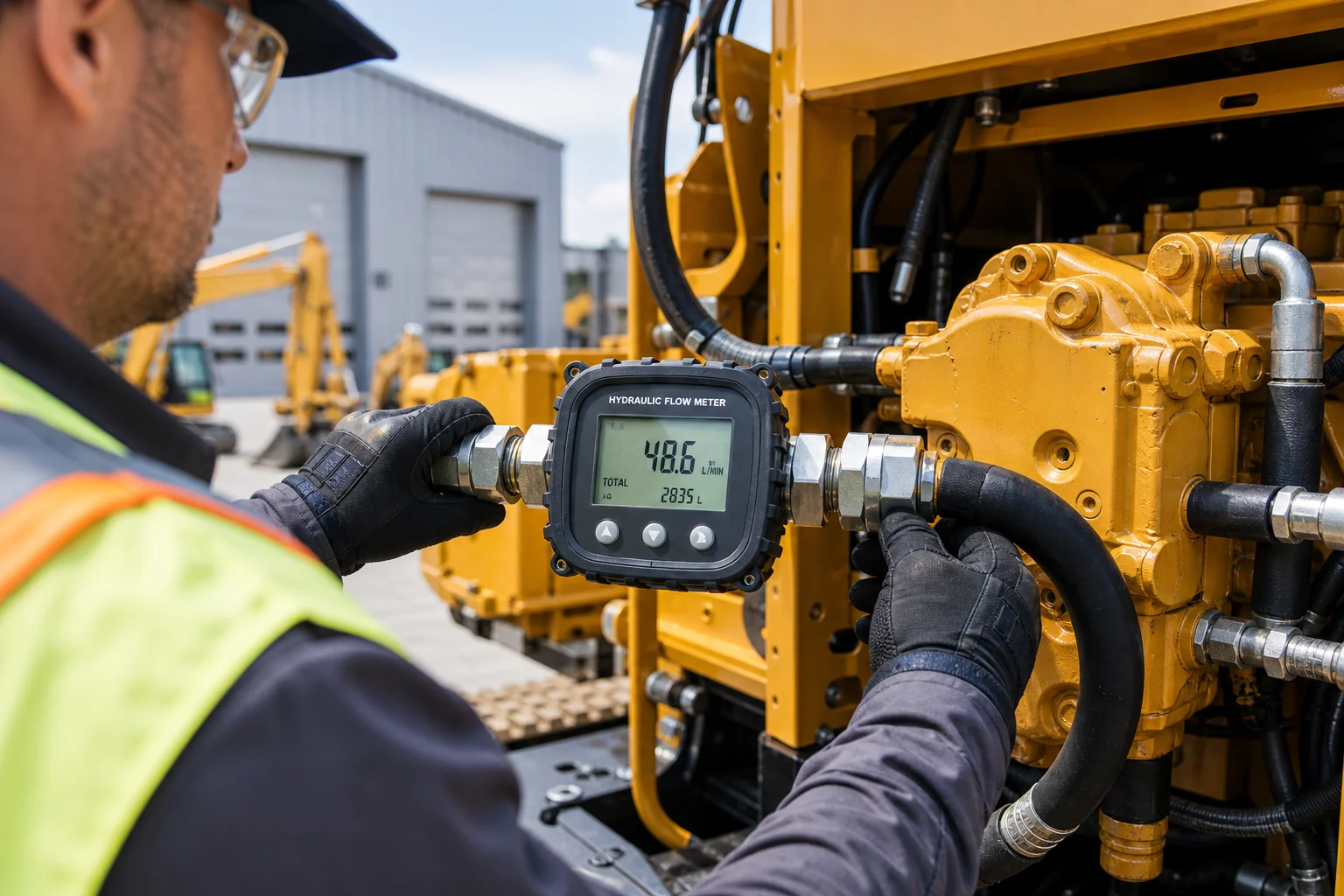
Digital diagnostic: Verifying the main pump relief pressure reaches the factory spec of 34.5 MPa.
3. Powerplant Diagnostics: Thermal Stability and the "Blow-By" Truth
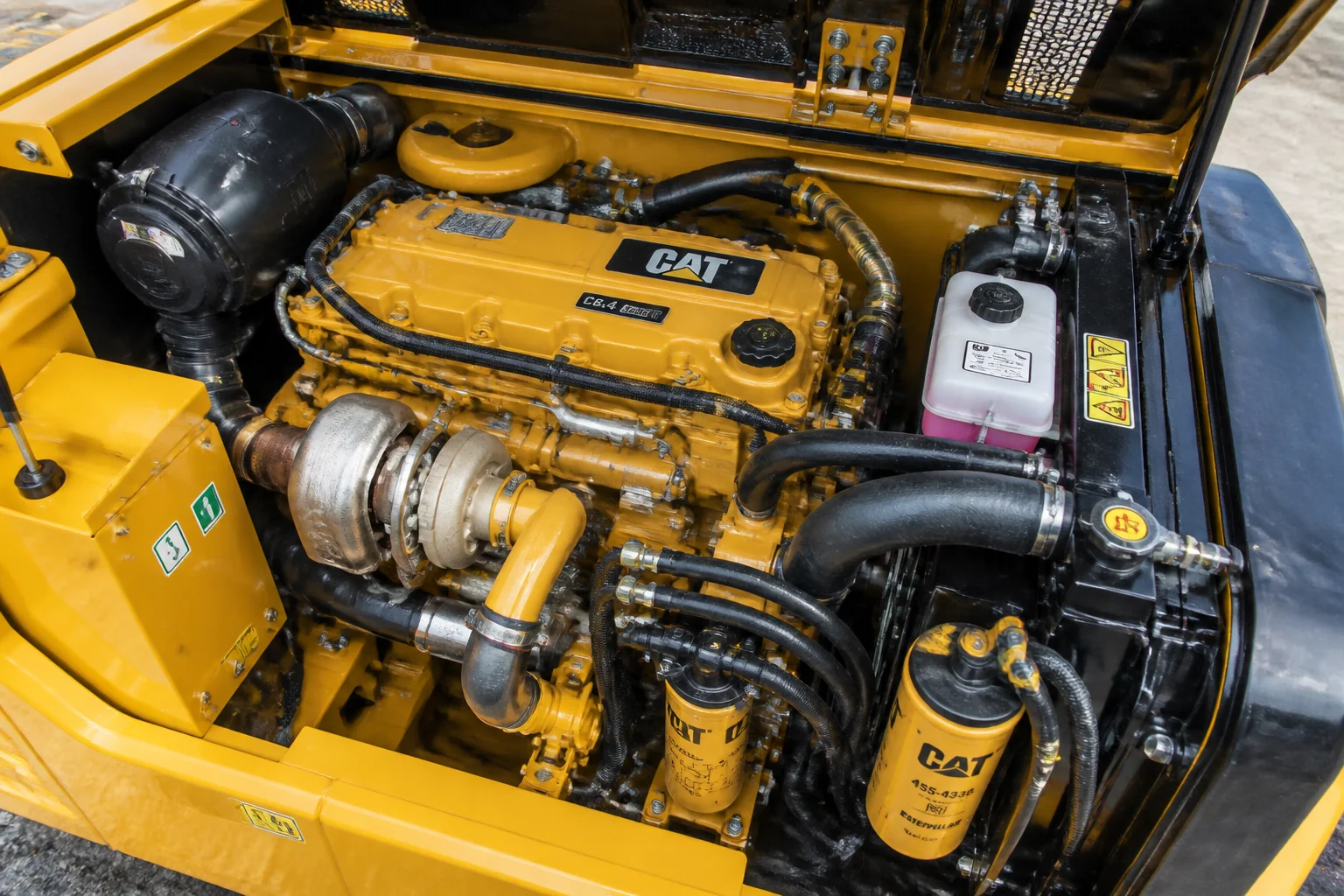
The powertrain remains the most critical variable in the lifespan of any hydraulic machine. In our yard, every unit—whether it’s a Cat C6.4 or an Isuzu 4HK1—undergoes a rigorous engine health diagnostic that goes far beyond the hour meter.
Cold Start and Exhaust Analysis
Always insist on a cold start. A healthy diesel power plant should clear its exhaust within 3 to 5 seconds of ignition. Sustained white smoke suggests coolant leakage (potential head gasket or liner seal failure), while blue smoke indicates engine oil consumption (worn piston rings or valve guides). Black smoke under load is often a sign of fuel system issues, such as failing fuel injectors or a clogged turbocharger air intake.
The Crankcase "Blow-By" Test
Open the engine hood while the machine is running at high idle and carefully check the crankcase breather tube. "Blow-by" is the migration of combustion gases past the piston rings and into the crankcase. In the operator community, this is considered the most accurate predictor of a looming overhaul. A slight wisp of vapor is normal, but if the tube is pulsing like a steam engine or dripping heavy oil, the engine is "tired." At our Shanghai technical hub, we provide high-definition video evidence of blow-by checks for every machine, giving remote buyers the same confidence as an on-site audit.
4. Undercarriage Economics: Measuring the 50% Maintenance Factor
The undercarriage of a crawler machine accounts for nearly 50% of its lifetime maintenance cost. Buying a machine with a 30% undercarriage isn't just a maintenance risk; it’s a financial liability that can bankrupt an independent owner-operator.
Ultrasonic Thickness Verification
Visual inspection of track links and bushings is notoriously deceptive. A link may look "thick" due to mud buildup, but its actual structural depth might be compromised. We utilize professional ultrasonic thickness gauges to measure the link height and bushing diameter. A reduction of just 5mm in link height can bring the pin bosses into contact with the rollers, causing severe vibration and leading to the "snaking" of the track chain.
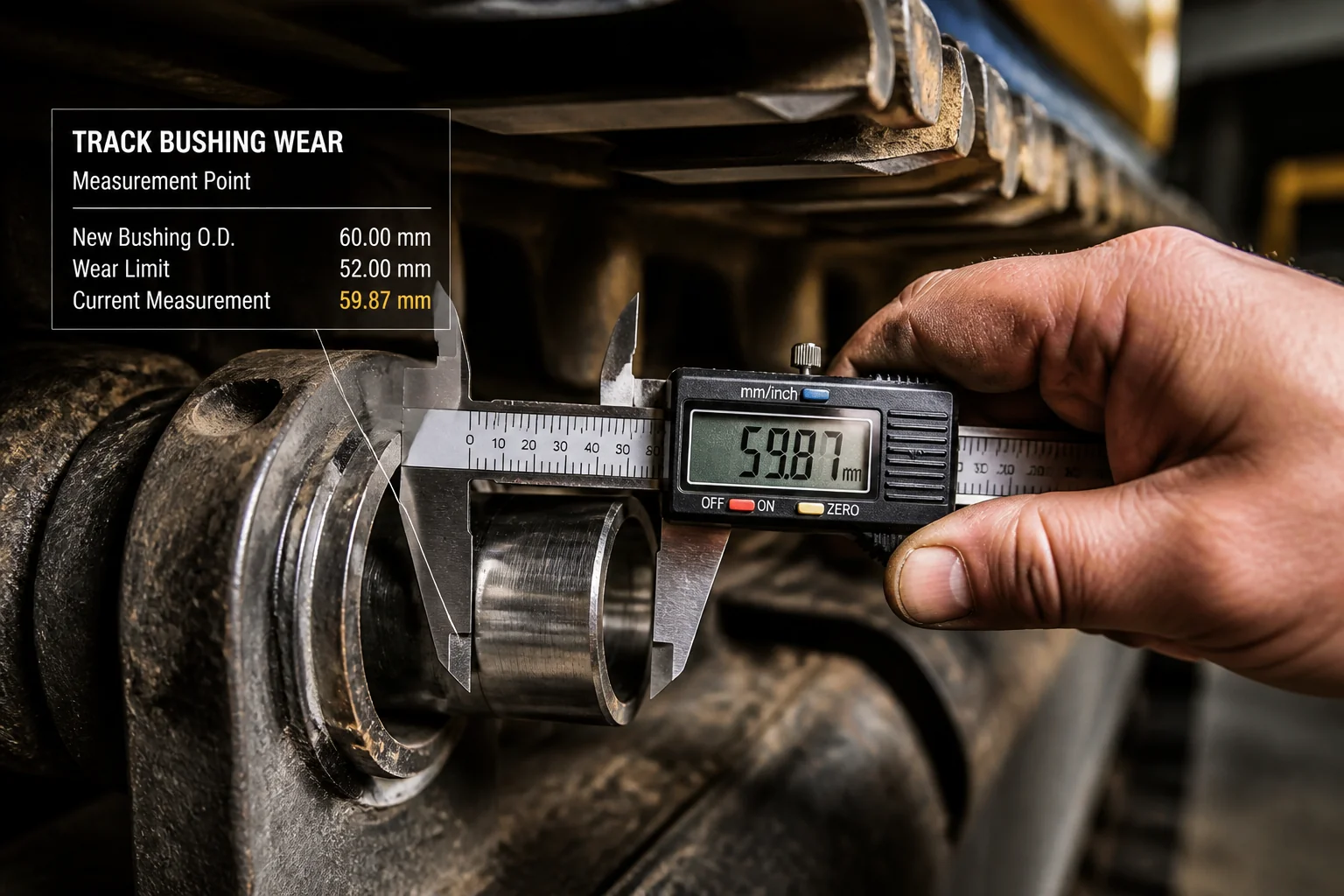
Technical evidence: Using ultrasonic sensors to verify track links have 85% residual life remaining.
5. The Digital Truth: Why Telematics Beats the Hour Meter
In 2026, the hour meter is merely a starting point. The real story of a machine's life lives inside the Electronic Control Module (ECM) and its onboard telematics.
Load History and Idle Time Analysis
Systems like Komatsu’s KOMTRAX or Caterpillar’s Product Link provide an unalterable record of operational history. We extract this data to identify the "load factor" of the machine’s life. A machine with 4,000 hours that has spent 80% of its time in "Heavy Power Mode" at 100% load has a mechanical age much higher than one that spent 80% in "Economy Mode" for utility work.
Furthermore, we analyze the ratio of idle time to working time. High idle time often suggests the machine sat while waiting for trucks—a low-stress life. Conversely, a machine with zero idle time and high fuel burn suggests it was pushed to its limits in a 24/7 quarry environment. This data-driven transparency is why contractors trust our china used machinery export services; we don't just show you the meter; we show you the brain.
6. Sourcing Mastery: The Strategic Advantage of the Shanghai Export Hub
China’s domestic infrastructure cycle is the most rapid in industrial history. Consequently, perfectly maintained machines from 2020-2023 are consistently being released into the wholesale market to make room for new Stage V and Tier 4 units.
The Capital Arbitrage
Buying a used CAT 320 for sale from a reputable Shanghai yard offers a price-to-hour ratio that is unmatched globally. A 3,000-hour unit that has been certified and refurbished often lands at 45% of the price of a new unit from an overseas dealer. This capital advantage allows contractors to scale their fleets 30% faster with the same budget, providing the muscle needed to win larger government infrastructure contracts.
Conclusion: The Professional Choice for 2026
Success in the earthmoving business isn't just about digging—it’s about managing the "cost per cubic meter" of your operation. By prioritizing certified technical audits, verifying relief pressures through stall tests, and calculating the residual wear life of the undercarriage, you transform a potentially bankrupting purchase into a predictable, high-ROI asset. The operators who dominate the 2026 construction landscape are the ones who buy with their eyes on the data and their hands on the welds. Explore our full catalog of verified heavy machinery today, and let us provide the technical evidence you need for your next fleet expansion.
Frequently Asked Questions (FAQ)
1. How long does a typical hydraulic pump last on a used Caterpillar or Komatsu?
With a strict maintenance schedule and the use of genuine 10-micron filters, a high-quality variable displacement pump is engineered for 12,000 to 18,000 operational hours. However, internal bypass can begin as early as 6,000 hours if the hydraulic oil is contaminated with water or metallic particulates.
2. Which is better for road construction: a 20-ton or a 30-ton excavator?
For most road projects, a 20-ton class machine like the **CAT 320** or **Komatsu PC200** is the industry standard. It offers the best balance of breakout force and transportability. A 30-ton unit moves more material but requires specialized heavy-haul permits.
3. What is the single most important document when importing from China?
Beyond the Bill of Lading, you must demand a **Certified 150-Point Technical Inspection Report**. This document should contain NDT (Non-Destructive Testing) results for the boom and verified hydraulic cycle times.
4. Can I easily find spare parts for a machine sourced from a Shanghai yard?
Absolutely. Global brands like Caterpillar, Hitachi, and Komatsu use standardized parts. China is the global manufacturing hub for these components, ensuring 7-10 day delivery to most major ports.
5. How do you protect the machine from rust and corrosion during sea transit?
For containerized shipments, machines are sealed in a dry environment. For Ro-Ro, we apply specialized anti-corrosion wax (such as Tectyl) to all exposed chrome and treat electrical connections.