Accueil / Blog
2026 Global Procurement Guide: Technical Audit and Logistics for Used Excavators
A procurement checklist covering technical inspection questions, hydraulic testing and export-logistics terms for used machinery. Confirm each requirement for the machine and destination country.
August 3, 2026 · Technical Guide
Le contenu technique complet est disponible en anglais afin de conserver les termes d’origine.
The heavy equipment industry in 2026 is defined by a flight to quality. As global infrastructure projects demand tighter schedules and lower carbon footprints, the reliability of your excavation fleet becomes the primary factor in contract profitability. Buying a used excavator from China—when backed by a certified technical audit—offers a significant capital advantage, providing tier-one engineering at a 30-40% wholesale discount compared to new inventory. However, the technical delta between a 'running' machine and a 'production-ready' machine is vast. This report provides contractors and procurement officers with the professional framework needed to evaluate, secure, and transport the most reliable pre-owned iron in the 20-ton to 50-ton categories.
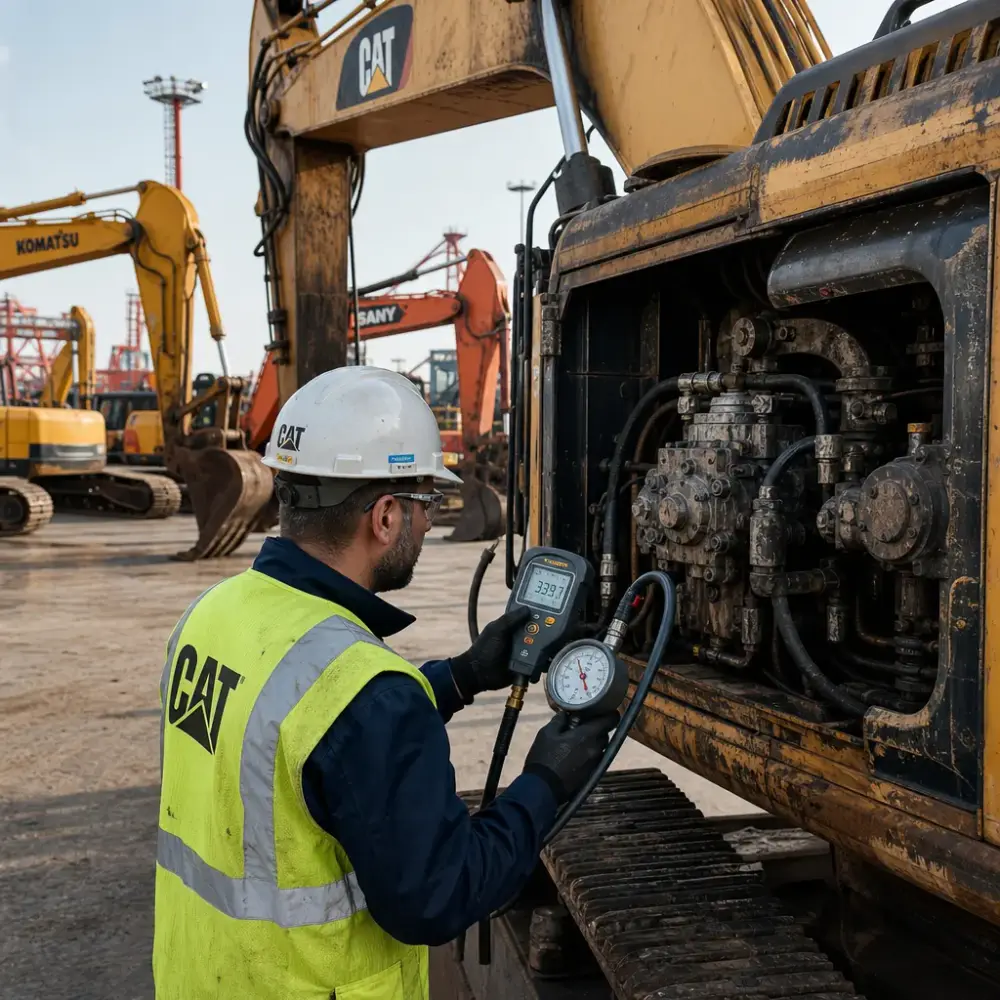
Our technical team performing a 150-point audit on a used CAT 320D for sale, verifying hydraulic volumetric efficiency.
1. The Foundation of Value: Engine Compression and Thermal Stability
The powertrain remains the most critical variable in the lifespan of any hydraulic machine. In our yard, every unit, including the popular used CAT 320D for sale, undergoes a rigorous engine health diagnostic. We utilize digital compression testers to ensure that each cylinder maintains its factory-specified PSI within a 5% variance. A primary indicator of engine fatigue is 'blow-by'—the migration of combustion gases into the crankcase. We perform a standardized blow-by analysis by measuring pressure at the breather tube during high-load stall tests. A healthy Cat C6.4 or Komatsu SAA6D107E engine should exhibit zero visible smoke and maintain a clear exhaust profile during cold-start cycles.
Thermal stability is equally vital. We run engines for 45 minutes to reach peak operating temperature, monitoring the coolant and oil heat exchange rates. In the tropical climates of our Southeast Asian and African clients, an engine that 'runs hot' will suffer from accelerated seal degradation and reduced fuel atomization. Our audits confirm that the radiator core integrity and thermostat response meet 2026 performance benchmarks, ensuring that your machine can handle 10-hour shifts in high-ambient environments without power derating.
2. Hydraulic Integrity: The Volumetric Efficiency and Pressure Stall Test
While the engine provides the power, the hydraulic pumps convert that torque into digging force. Volumetric efficiency is the measure of how much oil the pump actually delivers compared to its theoretical maximum. As pumps wear, internal bypass occurs, resulting in slower cycle times and increased fuel burn. During our technical audits of Komatsu PC200-8 specifications, we perform a 'stall test': raising the boom to its mechanical limit and holding the pilot controls to verify that the main relief valve maintains consistent system pressure (typically 33-35 MPa). Any fluctuation in pressure indicates internal piston barrel wear or a compromised control valve spool.
We also measure simultaneous multi-function response. A high-quality used Sany SY215C production report should show that the machine can swing, lift, and curl the bucket simultaneously without hydraulic hesitation. This 'harmony' of movement is what allows operators to finish projects on schedule. In our Shanghai yard, we provide HD video evidence of these pressure tests for every machine, giving global buyers the technical transparency needed for remote procurement.
3. Undercarriage Longevity: Calculating Residual Wear Life
The undercarriage of a crawler machine accounts for nearly 50% of its lifetime maintenance cost. When evaluating the used excavator cost, you must calculate the 'Residual Wear Life' (RWL) of the track components. We use ultrasonic thickness gauges to measure the link height and bushing diameter. On a 95% new unit, the links should show minimal scalloping and the sprocket segments must retain their rounded factory profile. Sharp, 'shark-tooth' sprockets indicate a machine that has worked in abrasive materials or with incorrect track tension, signaling imminent repair costs.
A critical focus area is the Sealed and Lubricated Track (SALT) joints. We check for 'dry' joints—pins that have lost their internal lubrication, leading to excessive friction and heat. A machine with 80% undercarriage life remaining is worth a $10,000 premium over a unit at 40% life, as it represents thousands of hours of productive work before a major rebuild is required. Our 150-point report includes a granular breakdown of each undercarriage component, from the front idlers to the heavy-duty track rollers.
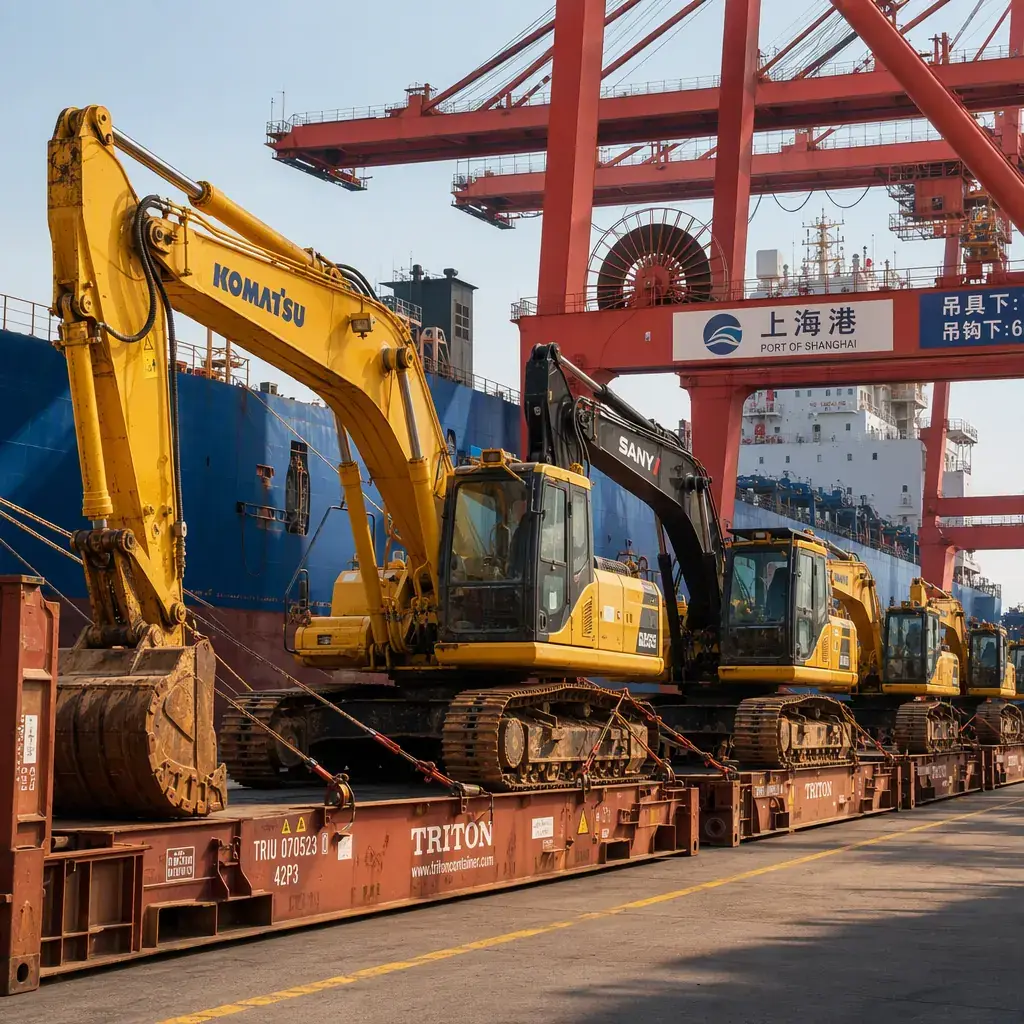
Global export logistics at Shanghai Port: Professionally securing heavy iron for trans-oceanic delivery.
4. The 2026 Digital Yard: Telematics and Electronic Diagnostics
Modern machinery procurement involves more than just mechanical checks; it requires a digital audit of the machine's onboard brain. Systems like Caterpillar's Product Link and Komatsu's KOMTRAX provide a data trail of the machine's entire operational history. We use specialized diagnostic software to extract these telematics reports, identifying the percentage of idle time versus working time and checking for 'ghost' error codes that may have been cleared but suggest intermittent sensor or electrical failures.
A digital audit also verifies the authentic hour-meter reading. In a market where 'tampered' meters can be a risk, telematics provides an unalterable record of fuel burn and operational cycles. This transparency is why we are the preferred heavy machinery exporter from China for corporate fleets that require absolute data integrity. We ensure that the digital cabin monitors are fully functional and that all electronic control modules (ECMs) are operating within factory software parameters.
5. Global Export Mastery: Secure Lashing and Customs Mastery
The final stage of a successful procurement is the safe delivery of the asset to your port of entry. Transporting a 20-ton used CAT 320D or a 50-ton mining excavator requires specialized logistics expertise. At Shanghai Port, we utilize two primary methods: 40HQ containers (for machines where the cabin and arm can be safely dismantled) and Flat Racks or Ro-Ro vessels for heavy units.
Securing the machine is an engineering task in itself. We apply industrial-grade steel lashing and structural bracing to prevent any shifting during rough ocean transit. Any movement in the hold can lead to catastrophic damage to the hydraulic cylinders or glass. Furthermore, our logistics team manages the entire documentation chain—from the Bill of Lading and Certificate of Origin to the pre-shipment inspections required by specific countries (such as CCIC or Bureau Veritas). Our goal is to ensure that your machine clears customs at your local port with zero administrative delays.
6. Comparison Matrix: Performance Benchmarks for Used Excavators
| Model | Key Strength | Max Relief Pressure | Target RWL |
|---|---|---|---|
| Used CAT 320D | Structural Over-Engineering | 35.0 MPa | 85% + |
| Komatsu PC200-8 | Hydraulic Sensitivity | 37.3 MPa | 80% + |
| Sany SY215C | Unbeatable ROI Speed | 34.3 MPa | 90% + |
Conclusion: The Data-Driven Path to Fleet Profitability
Choosing the right iron for your 2026 projects is a decision that defines your technical and financial future. By prioritizing used excavators technical audits and partnering with a transparent heavy machinery exporter from China, you secure more than just a machine; you secure a production engine that will drive your business success. Whether you are scaling for mining or residential infrastructure, our yard is dedicated to providing verified, high-performance machinery that arrives project-ready. Explore our full used excavator catalog today and take the first step toward a more profitable project outcome.
Frequently Asked Questions: Global Machinery Procurement
How do you verify the engine hours on a used excavator?
We use a combination of telematics data extraction (KOMTRAX/Product Link) and physical pedal-wear and cab-interior condition audits to ensure the hour meter matches the machine's mechanical DNA.
What is the benefit of buying a used Sany SY215C?
The Sany SY215C offers a significantly faster ROI due to its lower acquisition cost and the abundance of original spare parts in China, making it ideal for high-production Material handling projects.
Can you arrange door-to-door shipping?
We provide full Port-to-Port shipping services and can coordinate with your local freight forwarder for door-to-door delivery, handling all China-side export declarations.
How do you secure heavy excavators during sea transit?
We apply industrial-grade steel lashing and structural bracing to the machine's chassis points, ensuring it remains stationary even in severe weather conditions at sea.
Do you provide technical support after the machine arrives?
Yes. Our team of engineers provides remote technical guidance and can assist in sourcing genuine maintenance kits for your first 2,000 hours of operation.