Accueil / Blog
How to Import Used Excavators from China in 2026: A Country-by-Country Guide for Africa, Southeast Asia and Latin America
An overview of questions to research when importing used excavators from China, including ports, HS classification, local compliance, payment and shipping. Rules and costs must be checked with local authorities and providers.
August 5, 2026 · Import Guide
Le contenu technique complet est disponible en anglais afin de conserver les termes d’origine.
Global construction spending in 2026 has crossed 15.8 trillion USD, and a very large share of that growth is happening outside the mature markets of Europe and North America. Contractors in Nigeria are building roads under the Renewed Hope Infrastructure Programme. Kenyan operators are executing dam and irrigation projects on tight national budgets. The Philippines Build Better More initiative alone is releasing more than 200 civil packages per year. In every one of these markets, the fastest and most capital-efficient way to grow a fleet is to import used excavators from China, where a well-inspected 20-ton crawler in near-new condition can be secured for a fraction of the price of a new dealer unit. This guide is written for the operator, procurement officer or fleet owner who wants an operational, no-nonsense playbook — not a general trade essay — and every section is grounded in the shipments we handle out of Shanghai every week.
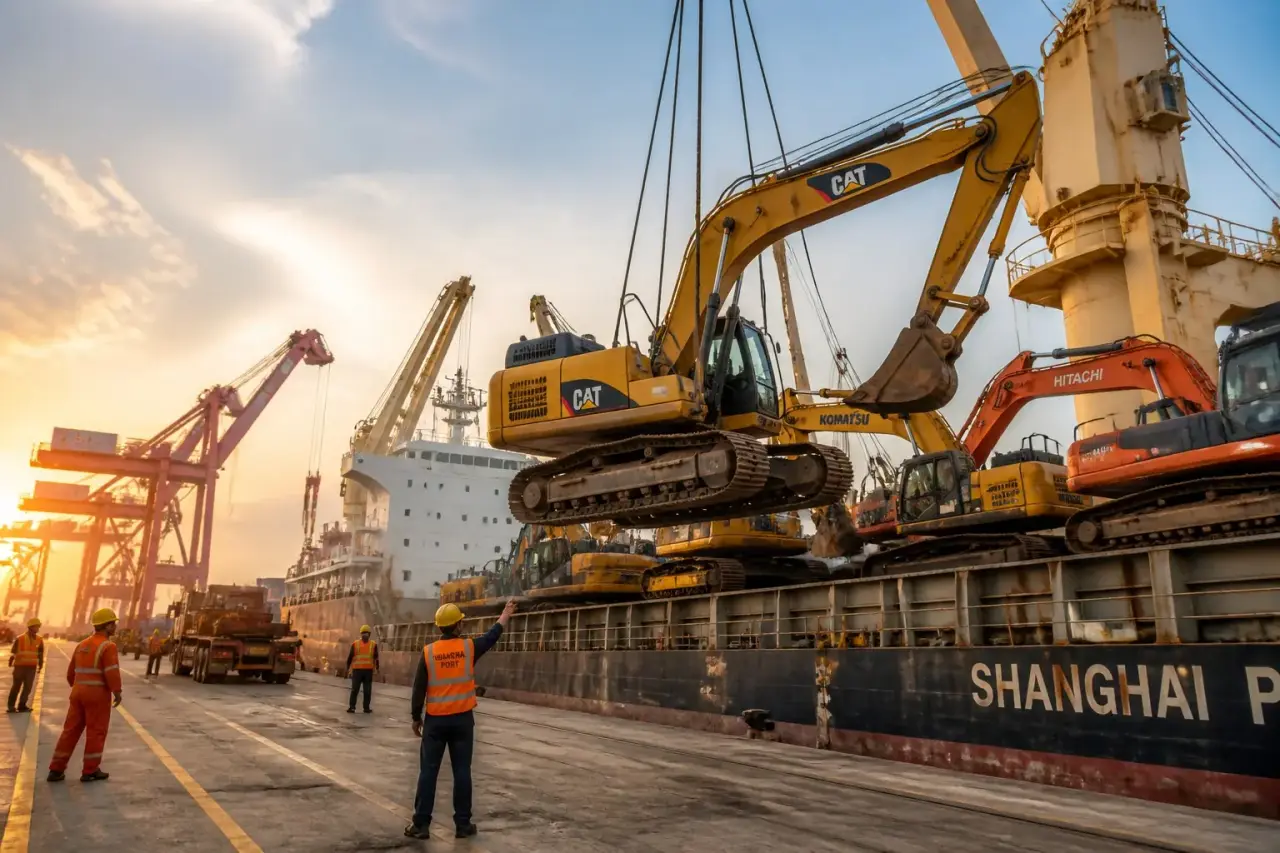
Shanghai Port loading: certified used excavators being staged for Ro-Ro and container shipment to Africa, Southeast Asia and Latin America.
1. Why 2026 Is the Best Year to Import Used Excavators from China
Three market forces have converged in 2026 to make Chinese used excavators the single best value in the global secondary market. First, the domestic renewal cycle: infrastructure operators in China are replacing 2015 to 2019 vintage fleets with new Tier 4 and Stage V machines, releasing a large volume of low-hour, well-maintained Caterpillar, Komatsu, Hitachi, Volvo and Kobelco iron into the wholesale channel at 30 to 45 percent below overseas retail prices. Second, ocean freight rates from Shanghai and Ningbo to West Africa, East Africa and Southeast Asia have stabilized after the 2024 disruption cycle, with 40HQ container rates to Lagos back below 3,200 USD and Ro-Ro slots to Mombasa and Dar es Salaam consistently available within 21 days. Third, Chinese export documentation and customs pre-clearance workflows are now the most digitally streamlined of any major machinery export origin, meaning a machine you buy today can be at your local port in 30 to 45 days for Africa and 15 to 25 days for Southeast Asia.
For a mid-size contractor, the arithmetic is decisive. A new 20-ton Caterpillar 320 from a European dealer channel typically lands at 235,000 to 260,000 USD, delivered. A 2020 to 2022 vintage used CAT 320D for sale from a Shanghai yard — inspected, refurbished and lashed for containerized ocean transport — lands in Lagos or Manila for 55,000 to 78,000 USD depending on hours and specification. That single procurement decision can free up 150,000 USD of working capital per machine, which most fleet owners redeploy into a second unit, a bucket set, a mobile fuel bowser, or a two-year operator training program. Multiplied across a fleet of five to ten machines, the capital arbitrage becomes the single biggest lever a growing contractor has in 2026.
2. Buyer Framework: Match the Machine to the Job Before You Wire a Deposit
The most common mistake we see with first-time international buyers is choosing the wrong tonnage class for the actual job profile. A 30-ton excavator on a residential subdivision burns twice the fuel of a 20-ton unit while delivering no productivity gain, because the bucket cycles are shorter than the swing radius allows. Conversely, a 13-ton mini-excavator on a highway earthworks project spends 40 percent of its time idle waiting for larger equipment to move material away. Before you shortlist a machine, write down four numbers: average daily production target in cubic meters, average trench or foundation depth in meters, transport corridor width in meters, and destination fuel cost per liter. Those four numbers determine your ideal tonnage class more accurately than any brochure.
Once tonnage is locked, brand selection becomes a matter of local support ecosystem. In Nigeria, Ghana and Kenya, Caterpillar and Komatsu enjoy the deepest parts networks and the largest independent mechanic pool, so a Caterpillar 320D or a used Komatsu PC200 for sale will keep your downtime lowest. In the Philippines, Indonesia and Vietnam, Japanese brands dominate — Komatsu, Hitachi and Kobelco all have OEM warehouses in Manila, Jakarta and Ho Chi Minh City, and mechanics trained on these platforms are widely available. In Peru, Chile and Colombia, Caterpillar and Volvo lead the mining and civil segments, with well-established regional dealers holding genuine parts. Buying the right brand for the right market means you never wait more than 72 hours for a critical hydraulic seal, main pump repair kit or track link replacement.
3. Country-by-Country Import Playbook
3.1 Nigeria
Nigeria is the single largest African destination for Chinese used excavators, and Lagos Apapa Port handles the vast majority of arrivals. The country classifies used excavators under HS code 8429.52.00 with an import duty rate of 5 percent plus 7.5 percent VAT, calculated on the CIF value declared to Nigeria Customs Service. A pre-shipment inspection through the Nigeria Certificate of Conformity programme, currently administered by Cotecna and SGS, is required, and we handle the appointment and documentation from Shanghai as a standard part of every Lagos shipment. Total landed cost for a 20-ton crawler typically sits at 8 to 11 percent above FOB price, and clearance in Apapa averages 9 to 14 working days once the vessel berths. The Lekki Deep Sea Port is now a reliable alternative for shipments destined for Ogun and Lagos East corridors, with congestion consistently lower than Apapa.
3.2 Kenya
Mombasa Port is the entry point for essentially all East African used excavator imports. Kenya requires a pre-export verification of conformity through KEBS, which we schedule with QISJ or Intertek before the container leaves Shanghai. Import duty for used excavators is 10 percent on CIF value, with VAT of 16 percent, IDF of 2.5 percent and Railway Development Levy of 1.5 percent. The Standard Gauge Railway now moves containers from Mombasa to Nairobi Inland Container Depot in under 24 hours, cutting the traditional road-haul lead time by more than a week. For upcountry destinations in Kisumu, Eldoret or Kitale, we recommend Ro-Ro discharge and a licensed heavy-machinery haulier from Mombasa rather than containerized road transport, because the disassembly and reassembly cycle at destination adds two weeks otherwise.
3.3 Ghana
Tema Port is Ghana's primary entry point for heavy machinery, and Takoradi handles western corridor destinations. Ghana charges a 5 percent import duty on used excavators plus 15 percent VAT, 2.5 percent NHIL and 2.5 percent GETFund on the duty-inclusive value. The Integrated Customs Management System now processes most heavy-equipment declarations within 5 to 8 working days provided the pre-arrival inspection through GSA is completed. Cocoa road rehabilitation and the Western Region gold-belt haul-road programme are driving strong 2026 demand for 20 to 30 ton crawlers, and Ghanaian buyers increasingly prefer Caterpillar and Hitachi platforms for their parts availability at Accra dealers.
3.4 Philippines
Manila South Harbor and Batangas Port together handle more than 80 percent of Chinese used excavator arrivals in the Philippines. Import duty is 3 percent on used excavators under HS 8429.52 with 12 percent VAT on the duty-inclusive value. The Bureau of Customs requires a Certificate of Registration through the Land Transportation Office only for wheeled excavators; crawler machines do not need LTO registration. Clearance in Manila typically runs 7 to 12 working days, and Batangas is noticeably faster at 4 to 7 days for shipments destined for CALABARZON industrial zones. The 20 to 22 ton class dominates the Philippine market because it matches the load capacity of standard 10-wheeler dump trucks used across the archipelago, making used Hitachi ZX200 price and specs queries among the highest-volume searches from Filipino contractors.
3.5 Indonesia
Tanjung Priok in Jakarta is the primary port, with Tanjung Perak in Surabaya handling shipments to East Java and Kalimantan. Indonesia imposes a 5 percent import duty on used excavators plus 11 percent PPN VAT and 2.5 percent PPh income tax withholding. The pre-shipment inspection through Sucofindo or Surveyor Indonesia is mandatory and must be scheduled before container loading in Shanghai — we handle this end to end. Clearance in Tanjung Priok averages 8 to 12 days, though the customs risk-management channel color assignment can extend this to 18 days for machines with incomplete documentation. Indonesian nickel mining, palm plantation road development and metropolitan MRT construction are driving strong demand for 20 to 40 ton crawlers in 2026.
3.6 Vietnam
Haiphong Port serves northern Vietnam and Ho Chi Minh Cat Lai Port serves the south. Vietnam requires used excavators to be no older than 10 years from date of manufacture — a critical compliance point that eliminates roughly 30 percent of the Chinese wholesale inventory from consideration. Import duty is 0 to 5 percent depending on the ACFTA certificate of origin, plus 10 percent VAT. Clearance runs 5 to 9 working days at both ports. Vietnamese contractors have a strong preference for Japanese-brand equipment with original Isuzu, Mitsubishi or Yanmar engines, so Komatsu, Hitachi and Kobelco units consistently outperform Chinese-brand equivalents in the local secondary resale market.
3.7 Peru
Callao Port handles almost all Chinese heavy-machinery arrivals in Peru. Import duty is 0 percent for used excavators under the China-Peru Free Trade Agreement provided the certificate of origin Form C is issued in Shanghai, and IGV VAT of 18 percent applies to the CIF value. Callao clearance runs 7 to 14 days and requires a technical file translated into Spanish by a certified translator. The Peruvian mining sector — copper in Arequipa and Cajamarca, gold in Puno — drives consistent demand for 25 to 45 ton excavators with reinforced undercarriages. We recommend Ro-Ro discharge at Callao rather than containerized shipment for machines above 25 tons, because the reassembly cycle at destination adds four to six weeks otherwise.
3.8 Colombia and Chile
Colombian imports enter primarily through Buenaventura on the Pacific coast and Cartagena on the Atlantic. Chile receives shipments through San Antonio and Valparaiso. Both countries apply 0 to 6 percent import duty on used excavators depending on free-trade agreement coverage, with VAT of 19 percent in both markets. Chile requires a technical homologation from CESMEC before the machine can be registered for on-road transport, while Colombia's process through the Superintendencia de Industria y Comercio is simpler and typically completes in 10 to 15 days after clearance. Both markets have well-established Caterpillar and Volvo dealer networks, and the price premium for these two brands versus Komatsu or Hitachi is notably higher than in African or Southeast Asian markets.
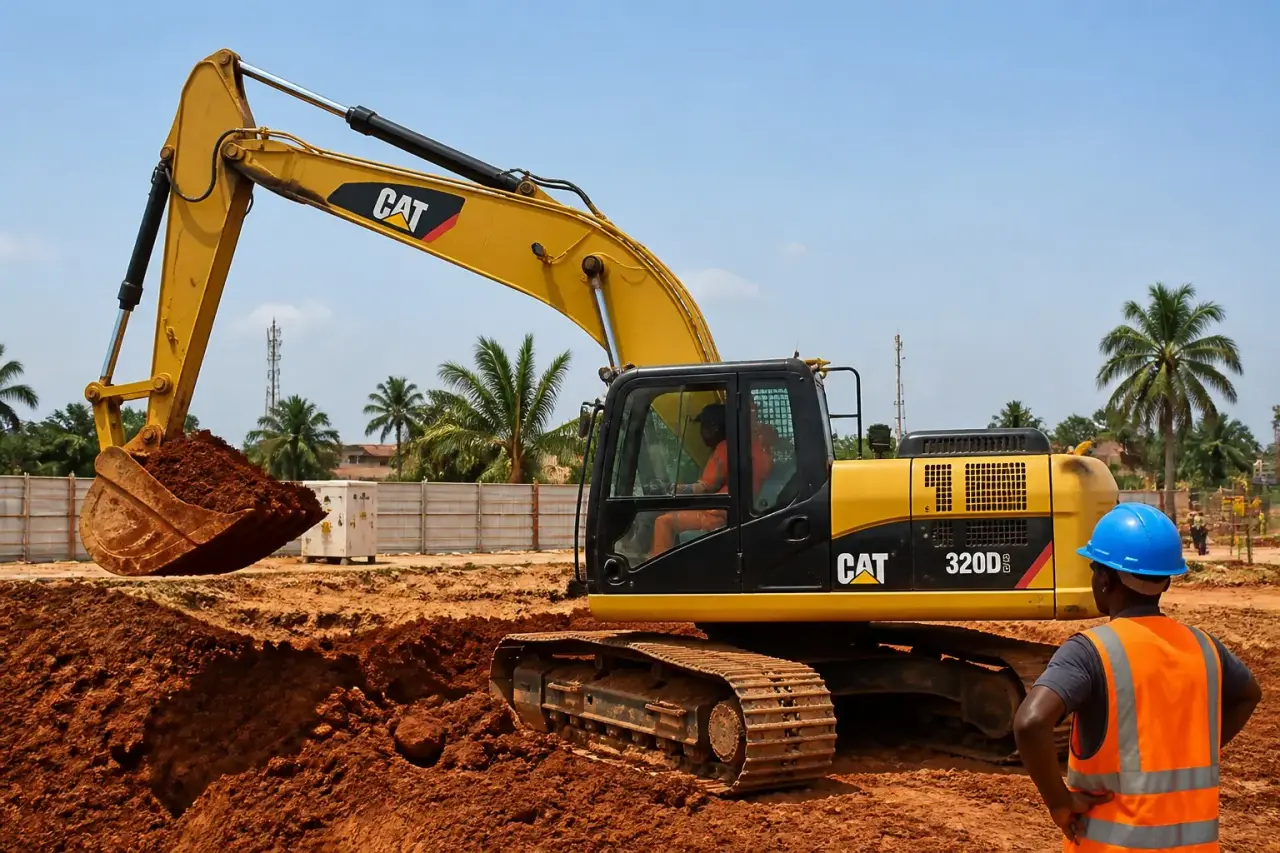
A refurbished used CAT 320D excavator on active duty at a Lagos highway rehabilitation project — the single most popular tonnage class among African contractors.
4. HS Codes, Duty Rates and Landed-Cost Comparison
Every used excavator shipment moves under HS chapter 84.29, with the standard subheading for self-propelled crawler mechanical shovels being 8429.52. Wheeled excavators sit under 8429.51, and mini-excavators under 6 tons are frequently classified under 8429.52 with a country-specific mini-excavator qualifier. Declaring the correct HS is not optional — the wrong classification triggers customs re-inspection, storage fees and, in extreme cases, seizure. Our export documentation package always includes the correct HS breakdown, chassis serial number verification, and a technical description sheet in the customs language of the destination country.
| Country | Main Port | Import Duty | VAT/Sales Tax | Total Add-On vs FOB |
|---|---|---|---|---|
| Nigeria | Lagos Apapa / Lekki | 5% | 7.5% | 18-22% |
| Kenya | Mombasa | 10% | 16% | 32-36% |
| Ghana | Tema / Takoradi | 5% | 15% | 25-28% |
| Philippines | Manila / Batangas | 3% | 12% | 17-20% |
| Indonesia | Tanjung Priok | 5% | 11% | 20-24% |
| Vietnam | Haiphong / Cat Lai | 0-5% | 10% | 12-18% |
| Peru | Callao | 0% (FTA) | 18% | 21-24% |
| Colombia | Buenaventura | 0-6% | 19% | 22-28% |
5. Ocean Freight, Container vs Ro-Ro, and Insurance
Shipping a used excavator from China to your port is a technical exercise, not a commodity spend. For machines under 22 tons the standard route is containerized shipment in a 40HQ container, which protects the machine from ocean spray, port handling damage and pilferage, and simplifies customs clearance at destination because the machine arrives sealed. For machines between 22 and 35 tons, we usually recommend flat-rack containers when the destination allows twin-crane discharge, or Ro-Ro service when the port has professional heavy-vehicle handling capability. For machines above 35 tons, Ro-Ro is almost always the correct choice — the vessel drives the machine on and off using its own tracks, eliminating the disassembly and lashing cycle that adds two to three weeks of transit time.
Marine insurance is not optional. A standard All-Risks policy under the Institute Cargo Clauses A costs 0.35 to 0.55 percent of the invoice value for reputable destinations and covers total loss, general average, partial damage and salvage costs. We arrange insurance through Ping An or China Pacific and can also work with your local broker if you prefer to keep the policy on your side. The single most important insurance point: the certificate must name the destination consignee, not the shipping agent, otherwise claim processing can add 60 to 90 days.
6. Payment, Financing and Escrow Structures for International Buyers
The Chinese used-machinery export industry now supports multiple payment structures beyond the traditional 30 percent deposit and 70 percent against copy of Bill of Lading. For first-time buyers, Alibaba Trade Assurance provides a solid escrow mechanism up to 200,000 USD per transaction, with dispute resolution and refund protection. For repeat buyers, we accept documentary Letter of Credit at sight through any major international bank, which many contractors prefer because the LC discipline forces documentation accuracy from the exporter. For larger fleet purchases, Sinosure-backed buyer credit through China Development Bank or Bank of China is available for creditworthy buyers in strategic markets, with terms up to 24 months. Whichever structure you choose, always insist on pre-shipment inspection by an independent agency named in the payment instrument — this is the single most effective protection any international buyer has against machinery mis-representation.
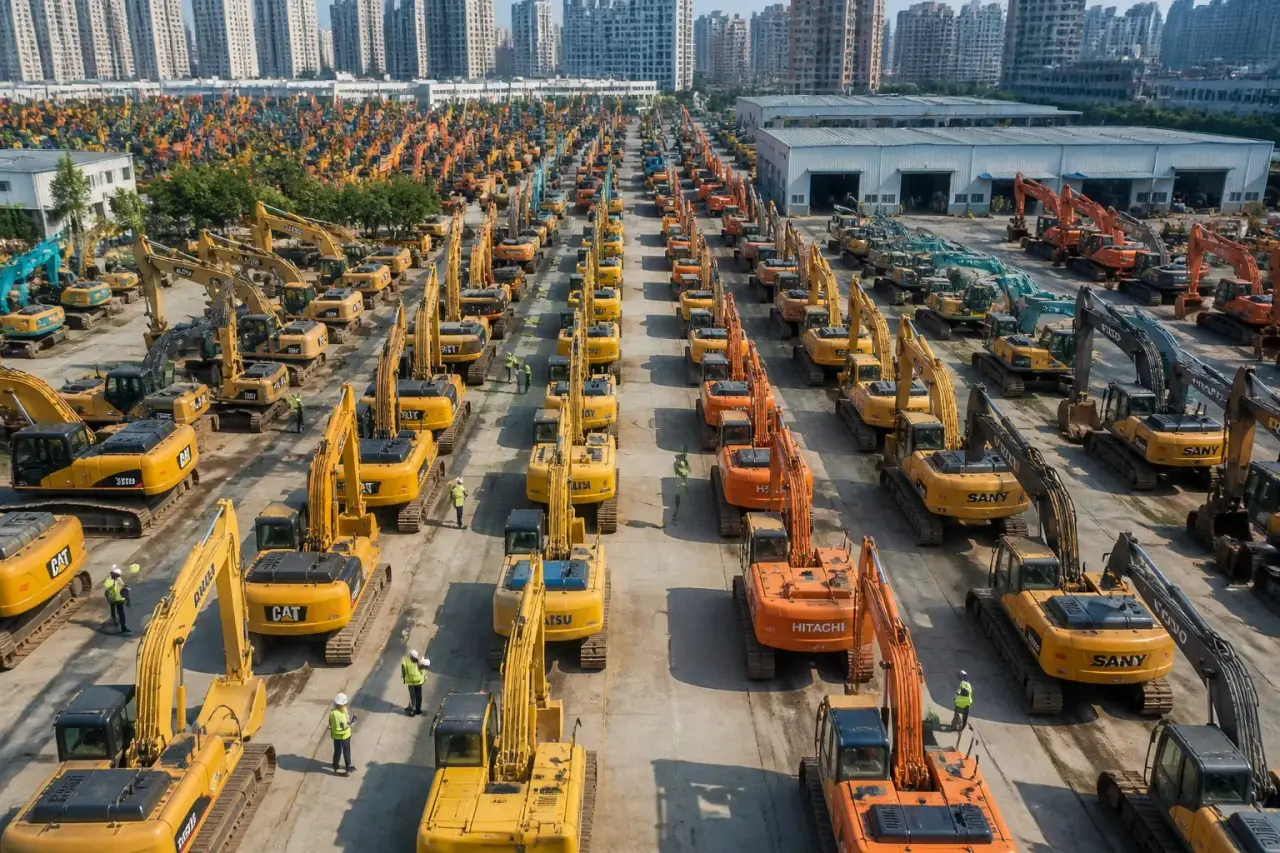
Aerial view of our Shanghai wholesale inventory yard — every machine is inspected before it enters this staging area, and re-inspected before it leaves for the port.
7. Delivery Timeline: What to Expect from Wire Transfer to Job Site
A realistic delivery timeline for a containerized 20-ton crawler from Shanghai is 45 to 65 days for East Africa, 40 to 55 days for West Africa, 25 to 40 days for Southeast Asia and 60 to 80 days for the Pacific coast of Latin America. The breakdown for a typical Lagos shipment is: 5 to 8 days for pre-shipment inspection and export documentation, 3 to 5 days for container stuffing and lashing at Shanghai Port, 28 to 32 days ocean transit, 2 to 4 days port berthing, 9 to 14 days customs clearance, and 2 to 5 days inland transport to your yard. Ro-Ro shipments to major ports typically save 7 to 12 days on the reassembly cycle at destination, which is why we default to Ro-Ro for machines above 25 tons whenever the port supports it.
8. Post-Delivery: Commissioning, Warranty and Parts Support
When the machine arrives at your yard the commissioning cycle takes 2 to 4 hours for a containerized unit and less than 60 minutes for a Ro-Ro shipment. We provide a step-by-step video commissioning guide in English, Spanish, French and Portuguese for every machine, and our technical team is available on WhatsApp for live troubleshooting during initial start-up. Every certified refurbished machine leaves our yard with a documented parts warranty covering the main pump, hydraulic distributor, swing motor, travel motor and engine cylinder head for a full 90-day operational window, and we maintain a genuine-parts stock program in Lagos, Nairobi, Manila and Callao that allows most consumables to reach your site within 5 to 10 working days. This after-sales infrastructure is what turns a one-time transaction into a multi-year fleet partnership, and it is the single most important quality signal to look for when comparing Chinese used-machinery exporters.
9. Common Pitfalls and How to Avoid Them
The three most common pitfalls we see international buyers fall into are all avoidable with the right process. First, buying based on photographs alone: always insist on an HD video walkthrough showing cold start, full hydraulic cycle and operation under load. Second, wiring funds to a supplier without any pre-shipment inspection instrument: whether Trade Assurance, LC at sight or an independent SGS report, always tie payment release to a verifiable inspection event. Third, underestimating the destination compliance burden: the difference between a 10-day clearance and a 45-day clearance is almost always a missing document or an incorrect HS declaration, both of which are 100 percent preventable when you work with an exporter who ships to your country every week. Our export documentation team maintains country-specific templates for every major destination and pre-clears the paperwork before the container is even loaded.
10. Building a Long-Term Fleet: The Repeat Buyer Advantage
The buyers who benefit most from Chinese wholesale channels are the ones who plan for repeat procurement rather than one-off transactions. Contractors who commit to three to five machines per year over a 24-month horizon get preferred inventory access, extended payment terms and consolidated shipping economics that reduce their landed cost per machine by an additional 6 to 9 percent. Just as importantly, they build a mechanical baseline: their operators learn one platform, their mechanics stock the right parts, and their fleet-management data starts telling them exactly which brand-model combination performs best in their specific operating environment. For a growing contractor, that operational compounding is worth more than any single-transaction price discount.
Conclusion: Your 2026 Procurement Playbook
The decision to import used excavators from China is no longer a leap of faith — it is a well-mapped, repeatable procurement discipline, and the operators who execute it correctly are building the fastest-growing construction fleets in Africa, Southeast Asia and Latin America. Match the tonnage class to your actual job profile, pick a brand that fits your local support ecosystem, verify the machine before payment, structure your payment through a real inspection instrument, and choose the freight mode that minimizes reassembly time at destination. Follow this discipline and you will land a certified 20-ton crawler at your yard for less than half the price of a new dealer unit, ready to earn its capital cost back within the first six months of operation. Browse our full catalog of certified used excavators or reach us directly on WhatsApp to discuss a shortlist for your next project.
Frequently Asked Questions
How long does it take to import a used excavator from China to my country?
For containerized shipments, count 25 to 40 days for Southeast Asia, 40 to 65 days for Africa and 60 to 80 days for Latin America, from wire transfer to arrival at your local port. Ro-Ro shipments save 7 to 12 days on the destination reassembly cycle. Actual customs clearance adds 5 to 14 days depending on the port, so a realistic wire-to-yard timeline for a Lagos or Mombasa delivery is roughly 60 to 75 days.
What is the total landed cost above the FOB price?
Total landed cost above FOB typically runs 17 to 36 percent depending on destination, made up of ocean freight, marine insurance, import duty, VAT, port handling and inland transport. Vietnam and the Philippines sit at the low end near 15 to 20 percent, while Kenya and Colombia can reach the mid-30s. Our quotation sheet always breaks these line items out separately so there are no surprises at clearance.
Do I need a pre-shipment inspection, and who arranges it?
Most African destinations (Nigeria, Kenya, Ghana, Uganda, Tanzania) legally require pre-shipment inspection through Cotecna, SGS, Intertek or Bureau Veritas. Southeast Asian and Latin American destinations do not always require it but we still recommend it, because it is the single most effective buyer protection against machinery mis-representation. We arrange the inspection appointment in Shanghai as a standard part of every shipment.
Can I combine multiple machines into one container to save on freight?
Two mini-excavators under 6 tons each will fit into a single 40HQ container with proper disassembly. Machines between 6 and 22 tons ship one per 40HQ. Above 22 tons the machine typically requires a flat-rack container or Ro-Ro service. If you are buying a mixed fleet — for example one 20-ton crawler and two 6-ton mini-excavators — we usually recommend Ro-Ro to consolidate the shipment and save 15 to 20 percent on total freight cost.
What payment terms do you accept for first-time international buyers?
For first-time buyers we accept Alibaba Trade Assurance up to 200,000 USD per transaction, which provides third-party escrow and dispute resolution. We also accept irrevocable Letters of Credit at sight through any major international bank. For repeat buyers we offer 30 percent deposit and 70 percent against copy Bill of Lading. Every payment structure ties the balance release to a verifiable pre-shipment inspection event.