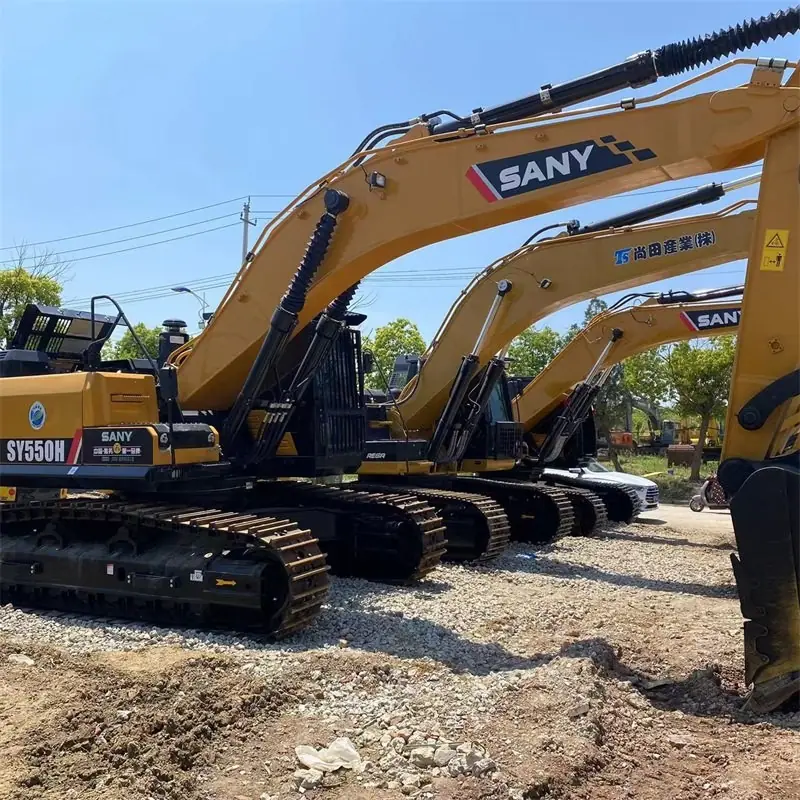
Excavadora usada Sany SY550H en venta
Respuesta rápida para compradores
Esta excavadora usada Sany SY550H es una máquina de orugas para movimiento de tierras y obras generales. La ficha muestra un precio de oferta de USD $35,000, un peso de referencia de 55t y un cucharón de 2.8m3. Confirme el número de serie, las horas, el estado y el envío de la unidad antes del pago.
- Precio publicado
- USD $35,000
- Peso operativo de referencia
- 55t
- Capacidad de cucharón de referencia
- 2.8m3
Descripción del modelo
Esta excavadora usada Sany SY550H es una máquina de orugas para movimiento de tierras y obras generales. La ficha muestra un precio de oferta de USD $35,000, un peso de referencia de 55t y un cucharón de 2.8m3. Confirme el número de serie, las horas, el estado y el envío de la unidad antes del pago.
Las secciones técnicas y las preguntas frecuentes se ofrecen en inglés para conservar la terminología original.
The Flagship Production Class: Deep Technical Diagnostics for Serious Buyers
This used SANY SY550H PRO excavator is a 55-ton flagship-tier mining-class production platform whose acquisition requires deep technical diagnostic rigor because at this capital scale, generic inspection produces inadequate condition confidence for defensible purchase decisions. For technical procurement specialists and mining fleet engineers evaluating this used SANY SY550H PRO excavator, understanding the deep technical diagnostic requirements for flagship-tier equipment is essential to appreciating why casual inspection approaches produce inadequate condition confidence at this capital scale. A 55-ton flagship-tier mining production machine represents substantial capital commitment where surface-level inspection findings fundamentally cannot support defensible acquisition decisions. The equipment complexity, component costs, and operational consequence patterns of flagship-tier machinery demand technical diagnostic rigor extending well beyond what mainstream production equipment inspection typically involves. Hydraulic system diagnostics require flow testing under sustained thermal load rather than casual pressure verification. Swing bearing evaluation requires precision radial play measurement across multiple positions rather than visual inspection alone. Undercarriage assessment requires quantitative wear measurement supporting percentage-remaining-life calculations. Structural evaluation requires ultrasonic testing at specific high-stress test points rather than visual weld inspection. Our documented audit protocol at our Shanghai facility explicitly delivers this technical diagnostic depth for flagship-tier equipment through calibrated instrumentation, structured inspection procedures, and detailed documentation supporting confident acquisition decisions.
Hydraulic Pump Diagnostic Testing Under Sustained Load
Hydraulic pump diagnostic testing for flagship-tier equipment requires flow measurement under sustained thermal load rather than casual pressure verification because pump degradation frequently manifests only under operational stress conditions. Hydraulic pump diagnostic testing represents one of the most consequential technical assessments for flagship-tier production equipment because pump replacement costs on machines at this scale typically represent five to ten percent of complete acquisition value. Casual inspection approaches examining pumps only at idle or under brief pressure verification frequently miss developing pump degradation that manifests only under sustained thermal load. Our diagnostic protocol conducts hydraulic pump testing across multiple operational conditions. Cold pump baseline testing establishes reference flow rates at controlled temperature. Warm pump testing after 60 minutes of continuous operation reveals thermal degradation patterns. Loaded pump testing under simulated working conditions reveals stress performance characteristics. Comparative flow analysis against factory specifications produces percentage-of-factory-performance figures that quantify pump condition rather than relying on qualitative descriptions. Case drain flow measurement reveals internal leakage patterns supporting predictive pump life estimation. This diagnostic rigor produces quantitative pump condition evidence that supports either confident acquisition at appropriate pricing or informed rejection when pump condition falls below flagship-tier standards.
Precision Swing Bearing Measurement Protocol
Precision swing bearing measurement for flagship-tier equipment requires radial play measurement across multiple bearing positions rather than casual visual inspection because swing bearing replacement represents one of the highest single-component costs for equipment at this scale. Precision swing bearing measurement represents another critical technical assessment because swing bearing replacement on flagship-tier equipment can represent fifteen to twenty percent of complete acquisition value including labor. Casual visual inspection fundamentally cannot detect swing bearing wear before it progresses to operational symptoms. Our diagnostic protocol conducts precision measurement across multiple bearing positions using dial indicator instrumentation. Radial play measurement at four points around the bearing circumference reveals wear distribution patterns supporting either uniform wear conclusions or asymmetric wear pattern identification. Axial play measurement supports thrust bearing condition assessment. Rotation smoothness evaluation using calibrated force measurement reveals developing bearing surface degradation. Bolt torque verification across the bearing mounting flange confirms proper bearing installation and detects any bolt loosening. Grease sample analysis when swing bearing configuration permits reveals internal contamination patterns supporting wear stage identification. This measurement rigor produces quantitative swing bearing condition evidence that traditional visual inspection cannot deliver, supporting acquisition decisions that account for one of the most significant potential lifecycle costs.
Undercarriage Wear Quantification Methodology
Undercarriage wear quantification produces precise remaining-life percentages across critical undercarriage components rather than generalized condition descriptions. Undercarriage wear quantification methodology delivers precise condition evidence supporting informed pricing decisions rather than the vague adjectives that traditional inspection approaches produce. Our measurement protocol quantifies wear across every critical undercarriage component using calibrated instrumentation and factory reference specifications. Track link pitch measurement using precision calipers produces exact remaining-life percentages compared to factory-new specifications. Track link plate thickness measurement supports individual link condition assessment. Bushing outside diameter measurement reveals bushing wear patterns supporting predictive replacement planning. Track pin diameter measurement supports pin wear evaluation. Roller flange thickness measurement produces roller condition percentages. Roller diameter measurement reveals rolling surface wear. Idler flange condition and diameter measurement supports idler assessment. Sprocket tooth profile measurement using contour gauges supports sprocket condition evaluation. Track shoe grouser height measurement reveals shoe wear patterns. This comprehensive measurement approach produces a complete undercarriage condition report supporting confident acquisition decisions and accurate replacement cost planning across the near-term ownership period.
Structural Ultrasonic Testing at Specific Test Points
Structural ultrasonic testing focuses on specific high-stress test points where fatigue crack development typically originates on flagship-tier production equipment. Structural ultrasonic testing represents a critical diagnostic dimension because structural failure on flagship-tier equipment can create catastrophic operational and financial consequences that dwarf inspection cost investment. Our ultrasonic inspection protocol targets specific test points identified through accumulated inspection experience across flagship-tier equipment as high-probability fatigue crack initiation zones. Boom foot casting internal ultrasonic scanning reveals internal cracks invisible to visual inspection. Stick box internal weld inspection detects weld root cracks that develop under sustained bending stress. Bucket linkage pin bore ultrasonic scanning reveals bore fatigue cracks. X-frame junction ultrasonic testing detects torsional stress crack development at critical structural intersections. Track frame side plate ultrasonic scanning reveals fatigue crack development in the highly stressed track frame structure. Swing bearing mounting flange ultrasonic testing supports mounting integrity verification. Counterweight mounting point ultrasonic inspection detects mounting stress crack development. This targeted ultrasonic testing produces structural condition evidence that visual inspection fundamentally cannot deliver, supporting flagship-tier acquisition decisions that account for structural integrity across the anticipated ownership horizon.
Engine Diagnostic Depth for Flagship Powertrains
Engine diagnostic depth for flagship powertrains includes compression testing, injector spray analysis, turbocharger performance verification, and cooling system efficiency measurement. Engine diagnostic depth for flagship-tier powertrains extends substantially beyond casual engine assessment because engine overhaul on flagship-tier equipment represents twenty to thirty percent of complete acquisition value. Casual engine inspection through visual examination and brief operational verification fundamentally cannot support flagship-tier acquisition decisions. Our comprehensive engine diagnostic protocol includes multiple assessment dimensions. Compression testing across all cylinders reveals combustion chamber condition and identifies developing head gasket, valve, or ring problems. Fuel injector spray pattern verification through visual testing during cranking reveals injector condition affecting combustion efficiency. Turbocharger boost pressure measurement under sustained load reveals turbo condition affecting engine performance. Cooling system efficiency measurement including radiator performance and coolant flow rates reveals thermal management capability. Oil analysis reveals internal engine wear patterns supporting predictive maintenance planning. Emissions system integrity verification confirms compliance with destination market requirements. This diagnostic depth produces engine condition evidence supporting confident acquisition decisions that account for one of the most significant potential lifecycle cost centers.
Attachment Configuration Verification for Flagship Equipment
Attachment configuration verification for flagship equipment documents specific configuration details including bucket teeth pattern, hydraulic circuit provisions, and quick coupler compatibility. Attachment configuration verification for flagship equipment addresses configuration details that dramatically affect deployment readiness and application flexibility. Our verification protocol documents attachment-related configuration across multiple dimensions. Standard bucket capacity confirmation with dimensional measurement verifies bucket suitability for anticipated applications. Bucket teeth pattern documentation including tooth count, spacing, and adapter configuration supports parts sourcing planning. Bucket cutting edge and side cutter condition assessment reveals bucket usable life. Auxiliary hydraulic circuit provisioning verification confirms availability of attachment operation hydraulic connections. Circuit pressure and flow rating documentation supports specific attachment compatibility verification. Quick coupler installation or provisioning confirms attachment change flexibility. Boom and stick configuration confirmation including standard, long-reach, or special configurations supports application planning. Counterweight configuration verification confirms lifting capacity implications. Track shoe width documentation supports ground pressure and traction analysis. This comprehensive attachment configuration verification supports confident deployment planning and prevents the deployment surprises that can occur when attachment expectations do not match delivered equipment configuration.
Operator Station Deep Inspection
Operator station deep inspection assesses cabin condition, control system function, monitor operation, safety system integrity, and ergonomic feature status. Operator station deep inspection assesses multiple critical dimensions affecting operational productivity and safety performance across the ownership period. Cabin structural integrity assessment includes ROPS certification verification and structural damage inspection. Cabin sealing effectiveness testing under positive pressure conditions verifies operator protection from dust and noise. Climate control system testing including cooling capacity, heating capacity, and airflow measurement verifies system function. Control system function verification tests every pilot control, foot pedal, and switch to confirm operational readiness. Monitor system verification including every screen function, warning system operation, and diagnostic capability confirms electronic system integrity. Safety system verification including emergency stop function, hydraulic lockout operation, ROPS integrity, and FOPS integrity confirms operator protection. Ergonomic feature assessment including seat suspension operation, armrest adjustment, and joystick calibration confirms operator comfort systems. Work light function verification including all installed work lights and light coverage assessment confirms night operation capability. This operator station inspection depth supports confident deployment readiness assessment that casual cabin inspection cannot deliver.
Flagship Equipment Logistics Planning
Flagship equipment logistics planning addresses the specialized transport requirements of 55-ton class equipment including dismantling scope, transport vessel selection, and destination handling coordination. Flagship equipment logistics planning addresses transport complexities that mainstream production equipment does not encounter. Fifty-five ton class equipment typically requires substantial dismantling planning to fit within standard maritime shipping infrastructure. Our logistics coordination protocol addresses multiple dimensions. Dismantling scope planning specifies which components require removal for transport including boom removal, arm removal, cabin removal, counterweight removal, and undercarriage modification when needed. Transport vessel selection between Roll-on Roll-off service, breakbulk vessel booking, and specialized heavy-lift vessel deployment depends on route availability and cost optimization for specific destinations. Destination port handling verification confirms adequate heavy-lift capability at destination for equipment reassembly. Inland transport planning from destination port to final operational site addresses road weight limits, bridge capacity restrictions, and permit requirements. Reassembly coordination at destination provides equipment recommissioning support to restore operational readiness. Documentation preparation including detailed dismantling records supports smooth destination reassembly. Our flagship logistics experience across major global mining destinations helps clients navigate the coordination complexity that flagship equipment deployment requires.
Flagship Acquisition Decision Framework
Flagship acquisition decision framework integrates deep technical diagnostic evidence with operational deployment planning to support confident capital commitment. Flagship acquisition decision framework integrates deep technical diagnostic evidence with operational deployment planning to support the confident capital commitment that flagship-tier acquisition requires. The framework processes candidate equipment through sequential evaluation gates. Technical diagnostic gate assesses whether comprehensive diagnostic evidence supports flagship-tier condition confidence. Attachment configuration gate confirms whether delivered configuration matches operational requirements. Operator station gate verifies whether operator systems support productive deployment. Logistics coordination gate confirms whether transport and destination coordination can execute successfully. Financial analysis gate evaluates whether total acquisition economics including deep repair provisions, transport costs, and destination coordination costs support the operational business case. Only candidates passing all gates warrant flagship acquisition commitment. Candidates failing any gate should be either rejected or renegotiated at pricing that accommodates identified deficiencies. This gated decision framework prevents the acquisition disappointments that can occur when flagship-tier equipment procurement relies on incomplete evaluation. Our procurement approach explicitly supports this decision framework through comprehensive diagnostic documentation and integrated deployment planning that support confident flagship-tier capital commitment.
Sany SY550H buyer FAQ
Why does flagship-tier equipment require deeper diagnostic testing than mainstream equipment?
Flagship-tier equipment involves substantially higher component costs where single-component failures like pump replacement, swing bearing replacement, or engine overhaul can represent ten to thirty percent of complete acquisition value. Deep diagnostic evidence supports confident acquisition decisions that mainstream inspection approaches cannot provide at this capital scale.
What hydraulic pump diagnostic testing does flagship acquisition require?
Comprehensive hydraulic pump testing includes cold baseline flow measurement, warm testing after sustained operation, loaded testing under working conditions, comparative flow analysis against factory specifications, and case drain flow measurement revealing internal leakage patterns supporting predictive pump life estimation.
How is undercarriage wear quantified for flagship equipment?
Quantification uses calibrated instruments to measure track link pitch and thickness, bushing dimensions, pin diameter, roller flange thickness and diameter, idler condition, sprocket tooth profile, and grouser height. These measurements produce precise remaining-life percentages supporting informed pricing and replacement planning.
What structural ultrasonic testing points matter most on flagship equipment?
Priority test points include boom foot casting internal scanning, stick box internal weld inspection, bucket linkage pin bore scanning, X-frame junction testing, track frame side plate scanning, swing bearing mounting flange testing, and counterweight mounting point inspection where fatigue cracks typically originate.
What logistics coordination does flagship equipment shipping require?
Flagship logistics addresses dismantling scope planning, transport vessel selection between Roll-on Roll-off, breakbulk, or specialized heavy-lift vessels, destination port handling verification, inland transport planning, reassembly coordination, and comprehensive documentation supporting smooth destination recommissioning.
Related SANY excavators
- SANY SY485H Pro — 48.5t reference weight
- SANY SY365H Pro — 36.5t reference weight
- SANY SY365H — 36.5t reference weight
Solicitar datos de la unidad
Indique el puerto de destino, la cantidad y sus prioridades de inspección. Responderemos con datos de la máquina concreta.
Solicitar datos de la unidad · Solicitar pruebas de inspección por WhatsApp · sales@lihangusedmachinery.com