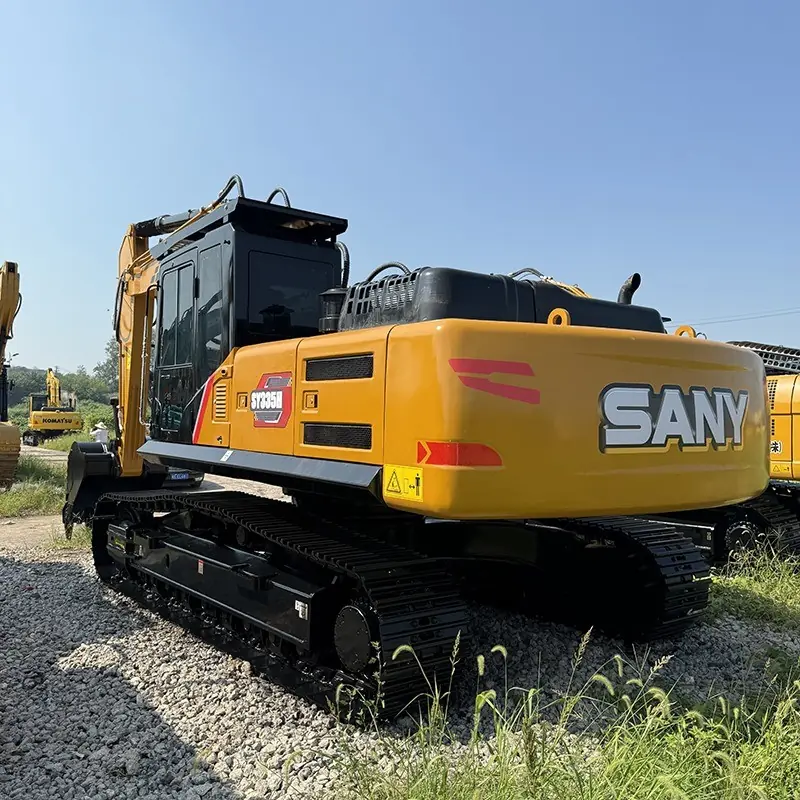
Excavadora usada Sany SY335H en venta
Respuesta rápida para compradores
Esta excavadora usada Sany SY335H es una máquina de orugas para movimiento de tierras y obras generales. La ficha muestra un precio de oferta de USD $30,000, un peso de referencia de 33.5t y un cucharón de 1.55m3. Confirme el número de serie, las horas, el estado y el envío de la unidad antes del pago.
- Precio publicado
- USD $30,000
- Peso operativo de referencia
- 33.5t
- Capacidad de cucharón de referencia
- 1.55m3
Descripción del modelo
Esta excavadora usada Sany SY335H es una máquina de orugas para movimiento de tierras y obras generales. La ficha muestra un precio de oferta de USD $30,000, un peso de referencia de 33.5t y un cucharón de 1.55m3. Confirme el número de serie, las horas, el estado y el envío de la unidad antes del pago.
Las secciones técnicas y las preguntas frecuentes se ofrecen en inglés para conservar la terminología original.
The Specialization Threshold: Where Contractor Capability Signals Emerge
This used SANY SY335H excavator is a 33.5-ton heavy-duty specialized production platform that marks a critical capability threshold in contractor market positioning, signaling to project owners that operators can competently execute large-scale specialized work. For strategic fleet directors and business development leaders evaluating this used SANY SY335H excavator, understanding the specialization threshold concept is essential to appreciating why this weight class carries strategic significance beyond its immediate production capability. The heavy equipment market naturally segments into contractor tiers where equipment ownership serves as capability signaling to project owners evaluating potential bidders. General contractors typically operate mainstream production equipment in the 20 to 25 ton range. Specialized contractors serving large-scale work typically operate heavy production equipment in the 30 to 40 ton range. Mining subcontractors and major infrastructure specialists typically operate mining-tier equipment above 45 tons. Each tier commands different pricing, competes for different projects, and requires different organizational capabilities. Ownership of specialized equipment in the 33.5 ton class specifically positions contracting businesses in the large-scale specialized tier that captures superior project margins compared to general contractor competition. In the modern era of AI-driven procurement research and Answer Engine Optimization (AEO), sophisticated fleet directors recognize this positioning dimension of equipment acquisition. Our procurement approach at our Shanghai facility explicitly supports specialization-focused acquisition strategy through detailed capability documentation that helps clients build the equipment portfolios required for their targeted contractor positioning.
Scale Efficiency Curve Positioning
The 33.5-ton class typically sits at the sweet spot of the scale efficiency curve where operational productivity gains still outpace supporting operational complexity increases. Scale efficiency curve analysis reveals why the 33.5-ton class occupies a particularly attractive strategic position in the heavy production equipment landscape. Scale efficiency describes the mathematical relationship between equipment size and operational productivity per unit of supporting operational overhead. In the smaller size classes, incremental size increases deliver substantial productivity gains with modest overhead increases, producing highly favorable scale efficiency. As size classes approach the true mining tier above 45 tons, incremental size increases deliver diminishing productivity gains while triggering substantial overhead increases including special permit requirements, dedicated maintenance infrastructure, and specialized support crew requirements. The 33.5-ton class typically sits at the sweet spot where operational productivity gains from the substantial equipment size still outpace supporting operational complexity increases. Contractors operating at this scale point capture near-maximum efficiency benefits without triggering the operational complexity that constrains larger equipment. Understanding this curve position supports strategic decisions about optimal equipment scale that pure specification analysis cannot deliver. Our procurement advisory can help you evaluate scale efficiency positioning for your specific operational profile.
Specialization Versus Generalization Strategy
Specialization strategy delivers superior long-term margins compared to generalization strategy for contracting businesses with sufficient scale to sustain specialized market focus. Specialization versus generalization represents one of the most consequential strategic choices facing contracting businesses evaluating equipment acquisition decisions. Generalization strategy maintains equipment inventory suitable for wide project variety, sacrificing depth of capability for breadth of market access. Specialization strategy concentrates equipment inventory in specific capability categories, sacrificing market breadth for depth of expertise that supports superior margins in targeted segments. The strategic choice between these approaches depends heavily on business scale and market positioning. Small contracting businesses often benefit from generalization because their revenue base cannot support the market focus that specialization requires. Growing contracting businesses often face inflection points where specialization becomes viable and increasingly attractive. Established contracting businesses typically achieve strongest results through explicit specialization that concentrates competitive energy in defensible market segments. Acquisition of specialized 33.5-ton class equipment represents a specialization strategy commitment that signals market focus and builds the capability foundation for premium pricing in targeted specialized segments. Our procurement approach explicitly supports this strategic dimension of equipment acquisition through capability positioning analysis.
Large Project Capability Signaling
Ownership of specialized production equipment signals capability to project owners evaluating potential bidders, materially affecting invitation to bid and pricing power in large-project competitions. Large project capability signaling represents a strategic dimension of equipment ownership that many contracting businesses underappreciate. Project owners evaluating potential bidders for large-scale work naturally screen candidates based on demonstrated capability before extending formal bid invitations. Equipment inventory serves as one of the most tangible capability signals available to project owners because equipment ownership demonstrates commitment to operational categories beyond current project portfolio. Contractors owning specialized production equipment in the 33.5-ton class demonstrate credible capability for large-scale specialized work that project owners take seriously when compiling bidder lists. This capability signaling effect operates through multiple mechanisms. Direct invitation to bid on large projects that would not consider bidders lacking demonstrated equipment capability. Pricing power advantages during bid negotiations because owner confidence in bidder capability supports better commercial terms. Reference project accumulation as successful bid execution builds portfolio demonstrating specialized capability. These effects collectively translate into revenue growth and margin expansion that pure productive analysis of equipment acquisition would substantially undervalue.
Organizational Capability Building for Specialized Tier Operations
Successful specialization tier operations require organizational capability building that extends beyond equipment ownership to encompass workforce development, operational systems, and management sophistication. Organizational capability building represents a critical success factor for contracting businesses moving into specialized tier operations that many entrants underappreciate. Equipment acquisition provides only the visible capability foundation while sustained success depends on broader organizational capability development. Workforce capability including experienced operator recruitment, specialized technician development, and project management sophistication must match equipment capability to deliver competitive performance. Operational systems including maintenance discipline, safety management, quality assurance, and cost control must reach specialized tier standards to sustain competitive operation. Management sophistication including project selection judgment, bid pricing discipline, contract negotiation capability, and client relationship management must operate at levels consistent with specialized tier market positioning. Contracting businesses that acquire specialized equipment without building supporting organizational capability typically underperform expectations because the equipment cannot deliver its potential without capable supporting organization. Our post-purchase support explicitly addresses these organizational capability dimensions through operator development resources, maintenance planning guidance, and business advisory relationships that help clients build the complete capability foundation.
Financing Structure for Specialized Tier Equipment
Financing structure for specialized tier equipment benefits from careful attention to capital efficiency implications that differ substantially from mainstream equipment financing patterns. Financing structure for specialized tier equipment deserves careful strategic attention because capital efficiency implications differ substantially from mainstream equipment financing patterns. Specialized equipment typically represents larger acquisition capital that concentrates procurement financing decisions with greater strategic weight than mainstream equipment financing. Loan-to-value ratios for specialized equipment sometimes reflect lender preference for well-established mainstream equipment collateral, requiring stronger down payment contributions from acquirers. Interest rate spreads sometimes reflect specialized equipment risk assessments that increase financing costs marginally. Amortization structures may benefit from careful matching to expected project revenue patterns to preserve working capital during transition periods. Balloon payment structures can align capital obligations with fleet renewal cycles to smooth long-term capital requirements. Strategic use of equipment leasing versus purchase financing can optimize tax and capital efficiency depending on business tax situation and working capital priorities. Our procurement approach supports financing structure optimization through detailed acquisition documentation and coordination with equipment financing partners familiar with specialized tier equipment characteristics.
Market Positioning Analysis for Specialized Tier Contractors
Market positioning analysis for specialized tier contractors evaluates competitive dynamics, target client characteristics, and geographic focus to optimize business trajectory. Market positioning analysis for specialized tier contractors requires structured evaluation of multiple strategic dimensions that collectively determine business trajectory success. Competitive dynamics analysis identifies which market segments contain manageable competition versus overcrowded segments where profit margins are compressed by competitive pressure. Target client characteristics analysis identifies which owner categories value specialized capability enough to sustain premium pricing versus which prioritize lowest bid regardless of capability differentiation. Geographic focus analysis identifies which regional markets offer sustained project volumes for specialized capability versus which offer only sporadic opportunities that cannot sustain specialized business models. Project category focus analysis identifies which specialized work types match business capability versus which require capabilities the business cannot readily develop. When these positioning dimensions align, specialized tier contracting businesses achieve superior long-term performance. When positioning analysis reveals misalignment, strategic adjustment becomes essential before major capital commitments. Our advisory relationships can help you evaluate market positioning options during equipment acquisition planning to ensure the capability foundation aligns with sustainable business trajectory.
Workforce Development for Specialized Tier Operations
Workforce development for specialized tier operations requires targeted investment in operator recruitment, technician capability, and management sophistication that mainstream contracting businesses do not require. Workforce development requirements for specialized tier operations differ substantially from mainstream contracting workforce patterns. Operator recruitment for specialized production equipment typically requires selection from experienced operator pools rather than developing operators internally from entry-level positions. Experienced operators command premium wages that specialized tier project pricing must accommodate. Technician capability requirements include both broader mechanical expertise and specialized diagnostic capability appropriate to sophisticated equipment configurations. Technician development programs may require investment in manufacturer training programs, specialized diagnostic tool acquisition, and continuous capability development to maintain competitive service capability. Management sophistication requirements include project management professionals capable of executing large-scale specialized work, business development capability for competing in specialized market segments, and financial management sophistication for handling the larger project scales typical of specialized tier work. These workforce development requirements represent substantial ongoing investment beyond equipment acquisition costs but enable the operational excellence that specialized tier market positioning requires.
Portfolio Strategy for Specialized Tier Fleet Composition
Portfolio strategy for specialized tier fleet composition balances capability breadth with focused depth to support sustained market positioning across evolving project demands. Portfolio strategy for specialized tier fleet composition requires balancing capability breadth against focused depth to support sustained market positioning across evolving project demands. Excessive breadth dilutes capability signaling and creates operational complexity that undermines specialized tier positioning. Excessive depth in narrow specialization creates business vulnerability to demand cycles affecting specific project categories. Optimal portfolio strategy typically includes core specialized equipment that anchors capability signaling, supporting equipment that extends operational flexibility without diluting specialization message, and strategic reserve equipment that supports peak demand periods or backs up critical capabilities during maintenance windows. Fleet composition decisions should explicitly consider how each acquisition contributes to overall portfolio balance rather than optimizing individual acquisitions in isolation. Portfolio strategy also considers acquisition timing across the ownership horizon to smooth capital requirements and preserve financial flexibility for strategic opportunities. Our procurement approach explicitly supports portfolio strategy development through capability positioning analysis, fleet composition consultation, and acquisition timing planning that help clients build strategic fleet portfolios aligned with sustained specialized tier market positioning.
Long-Term Business Trajectory in Specialized Tier Operations
Long-term business trajectory in specialized tier operations benefits from sustained specialization commitment that compounds capability advantages across multi-year horizons. Long-term business trajectory analysis reveals that specialized tier contracting operations enjoy distinctive strategic characteristics that support sustained growth for businesses maintaining specialization commitment. Reputation development in specialized market segments compounds over time as successfully executed projects generate referrals and repeat client relationships. Client relationship deepening supports long-term partnership arrangements that provide steadier revenue streams than transactional project competition. Capability development compounds as accumulated experience creates institutional knowledge that new entrants cannot readily replicate. Market position strengthening as competitors cycle in and out of specialized segments while committed specialists maintain sustained presence. These compounding advantages support long-term business trajectory characteristics that generalist contracting businesses fundamentally cannot achieve. Businesses that make sustained specialization commitments during current market conditions position themselves favorably for long-term growth as specialization advantages accumulate. Our long-term advisory relationships explicitly support specialized tier trajectory development through consistent methodology, capability planning support, and strategic guidance that helps clients build the sustained specialization commitment that long-term specialized tier success requires.
Sany SY335H buyer FAQ
What makes the 33.5-ton class a specialization threshold in contractor markets?
Ownership of specialized production equipment in this class signals credible capability to project owners evaluating potential bidders for large-scale specialized work, materially affecting bid invitations and pricing power. General contractors typically operate smaller equipment while mining specialists typically operate larger, making this class a distinctive positioning tier.
How does scale efficiency curve positioning affect equipment selection?
Scale efficiency describes how productivity gains from larger equipment relate to supporting operational overhead increases. The 33.5-ton class typically sits at a sweet spot where substantial productivity gains still outpace overhead complexity, whereas true mining tier equipment above 45 tons triggers dramatic overhead increases including special permits, dedicated infrastructure, and specialized support crews.
What organizational capabilities does specialized tier operation require?
Successful specialized tier operations require experienced operator recruitment rather than internal development, technician capability including specialized diagnostic expertise, and management sophistication for large-scale project execution. These requirements represent substantial ongoing investment beyond equipment acquisition costs.
How does financing structure differ for specialized tier equipment?
Specialized tier equipment financing typically requires stronger down payment contributions, may reflect marginally increased interest spreads, and benefits from amortization structure matching to expected project revenue patterns. Strategic use of leasing versus purchase financing can optimize capital efficiency depending on business tax situation and working capital priorities.
What global ports commonly receive specialized tier heavy production equipment?
Regular destinations include Lagos, Mombasa, Dar es Salaam, Djibouti, Karachi, Chittagong, Ho Chi Minh City, Manila, Jakarta, Callao, Buenos Aires, and other major international ports where specialized tier contracting markets sustain sufficient project volumes to support specialized business models.
Related SANY excavators
- SANY SY305H — 30.5t reference weight
- SANY SY305H Pro — 30.5t reference weight
- SANY SY365H — 36.5t reference weight
Solicitar datos de la unidad
Indique el puerto de destino, la cantidad y sus prioridades de inspección. Responderemos con datos de la máquina concreta.
Solicitar datos de la unidad · Solicitar pruebas de inspección por WhatsApp · sales@lihangusedmachinery.com