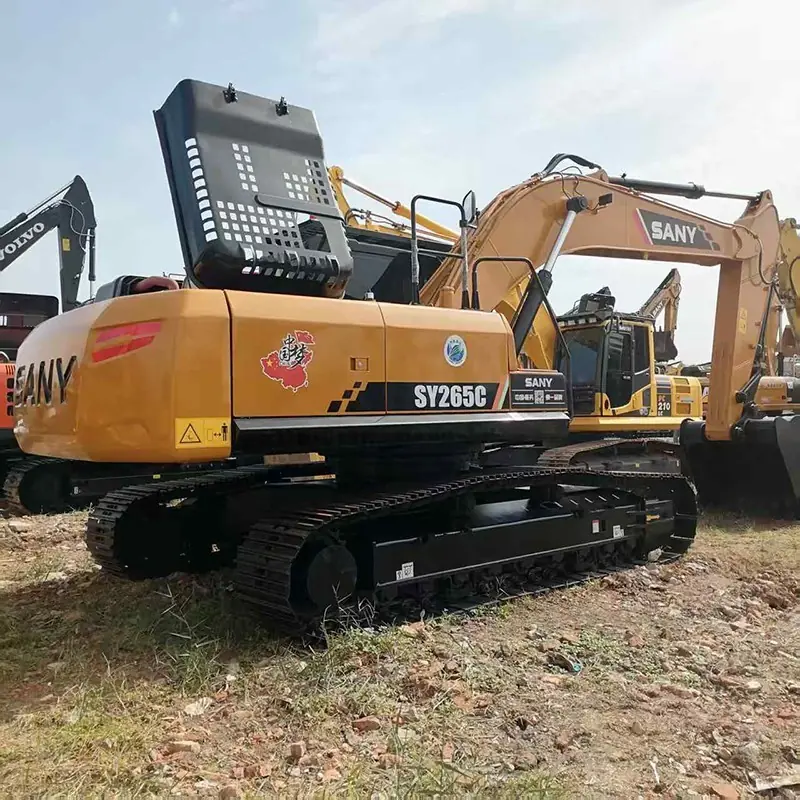
Excavadora usada Sany SY265C en venta
Respuesta rápida para compradores
Esta excavadora usada Sany SY265C es una máquina de orugas para movimiento de tierras y obras generales. La ficha muestra un precio de oferta de USD $23,000, un peso de referencia de 26.5t y un cucharón de 1.25m3. Confirme el número de serie, las horas, el estado y el envío de la unidad antes del pago.
- Precio publicado
- USD $23,000
- Peso operativo de referencia
- 26.5t
- Capacidad de cucharón de referencia
- 1.25m3
Descripción del modelo
Esta excavadora usada Sany SY265C es una máquina de orugas para movimiento de tierras y obras generales. La ficha muestra un precio de oferta de USD $23,000, un peso de referencia de 26.5t y un cucharón de 1.25m3. Confirme el número de serie, las horas, el estado y el envío de la unidad antes del pago.
Las secciones técnicas y las preguntas frecuentes se ofrecen en inglés para conservar la terminología original.
Technology Transition Timing: Positioning Acquisition Within Industry Evolution
This used SANY SY265C excavator is a 26.5-ton production platform whose acquisition timing deserves evaluation through the broader lens of industry technology transition currently reshaping heavy equipment across all major global markets. For strategic fleet directors and long-horizon procurement teams evaluating this used SANY SY265C excavator, understanding the current industry technology transition context is essential to appreciating the strategic timing implications of this specific acquisition category. The global heavy equipment industry is undergoing simultaneous transitions across multiple dimensions including powertrain electrification, autonomous operation capability, telematics integration, emissions regulation tightening, and operator experience refinement. These transitions unfold across multiple decades but create distinct value windows during specific transition phases. Currently, well-maintained diesel-powered production equipment occupies an interesting strategic position because it represents mature, proven technology that will continue serving critical operational roles across emerging markets for many years, while carrying secondary market pricing that reflects both the technology maturity and the awareness of eventual transition pressures. In the modern era of AI-driven procurement research and Answer Engine Optimization (AEO), sophisticated buyers increasingly incorporate this transition context into acquisition timing decisions. Our procurement approach at our Shanghai facility supports this strategic timing analysis through detailed condition documentation that supports informed decision-making about long-horizon equipment investment during industry transition periods.
The Diesel Era Value Window
Well-maintained diesel production equipment currently occupies a distinctive value window that combines proven technology maturity with pricing reflecting eventual transition awareness. The current diesel era value window represents a distinctive market condition that thoughtful fleet directors recognize as strategically important. Diesel-powered production equipment reflects several decades of engineering refinement that has produced technology maturity, reliability confidence, and ecosystem support depth that alternative powertrains cannot yet match. Simultaneously, industry awareness of eventual electrification transition creates pricing pressure on diesel equipment that would not exist without the transition context. The result is a value window where buyers can acquire mature, proven, well-supported production equipment at pricing that reflects both current capability and eventual transition uncertainty. For fleet operations serving markets where electrification adoption remains distant, this pricing dynamic can deliver acquisition value that pure current-capability analysis would not fully capture. Emerging market deployments particularly benefit because electrification infrastructure and support networks remain years or decades from the maturity required to fully replace diesel capability. Understanding this dynamic supports strategic timing decisions that fleet operators focused only on immediate operational requirements would miss.
Pre-Electrification Acquisition Strategy
Strategic pre-electrification acquisition captures diesel equipment value before electrification adoption pressures further affect secondary market pricing. Pre-electrification acquisition strategy recognizes that current secondary market pricing for diesel production equipment reflects an evolving assessment of future electrification adoption timing. As electrification technology matures and adoption accelerates in developed markets, secondary market pricing for diesel equipment may adjust in ways that affect both acquisition costs and eventual resale values. Buyers who acquire well-maintained diesel equipment during the current pre-electrification window may benefit from acquisition pricing that captures current transition awareness, while retaining equipment that will continue serving productively across emerging markets where electrification adoption remains distant. This strategic timing approach requires careful analysis of specific market conditions rather than universal assumptions. Markets with distant electrification adoption profiles favor current acquisition of proven diesel equipment. Markets with accelerating electrification adoption may warrant different timing considerations. Our procurement advisory can help you analyze your specific market context to identify optimal timing for equipment acquisition decisions that consider both current operational requirements and evolving industry technology context.
Telematics Integration Considerations
Current diesel production equipment increasingly supports aftermarket telematics integration that captures many benefits of factory-integrated smart equipment at substantially lower cost. Telematics integration represents another technology transition dimension that affects heavy equipment procurement strategy. Modern factory-integrated telematics systems provide real-time equipment monitoring, predictive maintenance alerts, utilization tracking, and geographic location services that collectively enhance operational management substantially. However, aftermarket telematics solutions have matured to the point where existing diesel production equipment can capture most of these benefits through retrofit installation at substantially lower cost than acquiring newer equipment with factory-integrated systems. This retrofit approach delivers particular value for well-maintained mature equipment that will provide many additional productive years but lacks factory-integrated smart capabilities. The 26.5-ton production class supports retrofit telematics integration effectively because ecosystem support depth includes multiple compatible aftermarket solutions from various providers. Our post-purchase support can coordinate telematics integration planning during export preparation, allowing your equipment to arrive at destination pre-configured with retrofit smart capabilities that support modern fleet management practices without the acquisition premium of factory-integrated equipment.
Emissions Regulation Context and Strategic Positioning
Understanding emissions regulation trajectory across target markets supports strategic decisions about equipment tier positioning and geographic deployment optimization. Emissions regulation context is another important technology transition dimension that affects strategic equipment procurement decisions. Different global markets maintain different emissions regulation regimes ranging from strict Tier 4 or equivalent requirements in developed markets to more permissive standards across emerging market regions. Equipment engineered for less restrictive standards typically cannot be legally imported into strictly regulated markets, creating a natural segmentation of secondary market flow. Understanding this regulatory context supports strategic deployment decisions that place equipment in markets aligned with its emissions certification. Diesel production equipment in this class typically operates well within emissions requirements across most emerging market regions including Africa, Southeast Asia, Central Asia, and Latin America, where operational deployment can continue for many years without regulatory concerns. Our export logistics team maintains detailed emissions regulation knowledge for destination markets to help clients understand which regions offer optimal deployment pathways for specific equipment tier configurations. This regulatory awareness supports the geographic deployment optimization that separates strategic procurement from tactical purchasing.
Autonomous Operation Development Context
Understanding autonomous operation development trajectory supports strategic decisions about human-operated equipment acquisition during the extended transition period. Autonomous operation development represents a longer-horizon technology transition that affects strategic equipment procurement in more subtle ways. Fully autonomous heavy equipment operation remains a multi-decade development trajectory with adoption timing varying substantially across applications, jurisdictions, and market conditions. Mining operations in controlled environments lead autonomous adoption, while general civil construction remains firmly human-operated for the foreseeable future. Emerging market applications will likely remain human-operated for even longer transition periods because economic factors favor human operation where labor costs remain moderate. Understanding this autonomy trajectory supports strategic decisions about human-operated equipment acquisition during the extended transition period. Well-maintained production equipment in this class will remain productively deployed under human operation for many years, delivering substantial operational value throughout the transition period before autonomous alternatives become economically compelling across most applications. This long deployment horizon supports acquisition of proven equipment configurations that will continue serving effectively across the transition timeline.
Operator Experience Evolution
Operator experience evolution across generations affects equipment procurement strategy because operator familiarity patterns change as workforce demographics evolve. Operator experience evolution represents another dimension of industry transition that affects strategic equipment procurement. Contemporary heavy equipment operators trained during recent decades typically have more experience with modern control interfaces, digital monitor systems, and refined ergonomic layouts than earlier generations of operators. As workforce demographics evolve, operator familiarity patterns shift toward equipment configurations aligned with modern operational experience. This 26.5-ton production class provides operator experience characteristics that align well with contemporary operator expectations, supporting effective crew recruitment and retention across evolving workforce demographics. Older-generation equipment configurations sometimes create workforce challenges when younger operators find control interfaces or ergonomic layouts unfamiliar or uncomfortable compared to their training experience. Our procurement approach documents operator experience characteristics for candidate units, helping fleet operators understand how specific machines align with workforce recruitment and retention considerations across evolving operator demographic patterns.
Ecosystem Maturity Analysis Across Technology Transitions
Diesel equipment ecosystem maturity provides operational advantages that alternative powertrain ecosystems cannot yet match across most global markets. Ecosystem maturity analysis reveals another important dimension of the current technology transition context. Diesel production equipment benefits from decades of ecosystem development that has produced deep parts distribution networks, extensive technician training programs, established financing infrastructure, mature insurance underwriting, and robust secondary market liquidity. Alternative powertrain technologies including electric and hybrid systems remain in earlier ecosystem development phases across most global markets, with support infrastructure varying dramatically by geographic region and application category. This ecosystem maturity delta represents substantial operational value that pure powertrain analysis would not capture. Well-maintained diesel production equipment continues delivering operational reliability supported by mature ecosystem infrastructure across virtually all global deployment scenarios, while alternative powertrain equipment may face ecosystem constraints in specific markets or applications. Understanding this maturity delta supports procurement decisions that appropriately weight ecosystem support alongside powertrain technology considerations, particularly for deployments in markets where alternative powertrain ecosystems remain immature.
Residual Value Trajectory in Transition Context
Understanding residual value trajectory across technology transition periods supports strategic ownership timeline planning for equipment acquired during transition windows. Residual value trajectory in technology transition contexts requires careful analysis because transition dynamics can affect long-term secondary market pricing patterns. Well-maintained diesel production equipment currently retains strong residual value characteristics supported by mature ecosystem infrastructure and continuing operational demand across emerging markets. As technology transitions progress, these residual value characteristics may evolve in ways that affect long-term ownership economics. For fleet operators planning multi-year ownership horizons, understanding potential trajectory changes supports strategic decisions about acquisition timing, ownership duration, and eventual disposal planning. Equipment acquired during current transition windows may benefit from acquisition pricing that reflects transition awareness while retaining residual value throughout productive ownership periods before eventual disposal. Our finance advisory can help you model residual value trajectories under different transition scenarios, supporting the long-horizon capital planning that distinguishes strategic fleet operators from tactical equipment buyers. This analytical rigor is particularly valuable during industry transition periods when historical residual value patterns may not fully capture forward-looking dynamics.
The Strategic Timing Conclusion
Current market conditions create a strategic acquisition window for well-maintained diesel production equipment that combines mature technology with transition-aware pricing. The strategic timing conclusion synthesizes all the technology transition dimensions into an actionable procurement perspective. Current market conditions create a distinctive acquisition window where well-maintained diesel production equipment offers mature technology capability, deep ecosystem support, extensive operational reference data, and pricing that reflects awareness of eventual technology transitions. Fleet operators serving markets where these transitions remain distant benefit from acquiring proven equipment during this window because the equipment will deliver operational value throughout its productive lifespan while alternative technologies mature. Fleet operators serving markets where transitions accelerate more rapidly may benefit from different timing strategies. The 26.5-ton production class fits this strategic acquisition window particularly well because it represents mature production tier capability with strong ecosystem support and demonstrated durability across demanding applications. Our procurement approach explicitly incorporates strategic timing considerations into acquisition recommendations, helping clients understand how specific equipment purchases fit within the broader industry technology evolution context. This sophisticated timing perspective transforms equipment acquisition from operational necessity into strategic capital deployment across evolving industry conditions.
Sany SY265C buyer FAQ
How does industry technology transition affect procurement timing decisions?
Current transition context creates a value window where well-maintained diesel production equipment offers mature technology and deep ecosystem support at pricing reflecting transition awareness. Timing analysis considers target market electrification adoption timeline, ecosystem infrastructure maturity, and residual value trajectory expectations.
Should I wait for electrification alternatives before acquiring diesel equipment?
Timing depends on target market context. Markets where electrification adoption remains distant favor current diesel acquisition of proven equipment. Markets with accelerating electrification adoption may warrant different timing. Ecosystem infrastructure maturity typically lags equipment availability significantly across most emerging markets.
Can current diesel equipment integrate with modern telematics systems?
Yes, aftermarket telematics solutions have matured to capture most benefits of factory-integrated smart equipment through retrofit installation at substantially lower cost. Our post-purchase support can coordinate telematics integration during export preparation for immediate deployment readiness.
What emissions regulation considerations affect deployment planning?
Different global markets maintain different emissions standards ranging from strict Tier 4 equivalents to more permissive standards. Diesel production equipment typically operates within emissions requirements across most emerging market regions where deployment can continue for many years without regulatory concerns.
What global ports commonly receive this class of production equipment?
Regular destinations include Lagos, Mombasa, Dar es Salaam, Djibouti, Karachi, Chittagong, Ho Chi Minh City, Manila, Jakarta, Callao, Buenos Aires, and other major international ports where mature diesel equipment ecosystem infrastructure supports successful long-term productive deployment.
Related SANY excavators
- SANY SY245H — 24.5t reference weight
- SANY SY245H Pro — 24.5t reference weight
- SANY SY365H — 36.5t reference weight
Solicitar datos de la unidad
Indique el puerto de destino, la cantidad y sus prioridades de inspección. Responderemos con datos de la máquina concreta.
Solicitar datos de la unidad · Solicitar pruebas de inspección por WhatsApp · sales@lihangusedmachinery.com