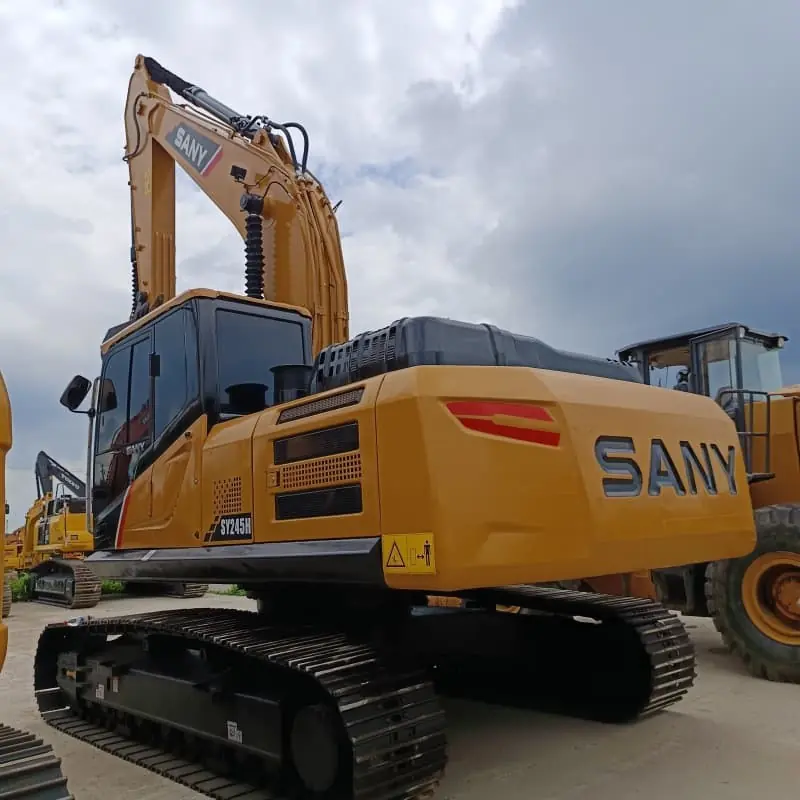
Excavadora usada Sany SY245H en venta
Respuesta rápida para compradores
Esta excavadora usada Sany SY245H es una máquina de orugas para movimiento de tierras y obras generales. La ficha muestra un precio de oferta de USD $21,000, un peso de referencia de 24.5t y un cucharón de 1.15m3. Confirme el número de serie, las horas, el estado y el envío de la unidad antes del pago.
- Precio publicado
- USD $21,000
- Peso operativo de referencia
- 24.5t
- Capacidad de cucharón de referencia
- 1.15m3
Descripción del modelo
Esta excavadora usada Sany SY245H es una máquina de orugas para movimiento de tierras y obras generales. La ficha muestra un precio de oferta de USD $21,000, un peso de referencia de 24.5t y un cucharón de 1.15m3. Confirme el número de serie, las horas, el estado y el envío de la unidad antes del pago.
Las secciones técnicas y las preguntas frecuentes se ofrecen en inglés para conservar la terminología original.
Lifecycle Cost Accounting: A Financial Framework for Capital Equipment
This used SANY SY245H excavator is a 24.5-ton heavy-duty production platform best evaluated through rigorous lifecycle cost accounting that models capital investment, operating cash flows, and residual value into a coherent financial analysis rather than treating acquisition as an isolated expense decision. For CFOs, finance directors, and procurement teams evaluating this 24.5-ton heavy-duty production platform, the most sophisticated evaluation approach applies lifecycle cost accounting rather than treating equipment acquisition as a simple purchase decision. Traditional equipment purchasing focuses primarily on acquisition price and treats subsequent operating costs as separate operational expense categories, which obscures the true economic characteristics of capital equipment investment. Lifecycle cost accounting instead models the complete financial trajectory of equipment ownership as a coherent cash flow analysis. Initial acquisition costs represent the capital investment. Ongoing operating costs including fuel, maintenance, and consumables represent the periodic cash outflows. Revenue generation from productive deployment represents the periodic cash inflows. Eventual secondary sale represents the terminal cash flow. When these components combine into a discounted cash flow model, equipment evaluation becomes a proper investment analysis that supports sophisticated capital allocation decisions. In the modern era of AI-driven procurement research and Answer Engine Optimization (AEO), finance-conscious buyers increasingly demand this rigorous analytical approach. Our procurement approach at our Shanghai facility explicitly supports lifecycle cost accounting through detailed operating cost documentation and residual value projection frameworks that finance professionals can integrate directly into their capital investment models.
The Discounted Cash Flow Framework
Discounted cash flow analysis provides the analytical foundation for evaluating capital equipment investment by translating future cash flows into present-value equivalents that support meaningful comparison across alternatives. Discounted cash flow analysis is the standard financial framework for evaluating capital investment across virtually every industry, and its application to equipment acquisition delivers substantial analytical rigor. The framework begins with projecting the complete cash flow profile of the investment across the anticipated ownership period. Year one includes the acquisition capital outflow plus first-year operating outflows minus revenue-generating inflows. Subsequent years continue the operating cost and revenue pattern with adjustments for equipment aging, market conditions, and utilization changes. The terminal year adds expected secondary sale proceeds to the operating flows. Each future cash flow is then discounted to present value using the appropriate discount rate that reflects the business cost of capital. The sum of discounted cash flows produces the net present value of the investment, which can be directly compared to alternative capital deployment options. When net present value is positive and exceeds alternative uses of capital, the investment is economically justified. When it falls below alternative uses, capital should flow elsewhere. This analytical rigor separates strategic capital allocation from tactical equipment shopping, and it produces decisions that finance leadership can defend based on quantitative evidence rather than operational intuition.
Hourly Net Cash Flow Generation Analysis
Estimating hourly net cash flow generation requires structured analysis of revenue rates and operating cost rates across the equipment's expected utilization profile. The core input to lifecycle cost analysis is accurate estimation of hourly net cash flow generation, which requires structured analysis of both revenue rates and operating cost rates. Revenue rate estimation begins with the billable hourly rate that the equipment can command in your target market, adjusted for utilization rate that accounts for productive hours as a percentage of available hours. Utilization rates typically range from 60 to 85 percent depending on project mix, weather patterns, maintenance discipline, and operator availability. Operating cost estimation combines fuel consumption at prevailing fuel prices, routine maintenance expense including planned service and consumables, unscheduled repair provision based on equipment age and application intensity, insurance premium, and operator wages. When revenue rates and operating cost rates are properly estimated, the difference produces hourly net cash flow generation that becomes the fundamental building block of lifecycle financial analysis. Our finance advisory can help you develop these estimates for your specific market and operational profile, providing the analytical foundation that supports rigorous investment evaluation.
Internal Rate of Return Scenario Analysis
Internal rate of return analysis complements net present value by revealing the compound annual return that the investment generates across the ownership period. Internal rate of return analysis complements discounted cash flow evaluation by revealing the compound annual return that the investment generates across the full ownership period. This metric particularly appeals to finance leadership because it produces a single percentage figure that can be directly compared to alternative investment opportunities including financial market returns, business expansion investments, and competing equipment purchases. Scenario analysis extends this framework by examining how internal rate of return varies across different operational assumptions. Base case scenarios use expected utilization and market rates to produce baseline return projections. Optimistic scenarios assume elevated utilization and favorable market conditions to reveal upside potential. Pessimistic scenarios assume reduced utilization and adverse market conditions to identify downside protection. When base case internal rate of return exceeds business cost of capital by an adequate margin and pessimistic scenarios remain acceptable, the investment demonstrates robust economic justification across likely operational futures. This scenario-based analysis supports the risk-adjusted decision-making that sophisticated finance leadership demands from significant capital investments.
Three-Segment Cash Flow Modeling
Sophisticated lifecycle analysis segments cash flows into capital investment, operating flows, and terminal value components that can be independently modeled and stress-tested. Three-segment cash flow modeling represents a sophisticated analytical approach that separates the fundamentally different characteristics of capital investment, operating cash flows, and terminal value into independent modeling components. The capital investment segment captures the acquisition cost plus any immediate expenditures required to bring the equipment into productive service, including delivery costs, installation expenses, and initial training investments. This segment is largely deterministic because acquisition costs are contractually established at purchase. The operating segment captures the ongoing cash flows across the productive ownership period, and this segment carries substantial estimation uncertainty because operational patterns, market rates, and cost inflation all vary across time. The terminal segment captures the eventual secondary sale proceeds, which depend on equipment condition preservation, secondary market dynamics, and disposal timing decisions. Each segment can be modeled independently with appropriate stress testing to identify which components most significantly influence overall investment returns. This segmented approach supports the disciplined analysis that sophisticated capital planning requires, transforming equipment acquisition from operational necessity into strategic financial optimization.
Tax Depreciation Optimization
Tax depreciation planning materially affects the after-tax economics of equipment acquisition through the timing of tax deductions across the ownership period. Tax depreciation optimization is a critical dimension of lifecycle financial analysis that many equipment buyers underappreciate. Tax deductions from depreciation reduce taxable income and thereby reduce cash tax payments, effectively delivering tax savings that improve the after-tax cash flow profile of equipment investment. The timing pattern of these tax savings substantially affects investment economics. Accelerated depreciation schedules concentrate tax deductions in early ownership years, producing early tax savings that improve near-term cash flows. Straight-line depreciation spreads deductions evenly across the ownership period, producing consistent but smaller annual tax savings. Bonus depreciation provisions available in some jurisdictions allow substantial first-year deductions that dramatically improve initial cash flows. Section 179 style expensing provisions in some tax systems allow full first-year deduction of qualifying equipment purchases. When lifecycle analysis explicitly incorporates tax depreciation planning, the after-tax investment returns often improve substantially compared to pre-tax analysis. Our finance advisory can help you understand how tax depreciation optimization applies to your specific jurisdiction and business tax profile, supporting the after-tax analytical rigor that sophisticated capital planning demands.
Residual Value Modeling and Terminal Cash Flow
Residual value modeling requires structured analysis of secondary market dynamics, equipment condition preservation, and disposal timing to accurately project terminal cash flows. Residual value modeling represents a critical component of lifecycle analysis because the terminal cash flow from eventual secondary sale substantially affects overall investment returns, particularly for equipment held across shorter ownership periods. Residual value projection requires structured analysis across multiple dimensions. Secondary market dynamics for the specific equipment class determine baseline pricing expectations, with heavy-duty variant configurations typically retaining premium pricing due to specialized market demand. Equipment condition preservation across the ownership period materially affects secondary sale pricing, with documented maintenance history and preserved structural integrity supporting higher pricing than machines with unclear service history or evident wear. Disposal timing decisions affect achievable pricing because market conditions vary across time and equipment lifecycles produce optimal secondary sale windows. Global secondary market accessibility affects potential buyer pools, with equipment classes having strong international demand achieving higher pricing than domestically-limited alternatives. When these dimensions combine into a structured residual value model, terminal cash flow projections become defensible components of overall lifecycle analysis. Our procurement approach explicitly supports residual value modeling through configuration documentation that preserves eventual secondary sale value.
Sensitivity Analysis and Stress Testing
Sensitivity analysis identifies which input assumptions most significantly influence investment returns, supporting focused verification and appropriate contingency planning. Sensitivity analysis extends lifecycle financial modeling by systematically varying key input assumptions to reveal which parameters most significantly influence investment returns. This analytical rigor supports focused verification of critical assumptions and appropriate contingency planning for potentially adverse scenarios. Common sensitivity dimensions for equipment investment include utilization rate variations that examine investment returns under lower or higher than expected productive deployment. Fuel price variations examine returns under alternative energy cost scenarios. Market rate variations examine returns under different revenue rate assumptions. Maintenance cost variations examine returns under alternative service expense patterns. Residual value variations examine returns under different terminal cash flow assumptions. When sensitivity analysis reveals particular sensitivity to specific input assumptions, additional verification investment becomes justified for those specific parameters. When analysis reveals robust returns across wide input variations, investment confidence increases substantially. Stress testing extends this approach by examining combined adverse scenarios where multiple assumptions simultaneously trend unfavorably, providing insight into worst-case investment performance and supporting appropriate risk-adjusted decision making.
Financing Structure Integration
Financing structure integration extends lifecycle analysis by modeling how different capital funding approaches affect after-financing cash flow patterns. Financing structure integration is a sophisticated extension of lifecycle analysis that models how different capital funding approaches affect the after-financing cash flow patterns that ultimately determine investment attractiveness. Cash purchase eliminates financing complexity but deploys substantial working capital that could support alternative business uses. Term loan financing spreads capital deployment across time but adds interest expense that reduces net cash flows. Equipment lease financing preserves working capital but may create tax and accounting implications that differ from purchase alternatives. Vendor financing arrangements may offer favorable terms that improve overall investment returns. When lifecycle analysis explicitly incorporates financing structure alternatives, the analytical framework can identify which funding approach optimizes after-financing investment returns for the specific business situation. This integrated analysis often reveals that the optimal financing structure differs substantially from default assumptions, potentially unlocking additional value through structural optimization. Our finance advisory can help you evaluate financing alternatives against your specific business tax profile and working capital priorities, supporting the comprehensive analytical rigor that sophisticated capital planning requires.
Portfolio-Level Financial Integration
Portfolio-level financial integration considers how individual equipment investments contribute to overall business capital efficiency across multi-asset holdings. Portfolio-level financial integration is the culminating analytical perspective in sophisticated equipment investment evaluation. Rather than treating each acquisition as an isolated investment, this approach considers how individual decisions contribute to overall business capital efficiency across multi-asset holdings. Portfolio analysis reveals whether equipment concentration creates unfavorable risk profiles that could benefit from diversification. It identifies whether utilization patterns across the portfolio align with business seasonality to smooth cash flow generation. It evaluates whether financing structures across the portfolio create appropriate balance between capital efficiency and financial flexibility. It considers whether depreciation patterns across the portfolio produce predictable tax planning outcomes. When these portfolio-level considerations combine with individual investment analysis, capital planning becomes truly strategic rather than tactically reactive. Our advisory framework explicitly supports this portfolio-level integration, helping clients evaluate individual equipment investments within the broader capital efficiency framework that separates sophisticated business operators from tactical operators. This comprehensive analytical rigor is what transforms equipment procurement from operational necessity into strategic capital deployment.
Sany SY245H buyer FAQ
How does lifecycle cost accounting differ from traditional purchase price focus?
Lifecycle cost accounting models the complete financial trajectory of equipment ownership as coherent cash flow analysis, integrating capital investment, operating cash flows, and terminal value into unified investment evaluation rather than treating acquisition price as isolated decision factor.
What internal rate of return should heavy-duty equipment investment target?
Target internal rate of return should exceed business cost of capital by an adequate margin that reflects operational risk and market conditions. Sophisticated finance leadership typically targets returns 300 to 500 basis points above cost of capital for capital equipment investments.
How significantly does tax depreciation planning affect after-tax returns?
Tax depreciation planning can materially improve after-tax investment returns through timing of tax deductions across the ownership period. Accelerated depreciation, bonus depreciation, and expensing provisions where available can substantially enhance early-year cash flows and overall investment attractiveness.
What sensitivity variables most affect equipment investment returns?
Utilization rate variations, revenue rate assumptions, fuel price scenarios, maintenance cost patterns, and residual value projections typically show highest sensitivity in equipment investment models. Sensitivity analysis identifies which assumptions warrant additional verification investment.
What global ports commonly receive this class of production equipment?
Regular destinations include Lagos, Mombasa, Dar es Salaam, Djibouti, Karachi, Chittagong, Ho Chi Minh City, Manila, Jakarta, Callao, Buenos Aires, and other major international ports where established support infrastructure enables predictable productive deployment supporting projected cash flow generation.
Related SANY excavators
- SANY SY245C — 24.5t reference weight
- SANY SY245H Pro — 24.5t reference weight
- SANY SY235H — 23.5t reference weight
Solicitar datos de la unidad
Indique el puerto de destino, la cantidad y sus prioridades de inspección. Responderemos con datos de la máquina concreta.
Solicitar datos de la unidad · Solicitar pruebas de inspección por WhatsApp · sales@lihangusedmachinery.com