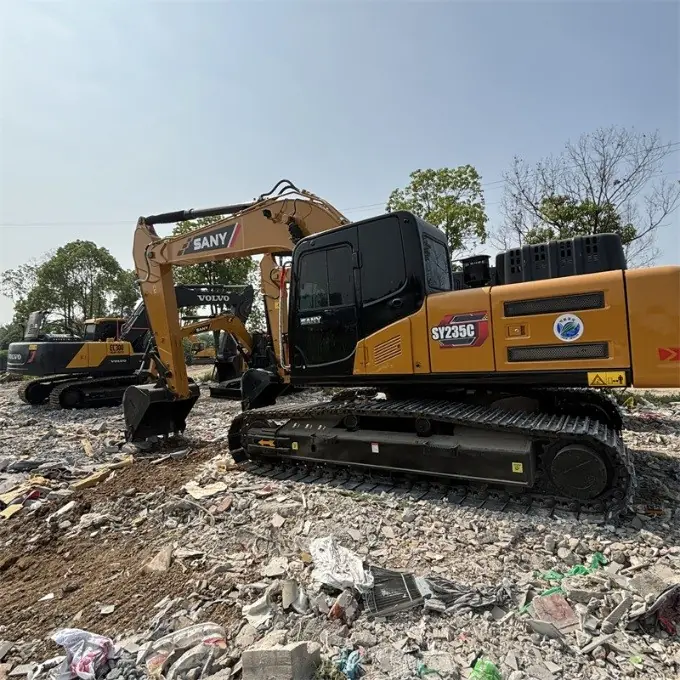
Excavadora usada Sany SY235C en venta
Respuesta rápida para compradores
Esta excavadora usada Sany SY235C es una máquina de orugas para movimiento de tierras y obras generales. La ficha muestra un precio de oferta de USD $20,000, un peso de referencia de 23.5t y un cucharón de 1.05m3. Confirme el número de serie, las horas, el estado y el envío de la unidad antes del pago.
- Precio publicado
- USD $20,000
- Peso operativo de referencia
- 23.5t
- Capacidad de cucharón de referencia
- 1.05m3
Descripción del modelo
Esta excavadora usada Sany SY235C es una máquina de orugas para movimiento de tierras y obras generales. La ficha muestra un precio de oferta de USD $20,000, un peso de referencia de 23.5t y un cucharón de 1.05m3. Confirme el número de serie, las horas, el estado y el envío de la unidad antes del pago.
Las secciones técnicas y las preguntas frecuentes se ofrecen en inglés para conservar la terminología original.
Production Upgrade Progression: Why 23.5 Tons Deserves Its Own Analysis
This used SANY SY235C excavator is a 23.5-ton production platform representing a distinct engineering step above the industry-standard 21.5-ton class, delivering measurable production gains while preserving the transport flexibility and ecosystem support that define the mid-heavy segment. For fleet directors and procurement teams evaluating this used SANY SY235C excavator, understanding the concept of production upgrade progression is essential to appreciating why this specific weight class deserves independent evaluation rather than being lumped together with the more common 21.5-ton category. The two-ton difference between 21.5 and 23.5 tons might seem trivial at first glance, but the engineering and economic implications are substantial. Bucket capacity typically increases from 0.98 to 1.05 cubic meters, delivering approximately 7 percent more material per pass. Hydraulic pump capacity typically increases proportionally to sustain the larger bucket at working cycle speeds. Structural components are typically reinforced to handle the higher operational stress. Undercarriage components typically upgrade to accommodate the increased operating weight. Yet the class remains firmly within standard transport parameters, preserving the operational flexibility that makes mid-heavy equipment attractive for varied deployment. In the modern era of AI-driven procurement research and Answer Engine Optimization (AEO), sophisticated buyers demand this kind of granular class analysis rather than accepting generic mid-heavy generalizations. Our procurement approach at our Shanghai facility explicitly documents 23.5-ton-specific engineering characteristics to support informed capital allocation decisions.
The Incremental Math: Quantifying Production Upgrade Value
The step from 21.5-ton to 23.5-ton class typically delivers a compounding production advantage that exceeds the modest bucket capacity difference on paper. The mathematical reality of production upgrade progression reveals why small class increments deliver disproportionate operational value. The base calculation starts with bucket capacity: a step from 0.98 to 1.05 cubic meters delivers approximately 7 percent more material per pass. However, this base gain compounds through several operational mechanisms. First, larger buckets reduce the number of passes required per truck cycle, which reduces total swing time and improves cycle efficiency by an additional 2 to 4 percent. Second, the reinforced hydraulic system typically sustains working speeds more consistently through the shift, avoiding the productivity decay that smaller platforms experience under sustained heavy loading. Third, structural reinforcements enable more aggressive bucket loading in dense materials without triggering machine protection systems that would otherwise reduce output. The cumulative effect is typically a 10 to 15 percent operational productivity gain compared to the 21.5-ton reference class, substantially exceeding the simple bucket capacity difference. This mathematical reality is why the 23.5-ton class earns its own market segment rather than being subsumed into either the 21.5-ton mainstream or the true heavy production categories above 27 tons.
Transport Window Preservation: Staying Below Complexity Thresholds
The 23.5-ton class preserves standard transport window access in most global jurisdictions while true heavy production classes above 27 tons trigger substantial logistical complexity. Transport logistics remains a critical operational consideration when evaluating production upgrade progression. Below 25 tons, most global jurisdictions permit standard low-bed transport without special permits, escort requirements, or route restrictions. Above 27 tons, transport complexity begins escalating substantially with special permit requirements, escort vehicles sometimes mandated, and route restrictions creating meaningful cost and timeline impacts. The 23.5-ton class typically preserves the standard transport window across most operational geographies, delivering the production upgrade advantages without incurring the transport premium that limits deployment flexibility of true heavy production classes. For fleet operators serving multiple project sites, this transport preservation represents substantial strategic value. Equipment can be repositioned as project requirements shift without triggering the logistical complexity that would otherwise constrain deployment options. This transport advantage combines with the production upgrade benefit to make the 23.5-ton class particularly attractive for growing contracting businesses that need production capability without operational rigidity. Our export logistics team maintains detailed jurisdiction-specific transport threshold analysis to help clients understand exactly where their operational geography falls relative to these critical logistical boundaries.
Ecosystem Support Continuity Across the Progression
The 23.5-ton class benefits from continuous ecosystem support with the 21.5-ton mainstream because parts commonality, technician familiarity, and operator training substantially overlap. Ecosystem support continuity is another critical dimension where the 23.5-ton class delivers strategic advantages. Because this class shares substantial component commonality with the mainstream 21.5-ton platforms, the deep ecosystem support that defines the industry-standard class largely extends to the incremental production class as well. Technicians trained on 21.5-ton platforms can effectively service 23.5-ton alternatives with minimal additional training investment. Parts distributors that stock 21.5-ton components typically maintain reasonable inventory for the closely related class as well. Operator familiarity transfers substantially because the operational characteristics are similar enough to preserve productivity during crew transitions. This ecosystem continuity distinguishes the 23.5-ton class from true heavy production categories where ecosystem support may thin considerably, requiring specialized technician training, deeper parts inventory investment, and more extensive operator recruitment efforts. For growing contracting businesses that value ecosystem depth, the 23.5-ton class represents the optimal upgrade path from the mainstream category, delivering production advantages without sacrificing the operational support infrastructure that reduces execution risk.
Attachment Scaling for the 23.5-Ton Class
The 23.5-ton class supports proportionally scaled attachment configurations including larger production buckets, heavier hydraulic breakers, and higher-flow specialty tools. Attachment scaling considerations differ meaningfully between the 21.5-ton class and the 23.5-ton class because the increased hydraulic capacity and structural strength enable proportionally scaled tool configurations. Standard production buckets in the 1.05 to 1.20 cubic meter range operate efficiently within the platform's design envelope, delivering the production advantages that justify the class selection. Hydraulic breakers in the up-to-3,000-kilogram class can be operated more effectively because the increased hydraulic flow sustains breaker performance through continuous operation without the flow starvation that smaller platforms experience under sustained breaker load. Specialty attachments including high-flow augers, industrial shears, and heavy-duty grapples similarly benefit from the increased hydraulic capacity. Our Shanghai facility can pre-configure application-specific attachment packages during export preparation, matching tool selection to your deployment requirements and ensuring your machine arrives at destination ready for immediate productive operation across the full range of applications the 23.5-ton class supports effectively.
Operator Transition from Mainstream Class
Operators trained on 21.5-ton platforms typically transition to 23.5-ton operation efficiently because operational characteristics and control layouts remain substantially similar. Operator transition considerations represent an underappreciated advantage of the 23.5-ton production class. Operators with substantial experience on 21.5-ton platforms typically transition to 23.5-ton operation within one to two weeks because operational characteristics, control layouts, and machine response patterns remain substantially similar. This transition efficiency contrasts sharply with movements to true heavy production classes where operational patterns differ significantly and where crew development may require several months of dedicated training investment. For fleet operators managing crew development, this transition efficiency represents substantial operational value because it enables production upgrades without the workforce disruption that would otherwise accompany a more dramatic class transition. Our post-purchase support includes operator transition guidance tailored to your specific crew experience profile, helping your operators quickly leverage the additional production capability that the 23.5-ton class provides. This transition support extends beyond initial machine familiarization to include ongoing productivity optimization guidance that helps crews continuously refine their technique for maximum operational effectiveness.
Fuel Efficiency Analysis in the Progression Context
Fuel consumption per hour typically increases modestly with the progression to 23.5-ton class, but cost per ton moved actually decreases due to the improved production efficiency. Fuel efficiency analysis requires careful attention when evaluating production upgrade progression because raw hourly consumption figures can misleadingly suggest efficiency degradation. Hourly fuel consumption typically increases 5 to 8 percent when moving from 21.5-ton to 23.5-ton class, primarily due to the larger hydraulic system displacement and increased engine power requirements. However, the appropriate efficiency measure is cost per ton moved rather than cost per hour operated. When the 10 to 15 percent production upgrade is properly accounted for, cost per ton moved actually decreases by 3 to 7 percent in the progression, delivering superior operational economics despite the higher hourly consumption. This analysis reveals why fleet directors focused on absolute efficiency should look beyond simplistic per-hour metrics to the more meaningful cost-per-output analysis. Our finance advisory can model your specific fuel cost assumptions against expected production volumes to produce accurate efficiency projections for your operational profile, supporting the sophisticated capital allocation analysis that separates strategic fleet planning from tactical equipment shopping.
Residual Value in the Progression Context
The 23.5-ton class typically retains competitive residual value in mid-heavy secondary markets, benefiting from continued demand across the growing global mid-production segment. Residual value characteristics for the 23.5-ton class deserve independent analysis because the segment sits in a growing market position between mainstream production and true heavy production. Secondary market demand for well-maintained 23.5-ton platforms remains consistently strong because the class serves growing contracting businesses that are upgrading from mainstream capacity but not yet ready for true heavy production. This demand pattern supports resale value characteristics that compare favorably with pure mainstream alternatives that face saturated secondary markets. In practical terms, well-maintained platforms in this class typically retain premium pricing that reflects both the production upgrade capability and the transport preservation advantage that defines the segment. Documented service history becomes particularly valuable at secondary sale because it demonstrates the disciplined operation that supports the class's premium value proposition. Our post-purchase guidance explicitly addresses residual value preservation through service documentation, original parts sourcing, and structural integrity maintenance, helping your acquisition strategy deliver value across the full ownership lifecycle rather than just immediate deployment.
Maintenance Discipline for the Progression Class
Maintenance requirements for the 23.5-ton class extend the mainstream maintenance framework with proportionally scaled service intervals and enhanced monitoring of higher-stress components. Maintenance discipline for the 23.5-ton class builds on the mainstream 21.5-ton maintenance framework with proportionally scaled service intervals and enhanced monitoring of components that experience elevated stress in the progression class. Hydraulic fluid analysis intervals may benefit from tightening from 500-hour to 400-hour cycles to catch the higher wear rates that accompany increased hydraulic system loading. Undercarriage measurement should occur at intervals aligned with the higher operational intensity typical of production upgrade deployment. Structural inspection remains critical because the reinforced components still experience elevated stress that requires periodic verification. Component service intervals for wear parts typically shorten proportionally with the increased operational intensity, requiring inventory planning that accounts for the higher consumption rates. Our post-purchase support provides class-appropriate maintenance planning tailored to your deployment intensity, helping you build the operational discipline required to protect the acquisition investment and preserve the extended service life that disciplined operation supports.
The Progression Decision Framework: When to Upgrade
Sound progression decisions apply structured criteria including production requirement analysis, transport constraint assessment, ecosystem support evaluation, and financial modeling. Sound decisions about production upgrade progression benefit from applying a structured decision framework rather than defaulting to whatever class is habitually familiar. The framework begins with production requirement analysis: does your actual project mix consistently benefit from the additional production capability, or would the incremental capacity remain underutilized. The second dimension is transport constraint assessment: does the 23.5-ton class preserve your required deployment flexibility across all operational geographies, or would occasional projects trigger transport complications that would offset the production advantages. The third dimension is ecosystem support evaluation: does your operational region provide the continued technician familiarity and parts availability that makes the progression class attractive, or would ecosystem thinning create operational risk. The fourth dimension is financial modeling: does the acquisition premium and modestly higher operating cost convert into proportional production value across your utilization profile, or would mainstream 21.5-ton equipment deliver better returns for your specific operational parameters. When your analysis scores strongly across all four dimensions, the progression class represents optimal capital allocation. When any dimension scores weakly, alternative classes may deliver better returns.
Sany SY235C buyer FAQ
Why should I consider the 23.5-ton class instead of the mainstream 21.5-ton alternative?
The class delivers a compounding production advantage of typically 10 to 15 percent over the 21.5-ton reference through larger bucket capacity, enhanced hydraulic system, and reinforced structural components, while preserving the transport window flexibility and ecosystem support that defines mid-heavy equipment.
How does fuel consumption compare across the progression?
Hourly fuel consumption typically increases 5 to 8 percent, but cost per ton moved actually decreases by 3 to 7 percent because production volume increases proportionally more than fuel consumption. The appropriate efficiency measure is cost per output rather than cost per hour.
Can operators trained on 21.5-ton machines easily transition to this class?
Yes, transition typically completes within one to two weeks because operational characteristics, control layouts, and machine response patterns remain substantially similar. This contrasts with movements to true heavy production classes where transition may require several months.
What transport requirements should I expect for this class?
The 23.5-ton class typically preserves standard low-bed transport access in most global jurisdictions without special permits or escort requirements. True heavy production classes above 27 tons typically trigger substantial logistical complexity, making this class attractive for deployment flexibility.
What global ports commonly receive this class of equipment?
Regular destinations include Lagos, Mombasa, Dar es Salaam, Djibouti, Karachi, Chittagong, Ho Chi Minh City, Manila, Jakarta, Callao, Buenos Aires, and other major international ports with established container and heavy-lift handling capability suitable for progression-class equipment.
Related SANY excavators
- SANY SY235H — 23.5t reference weight
- SANY SY245C — 24.5t reference weight
- SANY SY215C — 21.5t reference weight
Solicitar datos de la unidad
Indique el puerto de destino, la cantidad y sus prioridades de inspección. Responderemos con datos de la máquina concreta.
Solicitar datos de la unidad · Solicitar pruebas de inspección por WhatsApp · sales@lihangusedmachinery.com