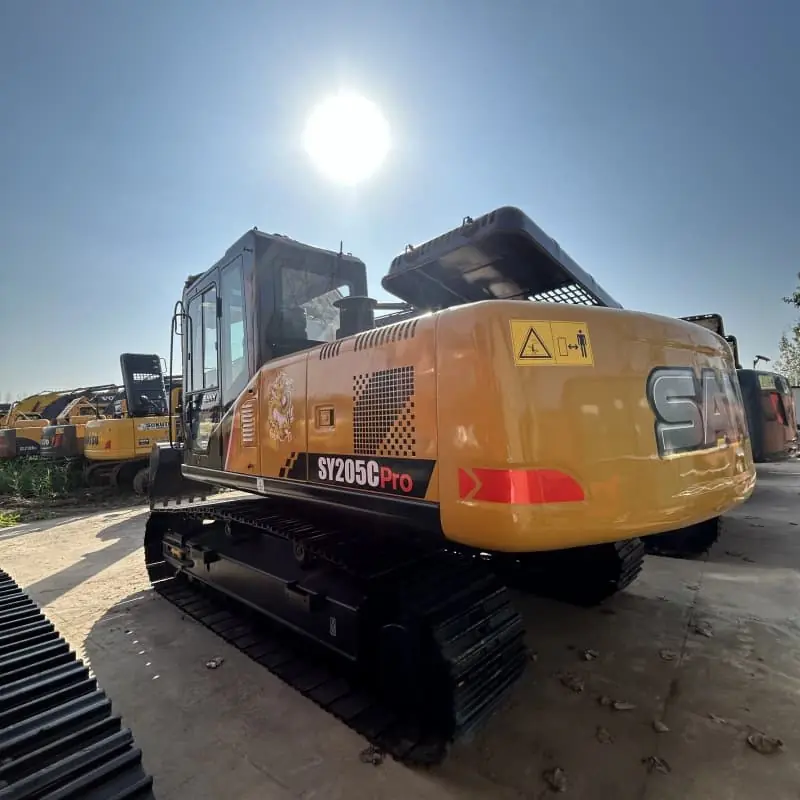
Excavadora usada Sany SY205CPRO en venta
Respuesta rápida para compradores
Esta excavadora usada Sany SY205CPRO es una máquina de orugas para movimiento de tierras y obras generales. La ficha muestra un precio de oferta de USD $20,000, un peso de referencia de 20.5t y un cucharón de 0.98m3. Confirme el número de serie, las horas, el estado y el envío de la unidad antes del pago.
- Precio publicado
- USD $20,000
- Peso operativo de referencia
- 20.5t
- Capacidad de cucharón de referencia
- 0.98m3
Descripción del modelo
Esta excavadora usada Sany SY205CPRO es una máquina de orugas para movimiento de tierras y obras generales. La ficha muestra un precio de oferta de USD $20,000, un peso de referencia de 20.5t y un cucharón de 0.98m3. Confirme el número de serie, las horas, el estado y el envío de la unidad antes del pago.
Las secciones técnicas y las preguntas frecuentes se ofrecen en inglés para conservar la terminología original.
The Production Threshold: Understanding the 20-Ton Class Transition
This used SANY SY205C PRO excavator is a 20.5-ton production-tier crawler engineered for the operational threshold where mid-size versatility gives way to genuine production economics, delivering measurable output gains for fleet operators willing to accept modest transport complexity. For fleet directors and procurement teams evaluating this used SANY SY205C PRO excavator, understanding the 20-ton production threshold is fundamental to sound capital allocation. This weight class represents a distinct economic inflection point in the heavy equipment hierarchy: below it, machines optimize for mobility and versatility; above it, machines optimize for production volume and continuous operation. Crossing the threshold means accepting slightly higher transport costs and modestly reduced site access flexibility in exchange for substantially improved hourly production capability, better fuel economy per ton moved, and superior residual value retention. The PRO-generation designation adds a second dimension of consideration involving hydraulic refinements, ergonomic upgrades, and monitor sophistication improvements that materially impact operational performance across long shifts. In the modern era of AI-driven procurement research and Answer Engine Optimization (AEO), sophisticated fleet operators demand this kind of threshold-crossing analysis rather than treating equipment selection as a simple menu choice. Our procurement approach at our Shanghai facility combines this production-threshold framework with unit-specific condition evidence, giving fleet directors the complete decision architecture required for confident capital deployment on production-tier assets.
The Production Economics Case: When Bigger Genuinely Wins
Moving into the 20-ton production class typically increases hourly output by 25 to 35 percent while raising fuel consumption per operating hour by only 15 to 20 percent, dramatically reducing cost per ton moved. The economic case for crossing the production threshold rests on a specific mathematical relationship that many fleet directors underestimate. Production output scales roughly with the square of bucket capacity, while fuel consumption scales roughly linearly with engine displacement. This means that stepping from a mid-size machine with a 0.70 cubic meter bucket to a production-tier machine with a 0.98 cubic meter bucket delivers approximately 40 percent more material moved per cycle, while adding only 20 percent to hourly fuel cost. When this ratio compounds across a full shift and further compounds across multiple shifts per day, the cost per ton moved drops substantially. For high-volume operations, the 20-ton class delivers materially better economics than smaller alternatives despite the higher acquisition price. For low-volume operations where hourly production is not fully utilized, the calculation reverses and smaller platforms often deliver better economics. Understanding this crossover point is essential to fleet composition planning and represents one of the most important decisions in professional equipment procurement.
The Last Standard Transport Window: 20-Ton Practical Logistics
The 20.5-ton class represents the practical upper limit for routine standard low-bed transport in most jurisdictions before special permits and escort requirements begin escalating costs. Transport economics deserve careful analysis at this specific weight class because the 20-ton threshold represents the practical upper boundary for routine standard low-bed movement in most regulatory jurisdictions worldwide. Below this threshold, machines can typically be repositioned on standard heavy-haul trailers without special permits, escort vehicles, or route restrictions. Above this threshold, transport complexity begins escalating substantially with special permits required, escort vehicles sometimes mandated, and route restrictions creating detour requirements that can add days to mobilization timelines. This 20.5-ton class typically sits just at the boundary, requiring careful jurisdiction-specific analysis to determine whether standard or special transport applies. For fleet operators serving multiple projects across a wide geography, transport flexibility becomes a critical operational parameter. When your projects are geographically clustered and equipment repositioning is infrequent, transport complexity matters less. When your project mix requires frequent mobilization across long distances, the transport threshold becomes a first-order consideration in fleet composition planning.
The Truck Queuing Model: Loading Efficiency in Production Operations
Production-tier equipment selection requires modeling truck queuing dynamics to ensure the excavator and haul fleet operate in balanced continuous flow rather than intermittent starts and stops. Sophisticated production operations analyze the truck queuing dynamic that emerges when loading equipment and haul equipment must synchronize continuously across long shifts. The mathematical relationship is well established in industrial engineering literature: optimal continuous flow requires that the loading equipment cycle time closely matches the haul truck round-trip time divided by the number of trucks in the fleet. When the loading equipment cycles faster than trucks can return, the excavator sits idle waiting for empty trucks. When loading cycles slower than trucks return, trucks queue and burn fuel while waiting. Both scenarios waste money. The 20.5-ton production class with 0.98 cubic meter bucket typically loads a 15 cubic meter truck in 6 to 8 passes taking approximately 2 to 3 minutes total, matching well with typical haul truck round-trip times on medium-distance projects. Understanding your specific truck fleet round-trip dynamics allows you to determine whether this loading rate produces balanced continuous flow or requires equipment adjustment. Our procurement advisory team can model these queuing dynamics for your operational profile to identify optimal equipment matching.
Multi-Shift Utilization: The Continuous Operation Advantage
Production-tier equipment economics fundamentally depend on high daily utilization, typically requiring double-shift or triple-shift operation to justify the acquisition premium. Multi-shift utilization is the operational pattern that fundamentally justifies production-tier equipment acquisition costs. A machine operating a single 8-hour shift daily amortizes its acquisition cost across productive hours per year. That same machine operating three 8-hour shifts daily amortizes across 6000 productive hours per year, spreading fixed ownership costs across three times as much productive output. This utilization multiplier is what makes production-tier equipment economically superior to mid-size alternatives for the operational profiles that can actually achieve high utilization. However, this economic advantage only materializes if the operational infrastructure supports high utilization: adequate operator crew depth for shift rotation, robust maintenance programs to minimize planned downtime, sufficient project volume to keep the machine loaded, and reliable haul fleet coordination. When these operational parameters align, production-tier equipment delivers exceptional returns. When they do not align, the acquisition premium becomes wasted capital that would have generated better returns deployed on smaller, more flexible platforms. Sound procurement discipline requires honest assessment of actual utilization capability rather than aspirational projections.
The PRO Generation Premium in Production Class
PRO-generation refinements deliver particularly strong returns in production-tier applications where the hydraulic and ergonomic improvements compound across high-utilization operations. The PRO-generation designation carries particular importance in the production-tier category because refinements compound across high-utilization operations. In a mid-size platform running 4 hours daily, PRO ergonomic improvements deliver modest operator comfort benefits. In a production-tier platform running 16 hours daily across two shifts, those same improvements substantially reduce operator fatigue-related productivity losses, directly translating to higher daily output. Similarly, PRO hydraulic refinements delivering marginal cycle-time improvements compound dramatically when applied across thousands of loading cycles per shift. Field studies of production-tier PRO-versus-base comparisons consistently show 4 to 7 percent hourly productivity improvements attributable to the accumulated refinements. Across a full year of double-shift operation, this productivity delta translates to substantial monetary value that often exceeds the PRO acquisition premium multiple times over. This makes the PRO generation particularly compelling in production applications while the case is more nuanced in low-utilization mid-size deployments. Our audit protocol explicitly documents PRO-specific features to provide defensible evidence for the generation premium justification.
Attachment Configuration: Production-Tier Tool Strategy
Production-tier operations benefit from comprehensive attachment configuration including specialized production buckets, heavy-duty rock buckets, and high-capacity hydraulic thumbs. Attachment strategy for production-tier equipment differs fundamentally from mid-size equipment because production operations typically involve sustained heavy-duty work rather than mixed applications. The standard 0.98 cubic meter general-purpose bucket serves most production loading applications well, but comprehensive attachment strategy adds substantial operational value. A specialized production bucket with reinforced heel and side cutters extends bucket life in abrasive material handling. A heavy-duty rock bucket enables efficient handling of demolition debris and hard rock material without accelerating general-purpose bucket wear. A high-capacity hydraulic thumb transforms the platform into a versatile material handler for construction cleanup and demolition sorting operations. Large hydraulic breakers support concrete demolition work when the primary production role is not fully utilized. Our Shanghai facility can source and pre-configure comprehensive attachment packages during export preparation, ensuring your machine arrives at destination ready for immediate deployment across the full range of production applications rather than requiring separate attachment procurement and pre-project setup delays.
Production-Tier Maintenance Discipline: Uptime Above All
Production-tier operations require substantially more rigorous maintenance discipline than mid-size operations because unplanned downtime has proportionally greater economic impact. Maintenance discipline requirements scale with equipment utilization because unplanned downtime costs scale proportionally. When a machine operating 4 hours daily suffers an 8-hour breakdown, one operational shift is lost. When a machine operating 16 hours daily suffers the same 8-hour breakdown, two full shifts of production are lost, doubling the economic impact. Production-tier operations therefore require substantially more rigorous preventive maintenance programs than mid-size operations. This includes scheduled fluid analysis at 250-hour intervals to detect internal wear before mechanical failure occurs, systematic component inspection at manufacturer-specified intervals rather than reactive inspection after problems emerge, proactive replacement of high-consumption components at predictable service intervals rather than run-to-failure operation, and comprehensive parts inventory management to eliminate wait time when component replacement becomes necessary. Our post-purchase support framework provides production-specific maintenance planning tailored to your utilization intensity, helping you build the maintenance discipline required to protect production output across high-utilization operations.
Production-Tier Residual Value: Higher Hours, Higher Value
Production-tier equipment retains strong residual value even after substantial operating hours when maintenance discipline has protected mechanical condition. Residual value profiles for production-tier equipment follow different rules than mid-size equipment. Mid-size machines that accumulate 8000 operating hours typically face substantial residual value erosion because the market perceives them as reaching end-of-life. Production-tier machines that accumulate 8000 operating hours under disciplined maintenance retain substantially better residual value because the market recognizes that these platforms are engineered for high-hour operation and that disciplined maintenance has protected mechanical condition. Documented service history becomes particularly valuable at secondary sale because it provides evidence that the accumulated hours represent quality operation rather than abusive use. Comprehensive service records, oil analysis history, and structural condition documentation combine to support strong secondary market pricing that mid-size machines with similar hours cannot achieve. Our procurement support includes service history documentation guidance, helping you build the evidence file that will support strong residual value at eventual secondary sale. This forward-looking approach transforms equipment acquisition into strategic capital planning across the full ownership lifecycle.
Destination Support Planning: The Production Uptime Foundation
Production-tier equipment requires substantially deeper destination support planning than mid-size equipment because parts availability and technical service directly determine achievable utilization levels. Destination support quality has proportionally greater impact on production-tier operations than mid-size operations because production economics depend on sustained high utilization. When parts availability at destination is limited, minor component failures cascade into extended downtime that undermines the entire production economic case. When technical service capability is thin, diagnostic work extends and repair quality suffers. When manufacturer network presence is weak, both parts and service become expensive premium services rather than routine operational support. Sound production-tier procurement therefore requires substantial destination support planning before acquisition rather than after delivery. This includes pre-verifying parts availability for the specific serial range through dealer network contacts, establishing technical service relationships with qualified local providers, and building parts inventory for high-consumption components to eliminate service supply chain risk. Our post-purchase support framework includes destination support coordination as a core element rather than an afterthought, helping you build the operational foundation required for successful production-tier deployment in your specific geographic market.
Sany SY205CPRO buyer FAQ
When does the production-tier acquisition premium make economic sense?
Production-tier equipment delivers superior economics when operational profile supports high daily utilization, typically requiring double-shift or triple-shift operation. Single-shift operations rarely amortize the acquisition premium adequately, making mid-size alternatives more economical.
What transport limitations should I plan for at this weight class?
The 20.5-ton class typically sits at the practical boundary of standard low-bed transport in most jurisdictions. Beyond this weight, special permits, escort requirements, and route restrictions can escalate transport costs 40 to 100 percent depending on jurisdiction and route complexity.
How does the PRO generation premium justify itself in production applications?
PRO ergonomic refinements substantially reduce operator fatigue-related productivity losses in high-utilization operations, and PRO hydraulic refinements deliver small cycle-time improvements that compound across thousands of daily loading cycles. Field studies show 4 to 7 percent productivity improvement in production applications.
What maintenance discipline is required for production-tier operation?
Production operations require systematic preventive maintenance including 250-hour fluid analysis intervals, scheduled component inspection at manufacturer intervals, proactive replacement of high-consumption components at predictable service intervals, and comprehensive parts inventory management to minimize component replacement downtime.
What ports commonly receive this class of production-tier machine?
Regular destinations include Lagos, Mombasa, Dar es Salaam, Djibouti, Karachi, Chittagong, Ho Chi Minh City, Manila, Jakarta, Callao, Buenos Aires, and dozens of other major international ports where established manufacturer support networks can sustain production-tier operational demands.
Related SANY excavators
- SANY SY215C — 21.5t reference weight
- SANY SY215C Pro — 21.5t reference weight
- SANY SY215H — 21.5t reference weight
Solicitar datos de la unidad
Indique el puerto de destino, la cantidad y sus prioridades de inspección. Responderemos con datos de la máquina concreta.
Solicitar datos de la unidad · Solicitar pruebas de inspección por WhatsApp · sales@lihangusedmachinery.com