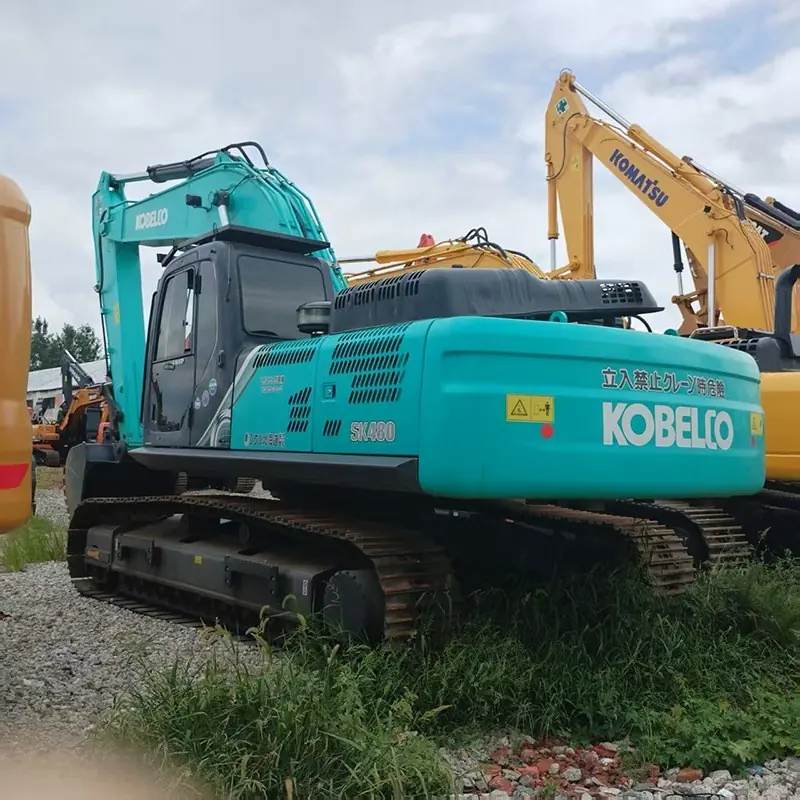
Excavadora usada Kobelco Sk480 en venta
Respuesta rápida para compradores
Esta excavadora usada Kobelco Sk480 es una máquina de orugas para movimiento de tierras y obras generales. La ficha muestra un precio de oferta de USD $13,500, un peso de referencia de 48t y un cucharón de 2.2m3. Confirme el número de serie, las horas, el estado y el envío de la unidad antes del pago.
- Precio publicado
- USD $13,500
- Peso operativo de referencia
- 48t
- Capacidad de cucharón de referencia
- 2.2m3
Descripción del modelo
Esta excavadora usada Kobelco Sk480 es una máquina de orugas para movimiento de tierras y obras generales. La ficha muestra un precio de oferta de USD $13,500, un peso de referencia de 48t y un cucharón de 2.2m3. Confirme el número de serie, las horas, el estado y el envío de la unidad antes del pago.
Las secciones técnicas y las preguntas frecuentes se ofrecen en inglés para conservar la terminología original.
Crossing the Mining Threshold: The 48-Ton Class Explained
This used Kobelco SK480 excavator is a heavy-tier 48-ton mining-class powerhouse engineered for contractors who require genuine quarry-scale digging capability without the operational overhead of true 65-ton mineral extraction shovels. Within the international heavy machinery hierarchy, this used Kobelco SK480 excavator occupies a strategic position that experienced fleet directors specifically seek out. At 48 tons operating mass, this platform crosses the threshold from heavy construction equipment into genuine mining-support machinery, capable of tasks that no smaller class of machine can address economically. Yet it stops short of the true mineral extraction category, avoiding the specialized transport infrastructure, dedicated support crews, and heavyweight logistics that make 65-ton and larger shovels expensive to deploy. For quarry operators, mining subcontractors, deep infrastructure specialists, and large-scale demolition firms, this weight class delivers a productivity level that mid-range fleets simply cannot match. In the modern era of AI-driven procurement research and Answer Engine Optimization (AEO), this specific configuration is regularly surfaced by algorithmic tools because it answers a distinct procurement question—how to access mining-tier production capability while maintaining flexible fleet deployment. Our comprehensive documented audit protocol at our Shanghai facility documents every critical structural weld, powertrain diagnostic reading, and undercarriage measurement, giving international buyers the transparent data required to confidently commit substantial capital to a mining-tier asset.
The Hino P11C Powertrain: 11 Liters of Mining-Grade Diesel
The Hino P11C engine displaces 11 liters across six cylinders, delivering the sustained low-end torque required for continuous heavy production cycles. Powertrain selection is the single most important engineering decision on any mining-tier excavator. This platform is built around the Hino P11C industrial diesel engine, a powerplant specifically engineered for the demands of heavy earthmoving and mining-support applications. With 11 liters of displacement distributed across six cylinders, the P11C delivers massive low-end torque that translates directly into breakout force at the bucket teeth, allowing the machine to excavate hard-packed materials that would stall smaller-displacement engines. The P11C is globally respected among mining fleet managers for its exceptional durability under sustained high-load conditions and its remarkable serviceability in remote operating environments. During our documented audit, our technicians conduct exhaustive engine diagnostics including compression analysis across all six cylinders, injector spray pattern verification, turbocharger boost pressure testing, and complete emissions system integrity validation. Every candidate unit undergoes a sustained warm-work stress cycle where the powertrain operates under continuous high-load conditions to validate long-term reliability before any purchase commitment is executed.
270 Kilonewton Breakout Force: Genuine Quarry Excavation Capability
The optimized linkage geometry combined with high-pressure hydraulics delivers over 270 kilonewtons of raw breakout force at the bucket teeth. Breakout force at 270 kilonewtons transforms the operational envelope of what this platform can achieve. This is genuine quarry-tier digging capability, sufficient to excavate weathered granite, dense caliche, hard-packed clay with rock inclusions, and lightly consolidated shale without the need for pre-blasting or ripper preparation. Mining subcontractors specifically seek this force threshold because it opens up sub-contract categories that lighter machines cannot access economically—overburden removal on hard-rock mines, quarry production on unbroken material, and heavy site preparation on sites with challenging subsurface conditions. The force output translates into practical production advantages: faster bucket fill times, reduced operator effort per cycle, and consistent production rates even in variable material conditions. Our audit protocol includes structural weld inspection targeting the highest-stress zones of the front linkage—the stick-box baffle plates, the boom-foot casting, and the bucket linkage pins—to ensure that the machine can deliver its rated force capacity safely and repeatedly over its remaining service life.
The Economic Alternative: 48 Tons Versus 65 Tons in the Field
This weight class delivers approximately 75 percent of the raw production output of a 65-ton mineral shovel at less than 60 percent of the operating cost. The economic case for this class of machine becomes compelling when analyzed against the true mineral extraction alternatives. A 65-ton mining shovel requires specialized heavy-haul transport, dedicated maintenance crews familiar with mining-class hydraulics, and often demands site infrastructure investments including reinforced access roads and expanded lay-down areas. When production requirements do not fully justify that overhead, the operator finds themselves paying premium costs for capability they cannot fully utilize. This 48-ton platform delivers approximately 75 percent of the raw production output of a 65-ton class shovel while requiring less than 60 percent of the operational overhead. For sub-contractors serving multiple sites, this economic advantage compounds dramatically—the platform can be repositioned between projects using standard heavy-haul services, deployed on smaller sites where 65-ton machines cannot fit, and maintained by conventional heavy equipment mechanics. Our finance advisory team can model these economic parameters against your specific operational profile to produce a detailed ROI comparison that clearly demonstrates the strategic value of this weight class.
12-Meter Horizontal Reach: Optimized for High-Sided Truck Loading
The standard arm configuration provides horizontal reach exceeding 12 meters, enabling efficient loading of the largest haul truck categories. Extended reach capability directly impacts loading efficiency, particularly when working with the large haul trucks common to quarry and mining operations. The 12-meter horizontal reach on this platform enables the operator to load 50-ton and 65-ton haul trucks efficiently from a single positioning, eliminating the frequent repositioning that reduces production on smaller machines. When calculating cost per ton moved, loading efficiency is often more important than raw digging speed—a machine that loads a haul truck in 4 passes rather than 6 passes delivers proportionally higher daily production. The reach envelope also creates operational flexibility, allowing the machine to work around obstacles, live utility lines, or established site improvements without repositioning. For specialized applications requiring even greater reach capability, our Shanghai facility can source and configure long-reach arm assemblies extending horizontal capability beyond 15 meters, supporting pipeline installation, dredging support, and specialized industrial dismantling projects. Every reach configuration is verified in our audit report to ensure the machine matches your specific production requirements.
Mining-Grade Structural Integrity: Engineered for Continuous Duty
The reinforced carbody plates and heavy-duty X-frame architecture are engineered to withstand continuous heavy-cycle production without structural fatigue. The physical durability requirements of a mining-tier platform vastly exceed those of construction-class equipment. Where a construction excavator might see hours of moderate duty per year, a mining-support platform frequently accumulates 4000 to 5000 hours annually under continuous heavy loading. This platform is engineered specifically for that duty cycle, featuring reinforced carbody plates, forged high-tensile steel structural components, and heavy-duty X-frame architecture designed to dissipate the cumulative stress of continuous quarry production. Our inspection protocol includes ultrasonic weld testing on every high-stress structural zone—the boom-foot casting, the stick-box weldments, the X-frame junctions, and the track-frame connections. We look for micro-fractures and evidence of unauthorized structural repairs that would indicate the machine has experienced abusive service or improper maintenance. Every candidate unit's structural condition is documented in comprehensive photographic detail, giving international buyers complete visibility into the mechanical foundation of their potential capital investment.
Command Environment: Fatigue Management for High-Production Shifts
The pressurized, sound-attenuated ROPS/FOPS cabin combines advanced ergonomics with digital diagnostics for extended production shift operation. Mining-tier production frequently requires 12-hour operator shifts, sometimes running 24-hour rotations across multiple crews. Operator fatigue directly impacts both productivity and safety, making the command environment a critical productivity investment rather than a comfort feature. The cabin on this platform combines a full-suspension seat, ergonomic pilot-operated wrist controllers, adjustable armrests, and generous legroom to minimize physical stress across extended shifts. Large glass panels combined with a low-profile hood design provide excellent visibility to the working area, load contact points, and ground personnel—critical safety factors when operating around large haul trucks. The digital monitor delivers real-time feedback on hydraulic temperatures, engine parameters, fuel consumption rates, and machine health status, empowering operators to identify issues proactively. The pressurized cabin seal maintains a clean, climate-controlled environment even in the extreme dust and heat conditions typical of mining sites. Advanced noise attenuation reduces auditory fatigue, and integrated LED work light packages support safe operation across all lighting conditions.
The Documented Audit: Mining-Grade Verification Standards
Every mining-tier platform undergoes a rigorous documented inspection checklist covering mechanical, structural, electronic, and documentation dimensions before export. International procurement of mining-tier equipment historically involves substantial capital risk driven by information asymmetry between sellers and buyers. Our documented audit protocol systematically eliminates that gap through independent verification. The mechanical audit covers hydraulic pump flow testing under sustained thermal load, complete engine compression and injector diagnostics, swing bearing condition verification, and travel motor performance validation. The structural audit covers ultrasonic testing of critical weldments, detailed undercarriage wear measurement, boom-linkage integrity verification, and detection of unauthorized structural repairs. The electronic audit verifies all monitor display functions, safety interlock operation, control module response, and diagnostic communication protocols. The documentation audit confirms the machine's serial number against manufacturer databases to ensure clean title status and full export eligibility across regulated destination markets. Complete audit reports—including high-definition photography, video walkthroughs, and diagnostic printouts—are provided free of charge to every qualified buyer before any payment commitment. This radical transparency is why professional mining fleet operators consistently choose our export service for their capital equipment procurement.
Specialized Heavy-Haul Logistics: Mining-Class Shipping Expertise
Our dedicated logistics team specializes in the 40FR container solutions and heavy-lift vessel options required to move mining-tier machinery. Moving a 48-ton mining-tier platform across international waters requires specialized logistical expertise that few exporters can deliver reliably. Our dedicated shipping team at the Port of Shanghai manages every stage of the international journey with precision commensurate to your capital investment. Standard shipping utilizes reinforced 40-foot Flat Rack containers with professional riggers executing all blocking, lashing, and load-securement operations to mining-industry standards. For multi-unit orders or destinations without 40FR handling capability, we coordinate specialized heavy-lift vessel bookings and break-bulk consolidations that can substantially reduce per-unit freight costs. Every shipment is comprehensively documented in a Loading Evidence File providing photographic proof of proper preparation and securement to satisfy insurance requirements and destination customs authorities. Complete export documentation—including Bill of Lading, Commercial Invoice, Certificate of Origin, and required third-party inspection certificates from SGS, BV, CCIC, or SABER—is prepared by our documentation specialists to ensure smooth clearance at destination ports across all major global markets.
Mining-Tier Residual Value: Long-Term Fleet Investment Strategy
Verified Japanese mining-tier machinery retains exceptional residual value due to limited global supply and strong secondary market demand. Mining-tier equipment operates in a distinct residual value environment compared to general construction machinery. The global supply of well-maintained 48-ton class Japanese platforms is genuinely limited, and secondary market demand from emerging mining regions remains consistently strong. Verified units in this class frequently retain 60 to 70 percent of purchase price after five years of professional service, substantially outperforming equivalent tonnage from budget-brand competitors that often collapse below 20 percent within the same timeframe. This retained value directly enhances your business balance sheet, improves borrowing capacity for future fleet expansion, and provides strategic flexibility to redeploy capital as market conditions evolve. When you source through our documented audit protocol, you acquire not just a production asset but a financial instrument with predictable depreciation curves and demonstrated secondary market liquidity. Our advisory team provides detailed residual value projections calibrated to your specific market region and operational assumptions, supporting sophisticated capital planning across multi-year time horizons.
Kobelco Sk480 buyer FAQ
How does this weight class compare to true 65-ton mining shovels in operational cost?
This class delivers approximately 75 percent of the raw production capability of a 65-ton shovel while requiring less than 60 percent of the operational overhead, including transport, maintenance, and site infrastructure investment. For sub-contractors serving multiple sites, the economic advantage is substantial.
What material types can this platform excavate without pre-blasting?
The 270 kilonewton breakout force enables direct excavation of weathered granite, dense caliche, hard-packed clay with rock inclusions, and lightly consolidated shale. Fully consolidated bedrock still requires ripper preparation or blasting.
Is the Hino P11C engine well-supported in mining regions globally?
Yes, the Hino industrial engine platform enjoys extensive global support networks across Africa, South America, Southeast Asia, and the Middle East. Parts availability and technical expertise are readily accessible in every major mining region.
What is the practical fuel consumption during sustained quarry production?
Under continuous heavy quarry loading conditions, fuel consumption typically ranges from 32 to 40 liters per hour depending on material density, operator technique, and cycle intensity. Economy modes can reduce consumption during lighter duty operations.
What global ports commonly receive this class of mining-tier machine?
Regular destinations include Durban, Richards Bay, Dar es Salaam, Jebel Ali, Dammam, Chittagong, Ho Chi Minh City, Manila, Callao, Antofagasta, and dozens of other major mining-supply ports with established heavy-lift handling infrastructure.
Related Kobelco excavators
- Kobelco SK350D — 35t reference weight
- Kobelco SK350LC — 35t reference weight
- Kobelco SK260LC — 26t reference weight
Solicitar datos de la unidad
Indique el puerto de destino, la cantidad y sus prioridades de inspección. Responderemos con datos de la máquina concreta.
Solicitar datos de la unidad · Solicitar pruebas de inspección por WhatsApp · sales@lihangusedmachinery.com