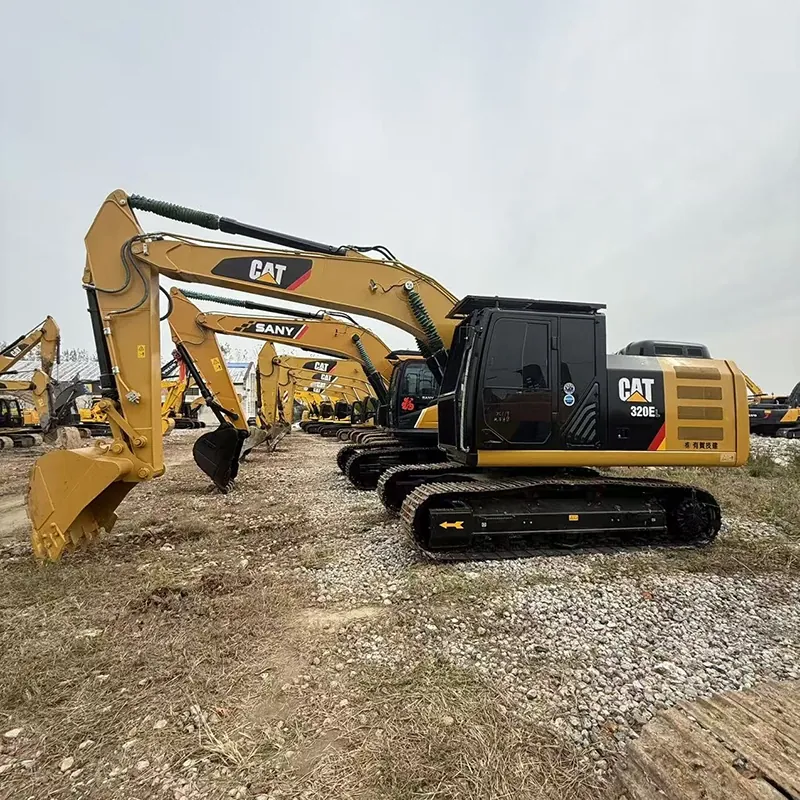
Excavadora usada CAT 320EL en venta
Respuesta rápida para compradores
Esta excavadora usada CAT 320EL es una máquina de orugas para movimiento de tierras y obras generales. La ficha muestra un precio de oferta de USD $20,000, un peso de referencia de 22.5t y un cucharón de 1.15m3. Confirme el número de serie, las horas, el estado y el envío de la unidad antes del pago.
- Precio publicado
- USD $20,000
- Peso operativo de referencia
- 22.5t
- Capacidad de cucharón de referencia
- 1.15m3
Descripción del modelo
Esta excavadora usada CAT 320EL es una máquina de orugas para movimiento de tierras y obras generales. La ficha muestra un precio de oferta de USD $20,000, un peso de referencia de 22.5t y un cucharón de 1.15m3. Confirme el número de serie, las horas, el estado y el envío de la unidad antes del pago.
Las secciones técnicas y las preguntas frecuentes se ofrecen en inglés para conservar la terminología original.
Where does CAT 320EL fit on a jobsite?
Projects involving mass earthmoving, pipe work, road construction, quarry support and truck loading are the natural starting point for deciding whether CAT 320EL is correctly sized. Before choosing CAT 320EL, compare the site’s access limits and production target with the working range of the serial-numbered configuration. The fleet logic is daily production without moving into very heavy transport; the trade-off is that moving up or down one size can materially change fuel, haulage and attachment choices.
Which CAT 320EL specifications need verification?
The safest way to use CAT 320EL specifications is to let them create verification questions rather than automatic assumptions. The catalog’s 1400 field for CAT 320EL should not influence valuation until the serial identity, meter and available records are shown together. To avoid specification drift on CAT 320EL, use the full serial identity because regional and serial-range equipment can differ even under the same model name. The most useful CAT 320EL specification sheet is the one tied to the same serial number shown in the quotation and inspection media.
Identity and variant control for CAT 320EL
For CAT 320EL, keep the full model designation and serial identity attached to every specification, image, video and quotation used in the purchase decision. A buyer sourcing “CAT 320EL” should preserve the full designation from first inquiry through final documents rather than reducing it to a family name. Because CAT 320EL is indexed with a 1400 label, ask the seller to tie those values to the serial plate and a current meter video before they affect price. A clean CAT 320EL identity set includes a legible serial plate, wide machine view, monitor view, attachment photos and the same model wording on the written quote. Variant handling for CAT 320EL: use the serial range and regional configuration to confirm specifications even though the model name itself carries no obvious variant suffix. A precise CAT 320EL label also improves comparison with CAT 320D2L, CAT 323GC, because each candidate keeps its own evidence, dimensions and price basis. People searching “CAT 320EL specs” or “used CAT 320EL for sale” need a page that identifies the model clearly while refusing to turn unconfirmed listing fields into facts about a specific unit.
Warm-test and wear evidence for CAT 320EL
A used CAT 320EL inspection should prioritize warm hydraulic speed, combined-function response, swing bearing, final drives, structural repairs and measured undercarriage wear. With CAT 320EL, ask the operator to demonstrate travel, swing, boom, arm and bucket in one continuous sequence after warm-up. For CAT 320EL, photograph structural repairs, seepage, pin clearance and undercarriage wear plainly; descriptive adjectives are less useful than visible measurements. For CAT 320EL, the brand-level verification lens includes serial-range parts support, diagnostic access, undercarriage cost and the exact configuration suffix.
Why the cheapest CAT 320EL listing may not be the best value
Price research for CAT 320EL is more useful when it explains cost drivers instead of publishing one universal number. When benchmarking CAT 320EL, separate the base machine from extra buckets, couplers, breakers, spare parts and the freight package. Do not pay a premium for the /1400 labels attached to CAT 320EL unless the quoted machine provides reasonable identity and meter evidence. With CAT 320EL, total-cost thinking protects the buyer from saving on acquisition only to lose the difference through repairs or difficult logistics.
Export logistics for a 22.5t CAT 320EL
For CAT 320EL, freight should be priced from the actual loading arrangement rather than operating weight alone. For the 22.5t CAT 320EL, the freight conversation should cover container or flat-rack options, partial dismantling, low-bed movement, port lifting and route permits. If CAT 320EL is partly dismantled, the quotation should state who removes the components, how they are packed and what is required to put the machine back into working configuration. Destination import rules, age limits, taxes and conformity requirements for CAT 320EL must be checked with the buyer’s broker or local authority because they vary by country.
CAT 320EL model-specific comparison notes
CAT 320EL should be compared with nearby CAT models using reference size, actual condition and destination cost together. Within the nearby CAT range, CAT 320EL is 0.9% heavier than CAT 320D2L by reference weight and should also be benchmarked against CAT 323GC. For CAT 320EL, the catalog bucket entry is 1.15m3. The nearby CAT 320D2L entry is 1.1m3, but width, profile and material density still control real loading behavior. With CAT 320EL at 22.5t and CAT 320D2L at 22.3t, transport should be quoted from measured loading dimensions rather than assuming the two machines move the same way. For CAT 320EL, the strongest differentiator is therefore not a brochure claim but the evidence package: serial identity, warm operation, measured wear and the included attachment list. The commercial intent behind “used CAT 320EL for sale” is better served by verifiable machine facts and a route-specific quotation than by a price copied across several listings. Specification-oriented searches for CAT 320EL are useful for shortlisting, while contract values should come only from the identity and equipment confirmed on the offered machine.
A practical buying scenario for CAT 320EL
For a fleet manager replacing an older general-purpose excavator, CAT 320EL can be evaluated through four gates: job fit, mechanical evidence, total delivered cost and destination support. For CAT 320EL, begin by writing the project constraints before looking at seller photos: reach, lift, access, truck match and hours per shift. The second gate for CAT 320EL is evidence quality; a continuous operating sequence and close wear images are more useful than a long description without proof. The third gate for CAT 320EL is total acquisition cost: machine, work tools, inspection, repair allowance, origin movement, ocean freight and arrival charges. Before committing to CAT 320EL, confirm that the destination workshop can support the serial range and obtain routine and high-wear components on acceptable lead times. This sequence gives CAT 320EL a clear pass-or-fail path: project fit, confirmed condition, comparable landed cost and serviceability at the destination.
Build a stronger shortlist around CAT 320EL
A one-model search for CAT 320EL becomes more reliable when CAT 320D2L, CAT 323GC and CAT 320GC are used as reference points for size and cost trade-offs. For CAT 320EL, score job fit, confirmed condition, wear cost, attachment compatibility, destination service access, freight and expected resale rather than relying on brand familiarity. The nearest model to CAT 320EL by tonnage may not be the nearest substitute in practice because tail swing, undercarriage, arm and auxiliary hydraulics can change job fit. For CAT 320EL, the destination market’s ability to diagnose and source Caterpillar components may matter more than a small difference in purchase price.
CAT 320EL buyer FAQ
What's actually different between this generation and the D2 generation you also list?
Refined emissions compliance, smoother hydraulic control tuning, and improved telematics integration, built on the same core engine and hydraulic architecture. The differences are incremental rather than a fundamentally different machine to operate.
Why is this generation less common on the used market?
It had a shorter production run than the generations on either side of it before Caterpillar moved to a major platform overhaul, so fewer total units were built and are now circulating on the used market.
Does that rarity make this harder to resell later?
Potentially, since the pool of buyers specifically seeking this exact generation and configuration is narrower than for a more widely produced generation. It's a genuine trade-off worth weighing against the benefit of buying a refined, well-proven platform.
How do you verify low hours on a generation with fewer comparable units to reference?
We cross-reference wear patterns against the larger body of inspection data available for the closely related D2 generation, since the two share core mechanical components, combined with the same physical checks and oil analysis we'd run on any used machine.
How can I be sure this is genuinely this generation and not a similar one?
We confirm it directly through the serial number and build plate rather than relying on a general description, since the two generations share enough visual similarity that an honest mix-up is plausible after a machine has changed hands.
Does the long undercarriage configuration work the same way as on other units in your lineup?
Yes — the same fore-and-aft stability benefit, the same modest weight trade-off, and the same somewhat narrower parts pool for undercarriage-specific components compared to the standard-length version.
Related CAT excavators
- CAT 320D2L — 22.3t reference weight
- CAT 323GC — 23t reference weight
- CAT 320GC — 21.9t reference weight
Solicitar datos de la unidad
Indique el puerto de destino, la cantidad y sus prioridades de inspección. Responderemos con datos de la máquina concreta.
Solicitar datos de la unidad · Solicitar pruebas de inspección por WhatsApp · sales@lihangusedmachinery.com