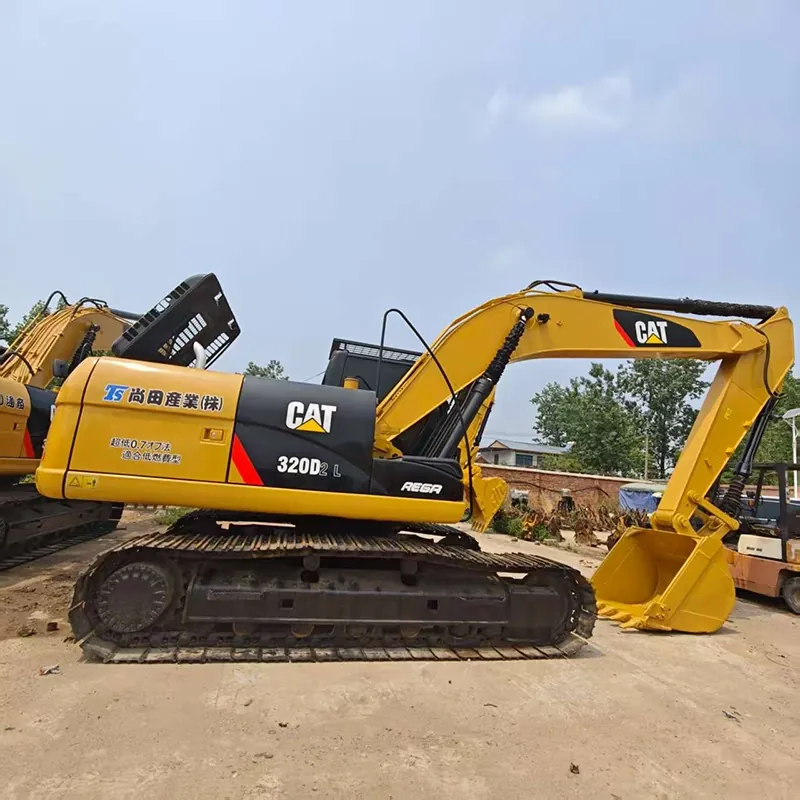
Excavadora usada CAT 320D2L en venta
Respuesta rápida para compradores
Esta excavadora usada CAT 320D2L es una máquina de orugas para movimiento de tierras y obras generales. La ficha muestra un precio de oferta de USD $20,000, un peso de referencia de 22.3t y un cucharón de 1.1m3. Confirme el número de serie, las horas, el estado y el envío de la unidad antes del pago.
- Precio publicado
- USD $20,000
- Peso operativo de referencia
- 22.3t
- Capacidad de cucharón de referencia
- 1.1m3
Descripción del modelo
Esta excavadora usada CAT 320D2L es una máquina de orugas para movimiento de tierras y obras generales. La ficha muestra un precio de oferta de USD $20,000, un peso de referencia de 22.3t y un cucharón de 1.1m3. Confirme el número de serie, las horas, el estado y el envío de la unidad antes del pago.
Las secciones técnicas y las preguntas frecuentes se ofrecen en inglés para conservar la terminología original.
Two Upgrades That Don't Usually Travel Together
Historically, buyers who paid extra for the long undercarriage option on Caterpillar's mid-size platform tended to be pipeline contractors, utility companies, and grading contractors prioritizing stability above almost everything else — often buyers who valued mechanical robustness over the latest technology, and who were just as likely to be running an older, simpler generation as a newer one. Buyers most drawn to the D2 generation's efficiency improvements, on the other hand, have tended to be fleet operators and rental companies tracking fuel costs closely across many machines, often prioritizing the latest technology specifically because the savings compound at scale. These aren't mutually exclusive buyer profiles, but they don't overlap as often as you might expect — which makes a factory-configured combination of both features worth understanding on its own terms rather than assuming it's simply the sum of two upgrades we've covered before. Think of it this way: ordering the long undercarriage alone signals a buyer who cared enough about stability to pay extra for it, regardless of what generation or technology level the rest of the machine offered. Ordering into the D2 generation alone signals a buyer drawn specifically to modern efficiency, often as part of a broader fleet-renewal decision where several machines were being upgraded together. A buyer specifying both wasn't compromising on either priority — they had a specific job profile in mind where dropping either one would have been a real limitation, not just a nice-to-have they were willing to skip.
Does the Longer Frame Actually Cost You Some of the Efficiency Gains?
This is worth answering honestly rather than glossing over: yes, to a small degree. The long undercarriage adds several hundred kilograms of additional frame and undercarriage material compared to the standard-length version of the same generation, and that extra mass takes marginally more energy to accelerate, decelerate, and rotate during normal digging and swinging cycles. In practical terms, this means a long-configuration unit from this generation won't quite match the fuel economy figures of a standard-length D2 model doing identical work — but it still delivers a meaningful efficiency improvement over the pre-D2 generations, since the engine, hydraulic tuning, and efficiency mode systems are otherwise identical between configurations. The honest way to think about this trade-off: you're giving up a small fraction of the D2 generation's headline fuel savings in exchange for a stability advantage that matters more on certain jobs than the last percentage point of fuel economy ever would. To put a rough sense of scale on it: if the standard-length D2 configuration might improve fuel economy by a meaningful double-digit percentage over the pre-D2 generation doing comparable work, the long-undercarriage version of the same generation typically retains the large majority of that improvement, with only a small portion given back to the extra frame weight. It's not a wash between the two configurations — the efficiency gain from the generation change is still the dominant factor, with the undercarriage choice being a secondary, second-order adjustment on top of it.
Verifying Both Claims, Not Just One
Because a listing combines two separate specification claims, buyers should verify both rather than assuming that confirming one implies the other. On the undercarriage side, buyers should cross-reference the machine's serial number and build information against Caterpillar's documented configuration for long-undercarriage units of this generation, and physically inspect mounting points and structural welds for evidence consistent with factory assembly rather than a later field conversion. On the efficiency side, buyers should cycle through the available efficiency modes to confirm each produces genuinely different hydraulic and engine behavior, and check that the automatic idle shutdown system activates on its intended schedule rather than having been disabled. Neither verification substitutes for the other — a machine can have a perfectly genuine long undercarriage while its efficiency systems have been neglected, or vice versa, so buyers should treat them as two separate questions requiring two separate answers. This distinction matters more than it might initially seem, because a seller focused on one impressive feature can sometimes let the other slide without necessarily meaning to mislead anyone. A previous owner who specifically valued this machine's stability for heavy lifting work may never have bothered exploring its efficiency modes at all, leaving that system essentially untested through years of ownership even though it works perfectly fine. Conversely, a fleet manager focused entirely on fuel-consumption reporting might never have had reason to confirm the undercarriage's structural authenticity, since it simply wasn't the feature they were tracking. Checking both independently, rather than assuming good news on one front implies good news on the other, is exactly how buyers can avoid inheriting either kind of blind spot.
Engine and Working Specifications
This platform runs the same Caterpillar C4.4 ACERT diesel found across the D2 generation, delivering net output in the range of roughly 105–121 kW depending on market configuration. Operating weight in this long-undercarriage configuration typically falls between about 20,900–21,900 kg, modestly higher than the standard-length D2 configuration due to the additional frame material. Standard bucket capacity is usually in the 0.6–1.3 m³ range, maximum digging depth generally runs around 6.5–6.7 m, and maximum digging reach typically falls between 9.6–10.0 m, consistent with the standard-length configuration of the same generation. Travel speed usually reaches roughly 5.5 km/h in high range, unchanged from the standard configuration. As always, these figures describe the general platform rather than confirming every detail of an offered unit — confirm the installed bucket and additional equipment in the serial-specific quotation and current media, alongside any available configuration and efficiency-system evidence.
Where This Specific Combination Makes the Most Sense
This configuration is particularly well suited to buyers whose work genuinely benefits from both properties at once — pipeline and utility contractors lifting heavier fittings at extended reach who are also tracking fuel costs closely across a fleet, or grading contractors working uneven terrain who bill enough annual hours that the D2 generation's efficiency gains, even at a slightly reduced level, still add up to a meaningful number. If your work only calls for one of these two advantages, a unit configured with just that feature — either a standard-length D2 for maximum efficiency, or an older-generation long undercarriage unit for maximum stability at a lower acquisition cost — may be the more cost-effective choice than paying for both. There's no wrong answer here, only a question of which trade-off actually matches your job mix rather than which configuration sounds most impressive on paper. Request current, unit-specific evidence and record the result before payment.
What to Check Before Buying a Used Machine With This Configuration
Beyond the general engine, hydraulic, and structural checks that apply to any used excavator, a few points matter specifically on a unit combining both of these features: Serial number and build record cross-reference, confirming the long undercarriage is factory-original for this specific generation rather than a later modification Efficiency mode and idle shutdown function, tested directly rather than assumed present from the model designation Weld and mounting point condition at the undercarriage attachment points, checked for evidence consistent with original factory assembly Overall weight verification against this generation's long-configuration specification, confirming the additional frame material matches expected values Telematics history, where available, reviewed for fuel and idle-time patterns consistent with genuine efficiency-system use over the machine's working life Ask for each point to be documented in a condition report or independent inspection notes before payment.
Shipping This Machine Overseas
At this weight and size, this machine's container suitability depends on measured transport dimensions, weight, dismantling scope and carrier approval. A practical export plan should cover: confirming the unit and price, agreeing payment terms, a final pre-shipment inspection with current photos or video, preparing export documentation, and coordinating loading and vessel booking based on your destination port's specific requirements and handling capability. Request current, unit-specific evidence and record the result before payment.
Next Step
If this combination of stability and efficiency fits how you plan to use the machine, ask for the verification notes covering both its configuration and its efficiency systems, condition report, and current photos or video for the offered unit, along with a shipping quote to your destination port. Ask the supplier to answer questions about either verification, about the fuel-economy trade-off discussed above, or about how this compares to the other configurations in the available model range, before you decide. Request current, unit-specific evidence and record the result before payment.
CAT 320D2L buyer FAQ
Why would someone order both the long undercarriage and the efficiency-focused generation together?
Typically because their work genuinely benefited from both — stability for heavier lifting or uneven-ground work, combined with fuel savings that matter enough at their annual hours to be worth paying for, rather than treating the two as separate, unrelated upgrades.
Does the long undercarriage meaningfully reduce this generation's fuel savings?
Only modestly. The additional frame weight takes slightly more energy to move, so this configuration won't quite match a standard-length D2 unit's fuel economy, but it still delivers a real improvement over pre-D2 generations, since the underlying engine and efficiency systems are unchanged.
How do you verify both the undercarriage configuration and the efficiency systems on one unit?
As two separate checks rather than one — serial number and build record cross-reference plus physical weld inspection for the undercarriage, and direct testing of efficiency modes and idle shutdown function for the productivity systems, since one being genuine doesn't guarantee the other is functioning correctly.
How does this compare to the standard-length version of this generation?
It offers better fore-and-aft stability at the cost of a small amount of the standard configuration's fuel efficiency advantage and a somewhat higher purchase price, given the added material and lower production volume of the long-configuration option.
How does this compare to the older long-undercarriage generations you also list?
It offers meaningfully better fuel economy and cycle-time efficiency through the D2 platform's updated engine and hydraulics, while carrying the same fore-and-aft stability benefit as the long-undercarriage option on earlier generations.
Is this configuration worth the premium over a standard unit?
It depends on whether your work actually uses both advantages regularly. If you need the stability and run enough annual hours for the efficiency gains to matter, yes. If you only need one of the two, a unit configured for just that priority is often the more cost-effective choice.
Related CAT excavators
Solicitar datos de la unidad
Indique el puerto de destino, la cantidad y sus prioridades de inspección. Responderemos con datos de la máquina concreta.
Solicitar datos de la unidad · Solicitar pruebas de inspección por WhatsApp · sales@lihangusedmachinery.com